Robert Fisk: End of an era for Lebanon's free press
Once a bastion of journalistic independence, Beirut's newspapers are losing their edge
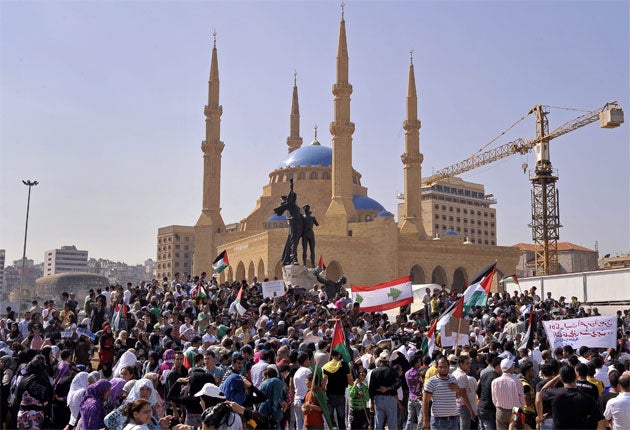
For decades, Lebanese journalism has been applauded as the freest, most outspoken and most literate in the heavily censored Arab world. Alas, no more. Beirut's best-read daily has just shed more than 50 staff and LBC, one of the country's best-known television stations, has just fired three of its most prominent presenters. The Lebanese media are being hit – like the rest of the world – by the internet and falling advertising revenues. But this is Lebanon, where politics is always involved. Is something rotten in the state of the Lebanese press?
Is it by chance that An Nahar's culture editor – whose supplement campaigned against assassinated prime minister Rafiq Hariri's plans for rebuilding downtown Beirut – has been fired after the paper cosied up to the politics of Hariri's son Saad, now the Lebanese prime minister designate? Is it a coincidence that the three senior presenters on LBC represented the last supporters of the old Lebanese Forces (of civil war infamy) still working at the channel?
Neither An Nahar nor LBC are saying anything. But the Lebanese are waiting to find out which of their more than 20 dailies will be the next to shed staff for "economic reasons". Will the old lefty As Safir find that it has politically recalcitrant staff (unlikely) or will the lovely French-language daily L'Orient Le Jour – whose 18th century French is Royalist rather than Republican – have a battle with those writers who still love ex-General Michel Aoun, Maronite Christian ally of the Hizbollah?
The problem is not so much the politics of Lebanon but the feudal state of the press. You cannot start a newspaper in Beirut – you have to buy an existing title from someone else. This costs money. So the rich own newspapers. Not much different, you may say, from the rest of the world. But the system in Lebanon is archaic; there are families in Beirut who own newspapers but don't publish them – they are still waiting for a buyer.
As Elias Khoury, the sacked culture editor of An Nahar, a prize-winning novelist and academic and one of 53 men and women fired by the paper, puts it: "Newspaper owners were originally journalists – and with capitalism, the system did not change. Television in this country are not the press – they are propaganda, owned by confessional groups or parties. It's the papers that are real journalism."
But "real" journalism is sometimes hard to come by. When the Syrian army was still in Lebanon, An Nahar was as careful as the rest of the press in making sure than no boats got rocked. Indeed, when the Syrian military first arrived in Beirut in 1976, its offices were raided – to make sure that its journalists realised that they would have to be as compliant as their colleagues on Al-Baath and Tichrin, those titans of Baathist journalism across the mountains in Damascus.
But, along with As Safir, An-Nahar had an edge about it. It poached a wonderful analyst called Jihad Zein from As Safir, and under boss Ghassan Tueni it upheld independent journalism. "Tueni offered me the cultural supplement," Khoury says, "and if he was still in control, none of this would have happened." It is now his granddaughter Nayla who is in charge. Along with Khoury, Edmund Saab, co-editor in chief, Saha Bahasin and Georges Nassif also lost their jobs. They were told to collect their dismissal notes from a Lebanese postal official on the pavement outside the paper's central Beirut office.
"One journalist came to work at 6pm on a Friday – when the postman had left," Khoury adds. "He worked the Friday night and on Saturday and Sunday – and read in our rival paper on Monday that he had been fired! This reveals things about our work and about Beirut. The formula that our supplement is independent – that we can say what we want – is no longer acceptable. I didn't fit. My supplement campaigned against Solidere [in which Rafiq Hariri held 10 per cent of the shares] and we got journalists and architects to write about how the company was destroying Ottoman Beirut and saving only the French colonial buildings. No-one stopped us. I could play the role of a leftist intellectual."
No more. Nayla Tueni's involvement in the majority March 14th movement, led by Hariri's son Saad – who himself runs a rather dull daily called Al-Mustaqbal – means An Nahar has taken on a distinctly pro-government flavour.
At the same time, LBC has dismissed three of its best-known journalists, apparently because they were the final remnant of the Lebanese Forces on the channel. Diamond Rahme Geagea, Denise Fakhry and Vera Abu Munsif were sacked along with dozens of fellow staff members, including one woman who was six months' pregnant, a fact which would normally make her un-dismissable under Lebanese law. Even the Christian Maronite patriarch, Nasrallah Sfeir, has expressed his concern.
The Lebanese journalists' union has no mandate to help unemployed writers. "Who protects the rights of journalists?" L'Orient Le Jour asked last week. In Lebanon, it seems, the answer is no one.
Join our commenting forum
Join thought-provoking conversations, follow other Independent readers and see their replies
Comments
Bookmark popover
Removed from bookmarks