Robert Fisk: German U-boats refuelled in Ireland? Surely not

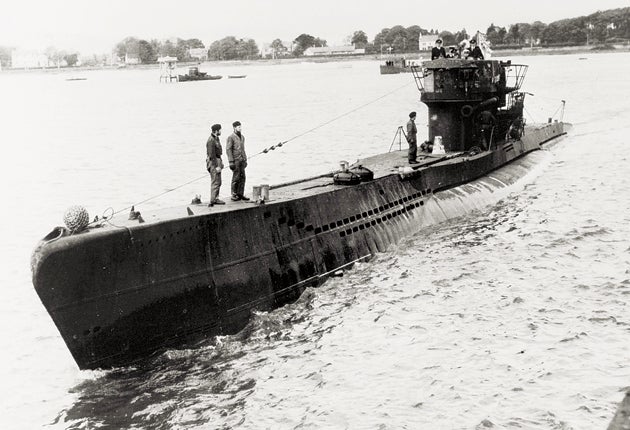
Never a man to neglect a good tale, I return to that old saw about German U-boats refuelling in neutral Ireland. Not because I believe it – I spent much of my PhD thesis on Ireland in the Second World War disproving it. But because a reader has sent me a fascinating account of his dad's war service as an SOE recruit.
He was an expert in bomb disposal, demolition and sabotage, trained at Brickendonbury Manor, near Hertford, with the rank of lieutenant and later attached to the Royal Navy in Derry – or Londonderry, as all good Protestants and Brits would at the time have called the last of our Irish Treaty Ports. The other three had been cheerfully handed over to de Valera by Malcolm MacDonald in 1938, earning Churchill's most poisonous hatred.
In 1940, our man – his reader-son asks for anonymity – was sent to a base unit at HMS Ferret in Derry with five members of 30 Commando, Royal Marines; their job was to "prepare and supply equipment" (incendiary and explosive charges) for 15 marines and two officers aboard the "Royal Fleet Auxiliary Tugboat Tamara which was disguised as a trawler".
Ho ho, cried Inspector Fisk when he caught sight of these words in our reader's letter. For the Tamara had appeared in my Trinity College thesis. It was commanded by Lieutenant Commander W R "Tiny" Fell who went on to design midget submarines and who had spent – according to my own research – a fruitless few weeks searching for German U-boats off the west coast of Ireland, or Eire as it was then known.
Our reader's dad, however, believed that the Tamara was on no wild goose chase. "Father regularly, as did many British servicemen, changed into civvies and nipped across the Eire border for a crafty drink. He usually went to the village of Dunfanaghy. Favourite haunts were... Molly's Bar, Arnolds Hotel and McGilloway's."
All still exist. Molly's Bar even has a Facebook page which boasts of its "craic" and McGilloway's is famous for oysters. Now, at least. But then? Our reader's dad "told me that one of the Irish landlords insisted he did not go into the snug since 'other gentlemen officers' were already there. He sneaked a look and discovered these were U-boat officers, whose craft were laying up in remote inlets on the coast, come ashore for unofficial R and R, and wearing their uniforms because Ireland was neutral."
On 12 September 1940, our SOE man was loading explosives on to Fell's Tamara, replacing them 11 days later when the boat returned to Derry. Fell was apparently blowing up fuel tanks in Cork which could be used to supply U-boats. Newly released British Cabinet papers suggest U-boat sightings in 1939 west of the Blasket Islands and near Bundoran, County Donegal. And they also state that, although "there was... no evidence proving the existence of refuelling bases, there was evidence that U-boats were... quite possibly... landing crews for purposes of relaxation and obtaining fresh provisions." Other reports of U-boat landings – except one in Bantry Bay "from a reliable [sic] source" – could "neither be accepted, nor wholly discounted".
Guy Liddell, the director of wartime British counter-espionage, wrote that he had asked Colonel Liam Archer of Ireland's G2 military intelligence about U-boat landings, to which the alleged reply was: "They are here in force, we can't do anything." According to Liddell, Archer said that a U-boat called in three times a week at a base at the mouth of the Doonbeg river, County Clare. Archer, who was a senior liaison officer at a secret meeting with the British, is on record as telling them that some Irish ports did not even have permanent military guards (but not as admitting that U-boat packs were flocking to Irish coastal waters).
Archer also gave British intelligence details of equipment, found on three captured German agents in Skibbereen, which included explosives inside a tin of French peas intended to blow up Buckingham Palace. Archer would not let the Brits interview the three German prisoners.
I can well see why. For before this glorious secret history takes hold of your imagination, there are one or two snags. Quite apart from the British Cabinet's lack of evidence, our reader's father suggested that the fuel storage tanks in the Republic might in fact be part of a smuggling racket between Eire and Northern Ireland (which, by the way, still continues). And our reader himself admits that "many of the suppositions about German forces in the Irish Republic may be down to the very German-looking uniforms used by the Irish at the time but which were changed in the 1940s".
All of which is correct. Norwegian Allied troops also used German-style helmets in 1940 – often prompting patriotic Englishmen to arrest them. In 1979, not long before he died, Frank Aiken, IRA veteran and wartime minister of "coordination for defensive measures" told me that "no German U-boat landed on the Irish coast – if it had done, I think I would have heard about it."
And so do I. But our reader's dad wasn't the only Brit to cross the border for rest and relaxation. Several Royal Navy officers regularly arrived in Donegal to go duck shooting at Drumbeg and Lough Eske in 1940. One of them, so they told me in the village of Inver, courted a girl who worked in a local post office. His name? RN Lieutenant Philip Mountbatten, later Prince Philip, Duke of Edinburgh, Lord High Admiral, originally from the House of Schelswig-Holstein-Sonderburg-Glücksberg, regarded still by villagers of distant Vanuatu as a god.
Join our commenting forum
Join thought-provoking conversations, follow other Independent readers and see their replies
Comments
Bookmark popover
Removed from bookmarks