Robert Fisk: Gulf War legacy flares as 'stingy' Kuwait puts the squeeze on Iraq
Oil-rich state demands billions from Baghdad as dispute over border rages
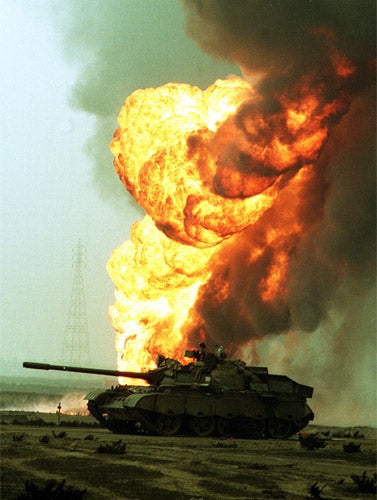
Almost 19 years to the day after Saddam Hussein's legions invaded Kuwait – and less than 18 years since the US coalition liberated it – the Croesus-rich emirate is still demanding reparations from Baghdad as if the dictator of Iraq was still alive. Only this week, the Kuwaitis were accusing the Iraqis of encroaching on their unmarked border while insisting at the United Nations that Iraq must continue to pay 5 per cent of its oil revenues to Kuwait as invasion reparations.
Hamid al-Bayati, Baghdad's UN ambassador, has pleaded at the UN for an immediate reduction now that Saddam's regime has been gone for more than six years. Up until April of 2009, Iraq had paid $27.1bn of the total compensation but still owes Kuwait alone another $24bn, "a heavy burden on Iraq," as Mr Bayati put it, "which needs the money for services, reconstruction and development."
Nouri al-Maliki, the Iraqi Prime Minister, has now told the UN that reparations can surely be reduced since modern-day Iraq no longer poses a threat to anyone.
He was speaking to the deaf. Kuwait is currently being as ruthless – or greedy – in its demands as it was before Saddam invaded on 2 August 1990. In the weeks before the attack, Kuwait had raised its oil production from 1.5 million barrels a day – the Opec quota – to 1.9 million. Saddam claimed that a fall of just $1 a barrel – it had already fallen from $18 to $14 – would cost Iraq, which had only two years earlier finally concluded its eight-year war with Iran, $1bn a year in lost income.
Saddam also claimed that Kuwait had been stealing oil from Iraq's southern fields by boring northwards along their mutual frontier; in other words, Kuwait was thieving the resources of the nation whose armies saved it from Iran's revolution.
Exclusive as these claims appeared to be – although no one could contradict the rise in Kuwaiti oil production – this formed part of the background to the frontier dispute which Kuwait is still haggling over.
Kuwait is still demanding not only reparations but another $16bn in loans that funded the war with Iran, a conflict that has already entered the history books. No wonder, then, that poor old Iraq – whose current oil revenues have fallen from $7bn just over a year ago to just over $2bn in May – is considering a request for $7bn in loans from the International Monetary Fund.
Since the current Iraqi government is effectively a Shia Muslim administration, Mr Maliki has reason to feel aggrieved. The Shia suffered more from Saddam than the Kuwaitis, and Iraq today is a friendly nation – if it really is a state – rather than an international pariah. The debt burden to Kuwait is beginning to sniff like that other outrageous set of reparations levelled against another state, Germany, in 1919. Which is why a number of countries to whom Iraq owed debts – the United Arab Emirates has just written off $7bn – have abandoned their reparations demands after the usual American pressure.
So is this just typical Kuwaiti meanness, an oil-dripping emirate with a per capita income of $41,000 further crushing a nation with a per capita income of less that $4,000? Middle East oil analysts have their doubts. "The Kuwaitis have always had a reputation for stinginess," one said yesterday in despair. "But I think there is more to this than you think. Kuwait was a founder of the Gulf development fund and in the '60s, '70s and '80s, treated Palestinians and Lebanese without restrictions – and the Palestinians then betrayed the Kuwaitis by falling in with Saddam after the 1990 invasion."
But there is more – and it involves the ethnic balance in the two nations' populations. "Maybe 40 per cent of people in Kuwait are now Shia rather than Sunni Muslims and these people are now investing heavily in southern Iraq," the oil man said yesterday. "The Kuwaiti Shias are becoming 'Basra-ites' and vice versa. More and more Shia from the south of Iraq are becoming businessmen and trading with Kuwait. This causes a blurring of the border between the two countries, a feeling that the two economies are becoming linked. No wonder the Kuwaitis want to stand by the letter of the law."
There are some unpleasant precedents for the Kuwaitis. The crushing debt which the Treaty of Versailles heaped upon Germany was lesson enough; Germany's financial loss became Hitler's gain. Maybe the Kuwaitis should pull out some history books and ponder what Iraq will look like – and who its leader may be – in 20 years' time.
Join our commenting forum
Join thought-provoking conversations, follow other Independent readers and see their replies
Comments
Bookmark popover
Removed from bookmarks