Robert Fisk: Hizbollah's silence over Scuds speaks volumes to Israel
Fears of conflict escalate as group refuses to discuss its arsenal with Jerusalem – or the Lebanese government
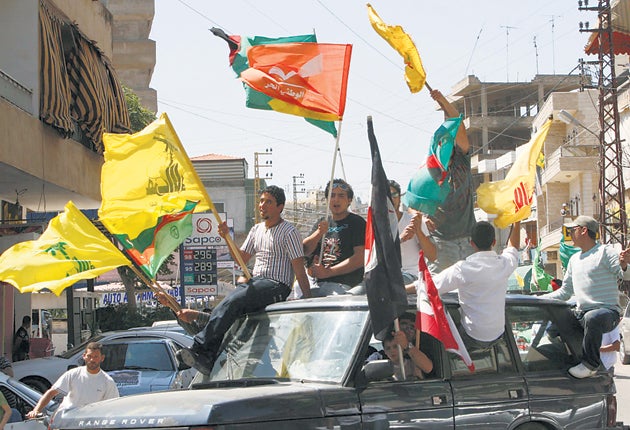
If Lebanon had a US-style colour-coded "war-fear" alert ranging from white to purple, we are now – courtesy of Israeli president Shimon Peres, the White House spokesman and the head of the Lebanese Hizbollah militia, Sayyed Hassan Nasrallah – hovering somewhere between pink and red.
Has Syria given the Hizbollah a set of Scud ground-to-ground missiles to fire at Israel? Can Israeli aircraft attack them if the Hizbollah also possess anti-aircraft missiles? Can the Lebanese army take these weapons from the Hizbollah before the balloon goes up?
It is a long-standing saga, of course, and Israel has been itching to get its own back on the world's most disciplined guerrilla movement. You can forget al-Qa'ida when it comes to Hizbollah's effectiveness – after the Israeli army's lamentable performance in 2006, when it promised to destroy the Hizbollah and ended up, after the usual 1000-plus civilian dead, pleading for a ceasefire. Over the past few months, Mr Nasrallah has been taunting the Israelis to have another go, promising that an Israeli missile attack on Beirut airport will be followed by a Hizbollah rocket attack on Tel Aviv's Ben Gurion airport.
But over the past week, a warning by Mr Peres that the Hizbollah has received Scud missiles from Damascus – or via Syria from Iran – and a refusal by the Hizbollah to even discuss its own disarmament within a Lebanese "national dialogue" chaired by the Lebanese President, Michel Suleiman, has darkened the spring skies over both Lebanon and Israel. The White House press secretary, Robert Gibbs, said this week that the United States has expressed its concern to both the Syrian and Lebanese governments over "the sophisticated weaponry that ... is allegedly being transferred". Mr Peres started the whole thing off a day earlier when he declared that "Syria claims it wants peace while at the same time it delivers Scuds to Hizbollah, whose only goal is to threaten the state of Israel."
These hootings and trumpetings have always had a strong element of hypocrisy about them. The Scuds – even if Hizbollah has them – are as out-of-date as they are notoriously inaccurate. In the 1991 Gulf war, Saddam Hussein's Scuds caused fewer than a hundred deaths. The more Peres thunders about the danger they represent, the more Hizbollah's allies in Iran – supposedly trying to build a nuclear weapon – take pride of place in public imagination over the continued and illegal Israeli colonisation of Palestinian land.
As for Mr Nasrallah, he promised only a year ago that Hizbollah's disarmament could not be discussed by the Lebanese government – only during the so-called "national dialogue". And now the "national dialogue" has begun, the organisation has made it clear that it has no intention of discussing disarmament with other Lebanese political parties.
The problems are legion. Hizbollah is itself represented in the Lebanese parliament, and under the Doha agreement which followed Hizbollah's one-day military takeover of west Beirut in May of 2008, it also has an effective veto over majority decisions taken by the Lebanese cabinet. And even if the Shia Muslim Hizbollah's opponents in the Cabinet – they are largely Sunni Muslim with a prominent Christian contingent – ordered the Lebanese army to take weapons from the militia, they would be unable to do so for one simple reason. At least half the army – possibly two-thirds – are themselves Shia Muslims, and would obviously object to attacking the homes of brothers, sons and fathers in the Hizbollah.
A clue to the seriousness with which everyone now takes the possibility of war is contained in a remark made by an anonymous US spokesman who warned that the transfer of Scud missiles to Hizbollah would represent a "serious risk" to Lebanon. Not to Israel, mark you – but to Lebanon. There is no doubt that this is an allusion to frequent threats from the Israelis themselves that in another war with Hizbollah, the Lebanese government would be held responsible and as a result Lebanon's infrastructure would be destroyed.
This does not sound so bad in Lebanon as it does elsewhere. For in its last Lebanese war – the fifth since 1978 – the Israelis blamed the Lebanese government for Hizbollah's existence and smashed up the country's roads, bridges, viaducts, electricity grid and civilian factories, as well as killing well over 1,000 civilians. Israel's casualties were in the hundreds, most of them soldiers. What worse can Israel do now against the ruthlessness of the Hizbollah, even after the accusations of war crimes levelled against its equally ruthless rabble of an army?
Join our commenting forum
Join thought-provoking conversations, follow other Independent readers and see their replies
Comments