Robert Fisk: If the rumours and conspiracies are true, then President Assad's regime is on the road to civil war
If the dead soldiers are victims of revenge killings, it means the opposition is prepared to use force
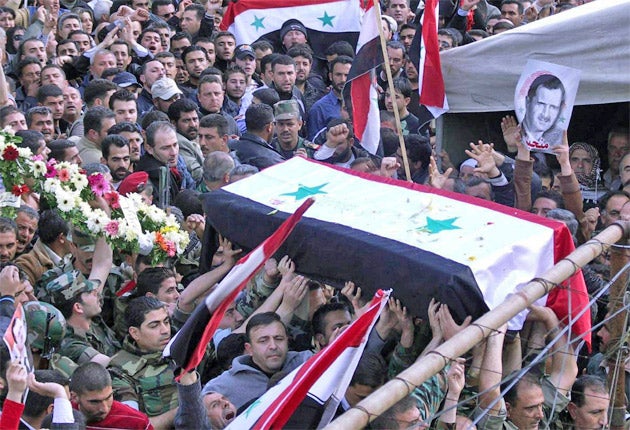
Every night, Syrian state television is a horror show. Naked corpses with multiple bullet wounds, backs of heads sliced off. All Syrian soldiers, the television insists, murdered by "the treacherous armed criminal gangs" near Deraa.
One of the bodies – of a young officer in his twenties – has had his eyes gouged out. "Knives and sharp tools" appear to have been used on the soldiers, the commentary tells us. There seems no doubt that the bodies are real and little doubt that they are indeed members of the Syrian "security" forces – the word security needs to be placed in inverted commas these days – nor that the weeping, distraught parents in the background are indeed their families.
Pictures show the bodies, newly washed for burial, taken from the Tishrin Military Hospital in Damascus. Their names are known. Mohamed Ali, Ibrahim Hoss, Ahmed Abdullah, Nida al-Hoshi, Basil Ali, Hazem Mohamed Ali, Mohamed Alla are all carried in flag-draped coffins from the army's mortuary by military police. They are from Tartous, Banias, Aleppo, Damascus. When al-Hoshi's funeral cortege was passing up the Mediterranean coast road to the north, they were ambushed by "an armed gang".
It's easy to be cynical about these dreadful pictures and the gloss put on their deaths. Shooting at funerals, after all, has hitherto been the prerogative of the government's armed cops rather than "armed gangs". And Syrian television has shown not a single dead civilian or civilian funeral after the death of perhaps 320 demonstrators in more than a month. Another 20 were reported killed around Deraa yesterday.
But these reports are important. For if the dead soldiers are victims of revenge killings by outraged families who have lost their loved ones at the hands of the secret police, it means that the opposition is prepared to use force against their aggressors. But if there really are armed groups roaming Syria, then President Bashar al-Assad's Baathist regime is on the road to civil war.
Hitherto, the demonstrators – pro-democracy or anti-Bashar or both – have been giving us the story line; their YouTube footage, internet descriptions, the stunning pictures of Syrian T-72 tanks powering through the streets of Deraa – not to mention the pathetic attempt to attack one with an empty glass bottle – have dominated our perception of the all-powerful dictatorship crushing its people in blood. And truth lies behind what they say. After the 1982 slaughter in Hama, no one is in any doubt that Syrian Baathists play by Hama rules. But their explanation for the daily series of macabre pictures on state television also lacks conviction. According to those bravely trying to telephone news out of Syria – although not from Deraa, where the telephones and internet have been completely shut down – the mutilated bodies are those of troops who refused to shoot at their own people and who were immediately punished by execution and mutilation by the shabiha, the "hoodlums" of Alawi fighters, and then cynically displayed on television to back up false government claims it is fighting an armed insurgency and that the people of Deraa themselves had invited the army into their city to save them from "terrorists".
Which sounds a little like the flip-side of the government's own propaganda. Of course, the Syrian authorities have only themselves to blame for their lack of credibility. Having cited "foreign plots" – the explanation of all the region's potentates when their backs are to the wall – the authorities have studiously banned all foreign journalists from entering Syria to prove or disprove these claims. The ministry of tourism has even been sent a list of Middle East correspondents by the ministry of interior to ensure that no reporters slip into Syria with a sudden desire to study the Roman ruins of Palmyra.
Thus history is written in rumours which begin, I suppose, with the last words displayed on Syrian television's evening news: "Martyrs Never Die." Clearly they do expire, but which martyrs are we talking about? A good tale from Deraa – one without a shred of evidence so far – is that after tanks of the Fourth Army Brigade of Maher Assad (little brother of the President) stormed into the city, elements of the regular army's Fifth Brigade near Deraa – supposedly commanded by an officer called Rifai, although even this is in dispute – turned their guns on Maher's invaders. But the Fifth, so the story goes, has no tanks and includes air force personnel who are not allowed to fly their jets.
So are there now armed civilians – an oxymoron that seems lost on the regime – now fighting back in a systematic fashion? In Lebanon, whose capital is closer to Damascus that Deraa, there is growing fear that this bloodshed is only two hours away by road. Syria's friends in Lebanon are now claiming that the Saudis – allies of the outgoing government in Beirut – have been subventing the revolution in Syria.
One former minister produced on television copies of cheques for $300,000 (£180,000) supposedly carrying the signature of Prince Turki bin Abdul Aziz, the former Saudi intelligence head – and in that capacity once on good terms with a certain Osama bin Laden – and brother of King Abdullah, and given to Lebanese political figures to instil unrest in Syria. One of those accused of involvement by Syria is the former Lebanese minister Mohamed Beydoun. The latter has said that his accusers are guilty of "incitement to murder" and Prince Turki has indignantly called the cheques "false". But the Syrian-supported Hezbollah has now endorsed the claim and at least one Lebanese MP, Ahmed Fatfat, has at last uttered the fateful words. By these accusations against the "Future Movement" – the largest grouping in the outgoing government – he said, "the Hezbollah and its crew are preparing the way for civil war in Lebanon".
Now the Syrian media have pointed the finger at Lebanese MP Okab Sadr, stating that he had been arrested – along with "Israeli officers" – in the Syrian city of Banias. In fact, Mr Sadr is safe in Lebanon where he has emerged to say that the only reason he would go to Banias would be to give blood at the hospital to its inhabitants.
In the northern Lebanese city of Tripoli this Friday, pro and anti-Assad supporters plan to hold further and larger demonstrations after morning prayers. Many Lebanese in the north fear that in the event of a civil conflict inside Syria, Tripoli will become a "capital" of northern Syria, though whether it would be a rebel or an Assad stronghold is open to question.
Somewhat more disturbing right now – and much nearer the truth – is that Ali Aid, a rather tough character from the Jebel Mohsen area of the Alawi mountains of Syria, has left his son Rifaat in charge of his proto-militia movement. He has instead built himself a fine villa next to the Syrian-Lebanese border. The problem is that Major Ali Aid is living in his new home – which lies on the Lebanese side of the frontier.
Join our commenting forum
Join thought-provoking conversations, follow other Independent readers and see their replies
Comments