Robert Fisk: Israel feels under siege. Like a victim. An underdog
Anyone who is anyone in Israel will come to Herzliya this week for a conference about the state of the Jewish nation. Our correspondent joined them and found a climate of unprecedented insecurity – and paranoia
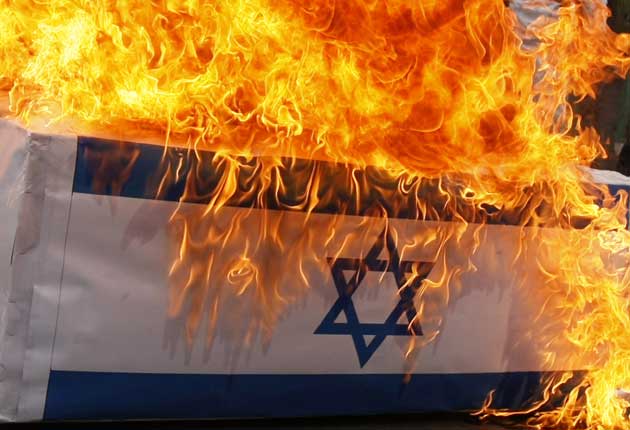
So the propaganda war is on. Forget Israel's invasion of Lebanon in 1982 and the 15,000 Lebanese and Palestinian dead. Forget the Sabra and Shatila massacre that same year by Israel's militia allies as their troops watched. Erase the Qana massacre of 1996 – 106 Lebanese killed by Israeli shellfire, more than half of them children – and delete the 1,500 in the 2006 Lebanon war. And forget, of course, the more than 1,300 Palestinians slaughtered by Israel in Gaza last year (and the 13 Israelis killed by Hamas at that time) after Hamas rockets fell on Sderot. Israel – if you believe the security elite of Israel's right wing here in Herzliya – is now under an even more dangerous, near-unprecedented attack.
Britain – this came yesterday from Israel's ambassador in London, no less – is "a battlefield" in which Israel's enemies wish to "de-legitimise" the 62-year-old Jewish state.
Even Israel's erstwhile friend, that fine Jewish judge Richard Goldstone, is now, in the words of one of Israel's staunchest American-Jewish supporters, Al Dershowitz, an "absolute traitor to the Jewish people" and "an evil, evil man". (Headlines for this, of course, in Israel yesterday.)
Israel under siege. That was the dreary, familiar, hopelessly misunderstood theme at the 10th annual Herzliya conference of diplomats, Israeli civil servants, military gold braid and government yesterday.
Israel the underdog. Israel the victim. Israel whose state-of-the-art, more-moral-than-any-other army was now in danger of seeing its generals arraigned on war crimes charges if they set foot in Europe.
Heaven forbid that Israeli officers should ever be accused of atrocities! The Jerusalem Post yesterday carried a photograph of Kadima leader Tzipi Livni looking at a Krakow poster abusing her as "wanted for war crimes in Gaza". Forget that she did nothing as Foreign Minister when the Israelis rained phosphorus on Gaza. This whole judicial attack on Israel was an abuse, a deliberate use of international law to de-legitimise the state of Israel – like all the other condemnation of Israel. Would that it was. This current identity crisis is indeed a tragedy for Israel – though not in the way that its right-wing government now suggests.
I remember all too well how, after the disastrous Israeli invasion of Lebanon in 1982, a huge London conference sought to find out how Israeli "propaganda" failed. Never mind the slaughter of the Lebanese and the growing Israeli military casualties. How come Israel's message didn't get across? How come the anti-Semitic press was allowed to get away with such calumny? It was an identikit forum to this week's Herzliya confab.
Today we must forget Operation Cast Lead against Gaza and its savage casualties. We must condemn the Goldstone Report for its unspeakable lies – that the army of good may have committed war crimes against the terrorists of evil – and realise that Israel only wanted peace.
In reality, Israel has made a series of terrible diplomatic mistakes. I'm not talking about the humiliation heaped on the Turkish ambassador by Deputy Foreign Minister Danny Ayalon – he, too, was at Herzliya. I'm not referring to the preposterous complaints by Ron Prossor, the Israeli ambassador to Britain, that in times of crisis there was "a cacophany of voices from Israel", rather than a single voice.
No, Israel's gravest mistake in recent years was to refuse to contribute to Goldstone's report on the 2008-09 slaughter in Gaza. A "foolish boycott", the daily Haaretz called it. A disaster, according to Israel's liberal left, who rightly spotted that it placed Israel on the level of Hamas.
I have sat through hours of the Herzliya conference – it ends with Prime Minister Benjamin Netanyahu's cheerleading for the masses tomorrow night – and the Goldstone Report and the fear of "de-legitimisation" has run like a thread through almost every debate.
I sat next to an Israeli PhD student yesterday who shook his head in despair. "I and my friends are filled with terrible disappointment when we hear these statements from our government. What can we say? What can we do?" It was an enlightening comment. Is this not what millions of British people said when Tony Blair took them to war on a sheaf of lies in 2003?
One of the most distressing moments at Herzliya came when Lorna Fitzsimons, former Labour MP and now head of Bicom, a British-based pro-Israeli think-tank, pointed out that "public opinion does not influence foreign policy in Britain. Foreign policy is an elite issue." Deal with the elite, and the proles will follow – that was the implication. "Our enemies are going out to international courts where we are not supreme," she said.
And that, in a sense, said it all. International legitimacy is what Israel demands. And as a state it is legitimate. It was voted into existence by the United Nations. And, as the Israeli historian Avi Shlaim has said, its creation may not have been just – but it was legitimate. Yet when an international juridical team invited Israel to participate in its inquiries, Mr Netanyahu smugly refused.
In this sense, the Gaza war proved what is so deeply troubling about the current Israeli body politic. It wants the world to recognise its democracy – however flawed this may be – but it will not join the world when asked to account for its behaviour in Gaza.It claims to be a light among the nations but will not let anyone look too closely at that light, to examine its fuel and to look precisely at what it illuminates.
Goldstone, Goldstone, Goldstone. The eminent lawyer who so bravely sought justice for the murdered and raped victims of the Serbs in the Bosnian war – and whose bravery inspired the world, including Israel, at that time – has been on the lips of every Israeli government apologist at Herzliya.
Tzipi Livni spoke of him. So did Yossi Gal, the Israeli foreign affairs ministry director-general. He spoke of the "attempt to use the Goldstone Report to push Israel to the margins of legitimacy". So did Malcolm Hoenlein of the Conference of Presidents of Major American Jewish Organisations. He noted that the US administration had been "overwhelmingly responsive" – ie dismissive – of the Goldstone Report. Even the mouse-like US ambassador to Israel, James Cunningham, suggested that the Goldstone Report might be used as an attempt to de-legitimise Israel.
What is this nonsense? After the 1982 massacre of Sabra and Shatila Palestinians, Israel appointed a government commission of inquiry. The Kahan Commission's report was not perfect – but what other Middle Eastern nation would examine its sins so courageously? It stated that the then Defence Minister Ariel Sharon's responsibility – he had sent in the Lebanese militias – was "personal". This report did not expunge Israel's guilt but it proved that it was a worthy state, one that was prepared to confront this slaughter with honesty rather than abuse.
Alas, no Kahan Commissions for Israel today. No judgment for Gaza. Just a slap on the wrist for a couple of officers who used phosphorus and a criminal charge against a soldier for stealing credit cards.
As it happens, I met Goldstone after he was appointed head of the war crimes tribunal for ex-Yugoslavia in The Hague. A palpably decent, honest man, he said that the world had grown tired of allowing governments to commit war crimes with impunity. He was talking, of course, about Milosevic. He wrote a book on the same lines, warmly praised by Israel. But now he is the earthquake beneath Israel's legitimacy.
I dropped by the eminently sensible Israeli army reserve colonel Shaul Arieli at his NGO's office in Tel Aviv yesterday afternoon and discussed the attempts to arrest Israeli military officers for war crimes if they visited Britain and other European countries.
"All this is much more disturbing to us today than it was a few years ago," he said. "We are afraid of this trend after Operation Cast Lead. It affects the image of Israel all over the world, not just for military officers. If they were charged, it would show that the state of Israel couldn't protect its soldiers. I am sure that the Goldstone Report affects these things."
All of which suggests that the real earthquake beneath Israel, the real danger to its image and standing and legitimacy, is a nation called Israel.
Join our commenting forum
Join thought-provoking conversations, follow other Independent readers and see their replies
Comments
Bookmark popover
Removed from bookmarks