Robert Fisk: New light on an old horror – and still there is no justice

On Wednesday morning, 14 April 1909, British Vice Consul Major Charles Doughty-Wylie set off to the Turkish city of Adana after receiving a letter from his dragoman – his Turkish translator, a man called Trypani – saying that "there was a very dangerous feeling in that town, threats had been freely offered, there were some murders...".
Doughty-Wylie departed by the next train, memorably adding, in his dispatch to the Foreign Office in London, that "so little had I expected that any massacre was imminent, that I took my wife with me". We can only imagine the good lady's reaction when "about two stations from Adana we saw a dead body... The nearer we got to Adana the more bodies there were, and while I was escorting my wife to Mr Trypani's house ... two or three more men were killed under the very noses of the Turkish guard...".
Doughty-Wylie's dispatches over the next four days are a first-class account of the start of the modern Armenian Holocaust – not the slaughter and butchery and mass rape and death marches in which the Ottoman Turks killed a million and a half Armenians in 1915, but the mass murder of up to 30,000 Armenians in southern Turkey six years earlier, a dry run – albeit a very bloody one – for the later genocide. "I got into uniform, went to the guard, and sharply recalled to the officer his duty to prevent murder," Doughty-Wylie wrote. Having summoned some unwilling Ottoman soldiery to support him, our vice consul "paraded through the town with bugles blowing... We cleared the streets sometimes by charging with the bayonet and sometimes by firing over the heads of the crowd". Ah, those were the days!
The letters of Doughty-Wylie, who was later to have an unconsummated affair with Gertrude Bell before dying at Gallipoli, are, in fact, a record of heroism – I am indebted to researcher Missak Kelechian for finding them in the British National Archives – for the vice consul rescued numerous British subjects and protected many hundreds of Armenian refugees. Trying to save their lives, the vice consul came under sniper fire from a mosque. The Turks blamed the Armenians for the massacres, claiming that they had armed themselves and planned to set up an Armenian principality on Turkish soil – killers have a habit of blaming the victims for their own deaths (see, for example, the Muslim victims of the Bosnian war, the Palestinian civilian victims of Gaza in 2008-9, etc) but Doughty-Wylie, while he acknowledged that an Armenian shot dead two Turks, suspected that the violence included "some secret preparation on the Turkish side". Of the 2,000 dead in Adana, 1,400 were Armenians.
The Turkish authorities supposedly hanged nine Turks for their part in the slaughter. So much for justice. Remarking that many of the dead had been thrown into rivers, the British vice consul concluded in a further dispatch to London that "in the villages, while no exact number can yet be given, the loss ... may be estimated at between 15,000 and 25,000; of these, very few, if any, can be Moslems (sic). In many cases women, even small children, were killed with the men". Exactly two weeks after Doughty-Wylie received the letter from his dragoman, The New York Times's journalist in Adana was reporting that in the city's vilayet (governorate), up to 30,000 Armenians had been murdered.
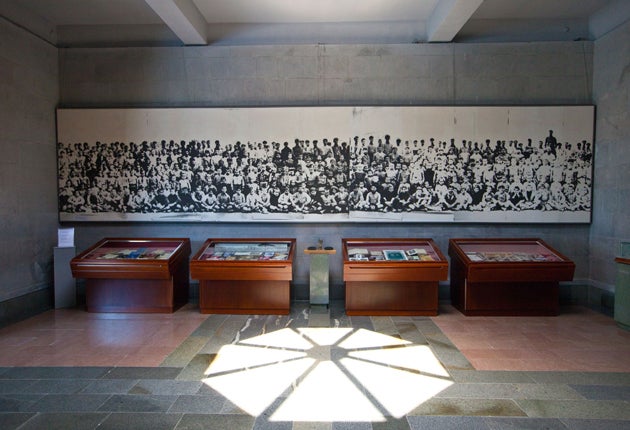
And Turkey, just as it does in the case of the later one and a half million Armenian dead, still denies – along with Britain, the US, need we add the rest? – that this was genocide. I have pointed out before that even in the 1930s, Churchill referred to the "holocaust" of Armenians. Now comes proof that the 1909 genocide, let alone the later 1915 massacres, were known as a Holocaust – correctly, with a capital H – before the First World War. For the Armenian Genocide Museum in Yerevan has just unearthed and published eyewitness Z Duckett Ferriman's book on the 1909 killings whose original cover bore the title The Young Turks and the Truth about the Holocaust at Adana in Asia Minor. The New York Times had, in fact, referred to "Another Armenian Holocaust" after an 1895 bloodbath, but Duckett Ferriman collected victims' names, dates, details of individual murders, statistics of orphans, widows, villages destroyed, photographs, and the identity of the militias – like the Turkish authorities in 1915 and like the Nazis, the 1909 killers used "special units" for killing and rape – and the mass violation of women.
By extraordinary chance, Duckett Ferriman's book coincides with the Beirut publication next week of the memoirs of Hagop Arsenian, a 1915 Armenian Holocaust survivor whose handwritten diaries have just been translated into English by his granddaughter, Arda Ekmekji. What makes this work so remarkable is that the Arsenians were very upper middle class. On their death trail to northern Syria, they were able, for a short period, to travel by rail, first class. "They were transporting us to our graves with our own money," Hagop wrote. At other times, still paying for their train tickets, they were packed into box cars, 45 to a carriage, Nazi-style. During his Golgotha, Hagop stood beside a pile of Armenian corpses. "One of them in a suffocating voice begged the gravedigger not to pull him by the legs and said, 'Brother, I have not died yet. Wait till morning before you bury me.'"
Like many Jews on the way to death in the second Holocaust of the 20th century, Hagop "would wonder whether we were such a terrible nation that God had chosen ... to manifest His anger and inflict His punishment on us...". There are good Turks in these stories – in 1909 as well as 1915 – but there are many criminals.
And again, no justice for the Armenians. Few of the Turkish war criminals were hanged. One of the worst, Talaat Pasha, was assassinated in Berlin in 1921, Bin Laden-style, shot by an Armenian revenge group called Nemesis. Most escaped their just deserts for ever, not even facing a Demjanjuk-like court in old age. All are now dead. "War will not end unless the truth is known," a Lebanese humanitarian agency stated four years ago. And that's all that's left to be fought for. Acknowledgement that these crimes were real. Justice is an odd creature.
Join our commenting forum
Join thought-provoking conversations, follow other Independent readers and see their replies
Comments
Bookmark popover
Removed from bookmarks