Robert Fisk: Once again, a nation walks through fire to give the West its 'democracy'
Democracy doesn't seem to work when countries are occupied by Western troops
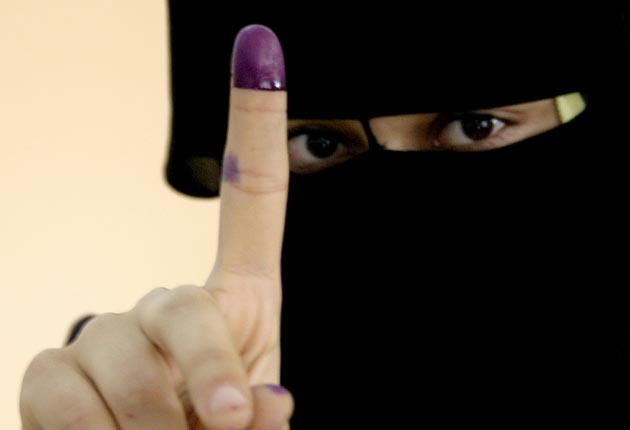
In 2005 the Iraqis walked in their tens of thousands through the thunder of suicide bombers, and voted – the Shias on the instructions of their clerics, the Sunnis sulking in a boycott – to prove Iraq was a "democracy". There followed the most blood-boltered period in Iraq's modern history. Yesterday, the Iraqis walked in their tens of thousands through the thunder of mortar fire – at least 24 dead before voting stations closed – to prove that Iraq was a "democracy".
This time, the Sunnis did vote. And we Westerners tried to forget the past, even the recent past. Few news reports recalled that only weeks ago hundreds of candidates, most of them Sunnis, were banned from standing on the grounds that they had once had links with the Baath Party. It was a clear return to sectarian politics. Shias who were close to Saddam still hold their jobs in the "democratic" Iraq for which the Iraqis supposedly went to vote yesterday.
Under Iraq's new laws, the electoral system has been jiggled to ensure that no single party can win power. There has got to be a coalition, an alliance – or a "broad alliance" as the television analysts were telling us – among whomever of the 6,000 candidates from 86 parties gain seats in parliament. But all this means is that the next sectarian government will hold power according to the percentage of Shia, Sunni and Kurdish communities in Iraq.
The West has always preferred this system in the Middle East, knowing that such "democracy" will produce governments according to the confessional power of each community. We've done this in Northern Ireland. We did it in Cyprus. The French created a Lebanon whose very identity is confessional, each community living in suspicious love of each other lest they be destroyed. Even in Afghanistan, we prefer to deal with the corrupt Hamid Karzai – held in disdain by most of his fellow Pushtuns – and allow him to rule on our behalf with an army largely made up of paid tribal supporters. This may not be – in the State Department's laughable excuse – "Jeffersonian democracy", but it's the best we are going to get.
And always we defend these miserable results with the same refrain. Do you want the Taliban back? Do you want Saddam back? Or, in the cases of Cyprus and Lebanon decades ago, do you want the Ottoman Turks back? And while we think that election results – however fraudulent or however complex (Iraq's next government may take months to form) – are an improvement, we do not stop to ask who really wins these elections. Iran, whose demented president knows how to handle "democratic" polls, is of course the victor. Its two enemies, the "black Taliban" and Saddam, have both been vanquished without a single Iranian firing a shot.
Sunni politicians in Iraq claim that Iran is interfering, both militarily and politically, in Iraq. But since most of the current ruling parties were nurtured in the Islamic Republic, Iran has no need to interfere. The Dawa Party, to whom we now graciously bend the knee in respect, was 20 years ago kidnapping foreigners in Beirut, and bombing the US and French embassies in Kuwait City. And we are not even mentioning Mosul and other cities in northern Iraq, where the elections are not about democracy at all, but about who controls the oil on the Arab-Kurdish front lines.
Yes, the Iraqis are a brave people. How many Brits would go to the polls under mortar fire? Or Americans, for that matter? It's not that Muslims don't want freedom or democracy. It's that "democracy" doesn't seem to work when their countries are occupied by Western troops. It didn't work in Afghanistan. The withdrawal of American "combat" troops from Iraq doesn't mean that US forces won't remain in great strength.
And as long as the Mubaraks and the King Abdullahs (both of them) have our uncritical political support, their nations will make no real progress towards freedom.
Thus yesterday's election day in Iraq does not represent further proof of the values of our Western democracies. It does mean that a courageous people still believes that the system under which it is voting will honour its wishes.
As so often in the past, however, the election is more likely – under our benevolent eye – to enshrine the very sectarianism which Saddam once used so ruthlessly to enslave his people.
Join our commenting forum
Join thought-provoking conversations, follow other Independent readers and see their replies
Comments
Bookmark popover
Removed from bookmarks