Robert Fisk: Once untouchable, the old despot and his sons faced the wrath of the nation they had terrorised
This was a moment when a country proved not only that its revolution was real, but that its victims were real

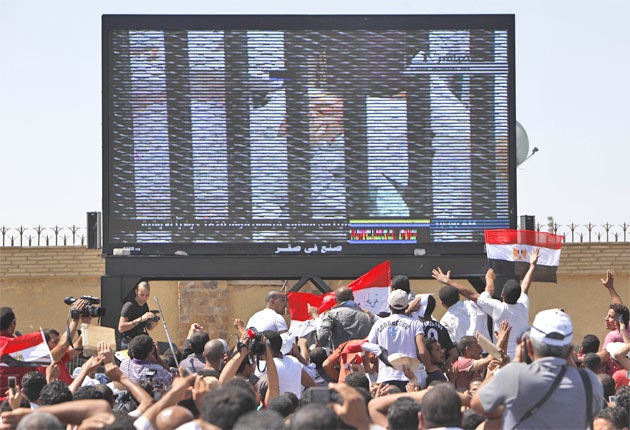
Just when the Arab dictators desperately need to drink the secure, cool waters of an Arab summer, along came the Egyptians yesterday to poison the well. Deep into its depths, those dictators could see a flickering enmeshed face, fragile, fingers playing over its nose and mouth, the arm of a man on a stretcher raised to prevent the light getting too close but – for just a few brief moments – with the same old arrogant eyes. Then the heavy black mike appeared in the man's left hand. "I am here, your honour," said a chillingly strong voice. "I have not committed any such crimes."
Yes, the Egyptians really did put their wretched, ancient dictator on trial yesterday, along with his effete, sullen sons – both dressed in white as if heading for yet another summer tennis party, an illusion broken only by the green Koran under Alaa Mubarak's arm. An encouragement to his dessicated, 83-year-old father, Hosni? Or an insult to the dead?
The lawyers screamed their clients' pain; of torture, of snipers, of the murder of Egypt's own people in the January-February uprising, of the brutality of the security forces, of corruption on a Mafia scale. And to whom else did these terrible charges apply? We thought about Damascus, of course. And Tripoli. And the Bahraini capital of Manama. And of Rabat and Amman and Algiers and Riyadh...
And across the vast, arid wastelands of the Arab despots, the government televisions continued to show game shows and cooking classes and domestic dramas and friendly crowds, all of whom loved their presidents and kings and potentates, who could never – could they? – be accused of these awful crimes. Outside Egypt itself, the only live coverage of the trial was broadcast by post-revolutionary Tunisia and that nemesis of the Mubarak regime and of the United States and of Israel: the Hezbollah's Al-Manar television.
"Are you Mohamed Hosni Sayed Mubarak?" asked Judge Ahmed Refaat. Or Bachar al-Assad? Or Muammar Gaddafi? Or His Majesty King Hamad? Or even His Highness King Abdullah, Guardian of the Three Holy Places in a place called Saudi Arabia?
For history – Arab history and western history and world history – will place the scenes in the Egyptian Police Academy yesterday in whole chapters, footnoted and referenced, the moment when a country proved not only that its revolution was real, but that its victims were real, its dictators' corruption detailed down to the last Egyptian pound and the last fake company title, its people's suffering forensically described.
Despite its flaws, this was not summary justice, the kind so beloved of the Assad family and the Gaddafi family or, indeed, the Mubarak family. The Caliph had been brought low – and the "Arab Spring" (ever a dodgy item right now, with the butchery in Syria and the trumpery of the Libyan war) revived. Even when the helicopter bringing the old boy to justice appeared in the pale, hot skies over the desert, we shook our heads for just a moment. All true.
Can the infection yet be stopped, the poisoned waters cleansed? The Egyptians didn't think so. If this was a "bon-bon", a toffee or two to humour the masses from Egypt's Supreme Military Command – which had promised this trial all along to the yawning scepticism of the Arab world – it promised by close of play to be a much more serious affair. Defence and prosecuting lawyers shrieked their demands, Mubarak's men to draw out the trial for weeks, months, years, for thousands more pages of evidence (5,000 against Mubarak alone), for subpoenas of all the other men around the sundered president.
The names of all kinds of intriguing personalities in the state security apparatus, the "Security Directorate" of Cairo, of the "Police Security" of Giza – of generals Ali-Shadli and Ali Magi and Maher Mohamed and Mustafa Tawfiq and Brigadier Reza Masir, along with generals Hassan Hassan and Fouad Tawfiq and Yahyia al-Iraqi, Abdul-Aziz Salem, Brigadier Rifaat Radwan and Brigadier Hani Neguid and Lieutenant Colonel Ahmed Attallah, Colonel Ayman al-Saidi – crept into the proceedings, all innocent to a man of course, but hitherto part of the secret state whose work was always anonymous, institutions which lived in gentle darkness.
And then the lawyers for "civil rights claimants" – the lawyers for the families of the dead and wounded – shouted out the names of the victims. They walked and were shot down again in the streets of Cairo and Alexandria and Giza, real people who died in astonishment and pain as Mubarak's thugs took aim at them. There were also, I have to say, some dark moments.
For outside the court, minutes before the start of proceedings, I found lawyers like Mamdouh al-Taf, who said that he had been cleared to represent civil victims by the Ministry of Justice but who had seen with his own eyes, he said, how his name on the court list had just been deleted by the Ministry of Interior.
There was the father of Hossam Fathi Mohamed Ibrahim, "martyr at Sehir Square in Alexandria", 18 years old but younger, in a red pullover in the picture his father held in his hand. "Why can't he be represented by his lawyer in this court?" he asked me. No wonder the first questions shouted at Judge Refaat came from the men and women representing the civilian dead and wounded. "Why are there more lawyers representing the defendants in this court than there are representing the victims?" a female lawyer demanded to know. Good point.
Poor old ex-interior minister Habib al-Adli, blue-suited and ignored by Gamal and Alaa Mubarak – who sometimes appeared to be deliberately standing in the way of the Egyptian cameras so that their father was censored from the frame – hovered on his side of the cage to receive yet more charges of corruption and violence. He has already received a sentence of 12 years and, in his drab blue uniform – a contrast to the virginal white of the Mubaraks (Hosni kept clutching a white sheet around his throat) – appeared a pathetic figure behind the iron bars and wire mesh of the court prison cage. Long ago, I asked him for an interview to discuss his business affairs – and was told I would be arrested if I asked again.
"I deny everything," declared Alaa. "I deny all the charges," announced Gamal. There was even a demand to subpoena Field Marshal Mohamed Tantawi, the military ruler of present-day Egypt (and old pal of Mubarak) to court. Now this was surely taking things too far. From Damascus and Amman and Rabat and Manama and Riyadh, of course, there was silence. And, strange to say, not a word from Washington, whose old chum Hosni now faces (in theory) a death sentence. Perhaps Foggy Bottom also has its poisoned wells.
The accused...
1. Hosni Mubarak
The former president is accused of conspiring in the premeditated murder and the attempted murder of protesters. Accused of corruption in accepting gifts to facilitate a land deal, and in relation to a natural-gas export deal.
2. Gamal Mubarak
A senior party figure with an eye on the presidency, Gamal is charged along with his father with land-deal corruption. It is claimed they accepted five villas worth $7m from a businessman and in return sweetened a real-estate deal in the resort of Sharm el-Sheikh.
3. Alaa Mubarak
Better liked by the public and said to have attempted to moderate his brother Gamal's instincts, Alaa is also included in the corruption charge.
4. Habib al-Adly
Hosni Mubarak's security chief and former interior minister, he is also included in the accusations of murder and attempted murder during the Egyptian uprising.
Six other senior policeman face the same charges.
Join our commenting forum
Join thought-provoking conversations, follow other Independent readers and see their replies
Comments