Robert Fisk: Syria is used to the slings and arrows of friends and enemies
Bashar al-Assad is clinging to power despite the slow growth of a civil war. But if the regime should survive, what sort of country will it rule?

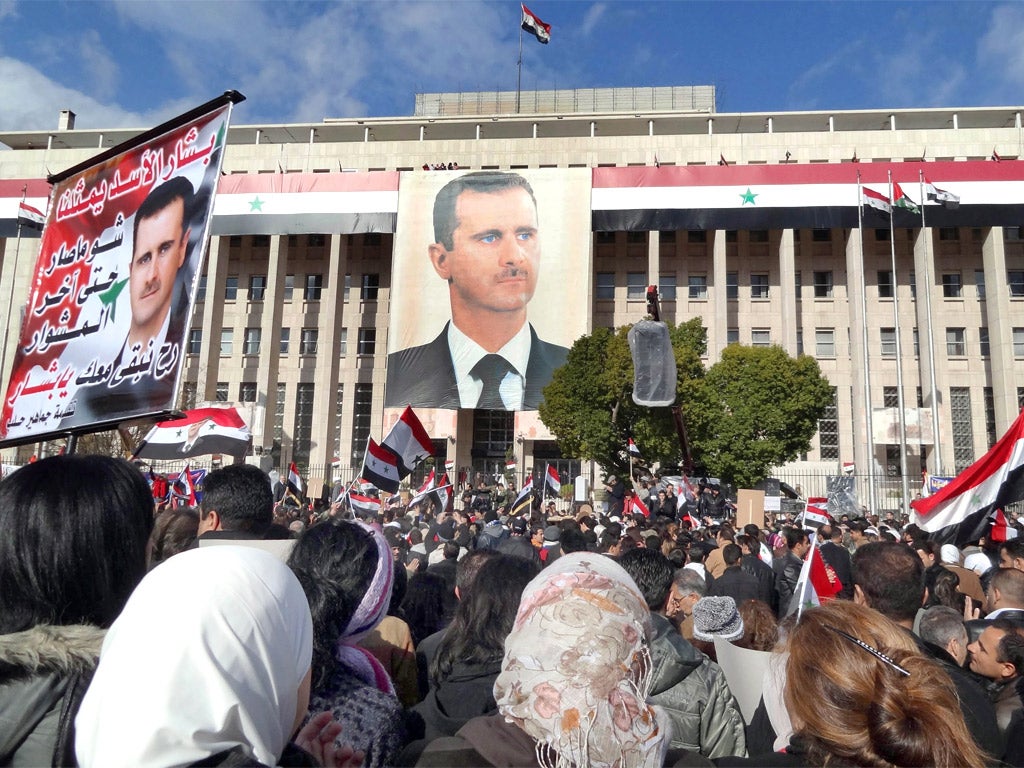
The violence grows worse. The Arab League throws up its hands in despair. Madame Clinton may huff and puff at the United Nations. But the Syrian regime and the stalwarts of the old Baath party don't budge. Only the Arabs are unsurprised. For Syria – the "Um al-Arabia wahida", the Mother of One Arab People, as the Baathists would have it – is a tough creature, its rulers among the most tenacious in the Middle East, used to the slings and arrows of their friends as well as their enemies. Syria's "No" to anything but total Israeli withdrawal from the Golan Heights in return for peace is almost as famous as De Gaulle's "No" to British entry to the European Union.
True, the Syrian regime has never confronted opposition on such a scale. If the fatalities do not yet come close to the 10 or 20 thousand dead of the 1982 Hama uprising, which old Hafez al-Assad crushed with his customary ruthlessness, the widespread nature of today's rebellion, the defections from the Syrian army, the loss of all but one Arab ally – little Lebanon, of course – and the slow growth of a civil war make this the most dangerous moment in Syria's post-independence history. How can Bashar al-Assad hang on?
Well, there's Russia, of course, and the Putin-Medvedev determination not to be caught out by the West at the United Nations as they were when they failed to oppose the no-fly zones over Libya that led directly to Gaddafi's collapse. And there's Iran, for which Syria remains the Arab bridgehead. And Iranian suspicion that Syria is under international attack principally because of this alliance may well be correct. Strike down Baathist Syria and its Alawi-Shia President, and you cut deep into the soul of Iran itself. And there's Israel, which utters scarcely a word about Syria because it fears that a far more intransigent regime might take its place.
But Syria is also a symbol. In Arab eyes, it alone defied the West in refusing an unjust peace in the Middle East. Alone, it refused Anwar Sadat's peace with Israel. Alone, it turned its back on Yasser Arafat after his doomed agreement for "peace" with Israel. And historically, Syria alone defied its French occupiers in 1920 and then again in 1946 until its Damascus parliament was burned down over the heads of its defenders. And while many Lebanese choose to forget their own history, it remains a fact that after the First World War, most Lebanese wished their land to remain part of Syria – see the results of the King-Crane commission – rather than live in a separate nation under French patronage.
And far from being a state based on expansion, as America likes to claim, Syria has steadily lost territory. It lost Lebanon to French machinations. It lost Alexandretta in 1939 when the French handed it over to Turkey after a fraudulent referendum in the vain hope that the Turks would join the Allied alliance against Hitler. And it lost Golan to Israel in 1967. For Syria as a nation – rather than a regime – there is much sympathy as well as respect in the Arab world. Bashar al-Assad – neither a toady like Egypt's Hosni Mubarak nor mad like Libya's Gaddafi – knows all this.
But Baathism is not "Arabism", however much its supporters may claim the opposite. Decades of stability did not rid Syria of corruption. It fostered dictatorship along the same, dull rules which the Arabs tolerated for so many years: better autocracy than anarchy, better peace than freedom, albeit controlled by a Shia minority, better secular than sectarian. Why, if any Syrian wanted to see the results of a confessional state, they had only to look at the civil war in Lebanon.
With embarrassment, I look back now to that terrible conflict and the cruel words I wrote so many years ago; that one day, after years of Syrian military "peacekeepers" in Lebanon, the Lebanese army may be asked to fulfil the role of "peacekeepers" in Syria. At the time, it was a wicked joke. Not now, perhaps. Indeed, a Lebanese peace force in Syria – where all of Lebanon's communities (Sunni, Shia, Christian Maronite, Orthodox, Druze, Armenian) are represented – might just be one way of damping down the civil conflict there. A supreme irony, perhaps, after the 1976-2005 Syrian army's presence in Lebanon. An impossibility, of course. But it shows the nature of political change in the Middle East.
In reality, the Syrian government is likely to fight on alone. It always has. The Assad father-and-son doctrine has always been one of patience. Hold on tight – however great the condemnation by the rest of the world, however terrible the threats from Israel or America – and eventually the wheel of fortune will turn once more in your favour.
The awful carnage in Homs and the rest of Syria, the beheadings and the torture, however, suggest that Assad rule really is running out of time. Syria's people are dying just as the people of Egypt and Libya and Yemen have died, because they want the dignity of governing themselves. Their own battle is already infecting the sectarian divisions in northern Lebanon and they exist inside the Lebanese parliament, although this will not be the Syrian government's primary concern.
The battle for survival is a terrible thing and Bashar al-Assad still appears to believe that he can squeeze through his mass of proposed reforms before the disintegration of Syria. No one outside Syria appears to believe he will be successful. But there is one unasked question. Just suppose the regime did survive. Over what kind of Syria would it rule?
Join our commenting forum
Join thought-provoking conversations, follow other Independent readers and see their replies
Comments