Robert Fisk: The immortality of a great, if flawed, historian

How many of the Nato admirals fighting the beast of Tripoli realise the origin of their title?
"Admiral" comes from the French amiral, which comes from the Arabic amir al-bahr which means "Master of the Sea". Our own "First Sea Lord" captures the original rather well. Then there's the Spanish hero El Cid which comes from the Arabic el-sayed ("the Lord"). We eat lemon sorbet which comes from the Arabic charbat. We lie down on a mattress which originates with the Arabic matrah. And so on.
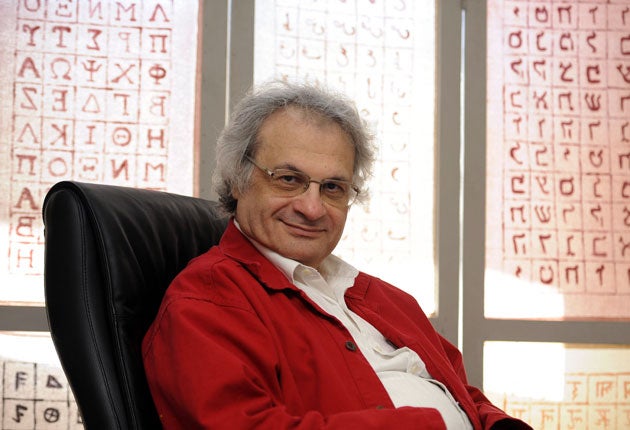
Amin Maalouf is promising an extensive study of etymology when, as a new member of the "Immortals" – he has just been elected to the Académie Française in Paris – he puts his Arab-European culture to good use at its Thursday meetings. If the French have banned the burka, they might as well know that matraque (truncheon) comes from the Arabic matraq. Maalouf is better known in France than Britain, although many will have admired his wonderful novels, among them The Rock of Tanios, a grim, painfully accurate account of sectarian life in Lebanon's Chouf mountains and colonial interference in the Levant.
However, I believe his finest work is The Crusades Through Arab Eyes, a non-fiction account of the first "war of civilisation" drawn mostly from Arab rather than European documents. It revealed how the starving knights of Christendom ate their dead Muslim victims near the Syrian city of Homs. Even Assad's lads haven't quite resorted to this.
Now Maalouf returns with more non-fiction, Disordered World, Setting a Course for the 21st Century, and I fear for his reputation. The New York Times puffed him as "the clear, calm, cogent and persuasive voice from the Arab world that the West has been waiting for". Well, not quite. Maalouf, a Maronite Christian who has spent the past 30 years in self-imposed exile in Paris, admits that "I am not a specialist on the Muslim world, still less an Islamic scholar".
Perhaps for this reason, his view of the Middle East-Western world is dizzying yet deeply flawed. When he says that "the end of the balance of terror has created a world obsessed with terror", I can only agree. Yet when he tells us that "rich or poor, arrogant or downtrodden, occupiers or occupied, they are – we are – all aboard the same fragile raft and we are all going down together", I can only say that this is nonsense.
The Palestinians who are occupied by the Israelis and the Israelis who are occupying the West Bank are not in the "same fragile raft". One lot have won (for now). The other lot have lost. The real question – in the case of Palestine – is whether the Israelis will stop stealing Palestinian land that does not belong to them, upon which they are building colonies for Israelis, and Israelis only, against all international law.
It is worth reflecting – as Maalouf does not – that back in 1983, he was part of a Lebanese delegation which visited Israel for Amin Gemayel, when the Lebanese president was going along with America's hopeless desire for an Israeli-Lebanese peace agreement. Maalouf inspected the damage caused by Palestinian Katyusha rockets to the Jewish town of Kiryat Shmona. I can see why he has buried himself in the idea of "both sides losing", but there is a moral, ethical side to this which seems to be missing from Maalouf's writing. In 1982, the Israelis in Lebanon had inflicted infinitely more suffering (17,500 dead, mostly civilians) than the Palestinians had caused in Israel.
When it comes to democracies, Maalouf tells us that he doesn't "know many which function better" than America's. Really? And when he asks himself whether "in the course of the past few decades have the Americans and Israelis not borne a more specific responsibility" for the world's decline, the answer "probably" is not good enough.
But he is a friendly soul. I met him many years ago, just after the publication of The Rock of Tanios, at a Maronite monastery high in the fog-covered early summer hills of the Metn, where monks offered the most devastating arak with breakfast. A slightly chubby, humorous man, Maalouf looked like what he was and is: a great author. As a political animal, however, he sometimes sounds like a boring prelate. "My profound [sic] conviction," he tells us, "is that too much weight is placed on the influence of religion on people, and too little on the influence of people on religion." This may impress "Immortals" but not, I suspect, us ordinary folk. But let's not be too hard on the great man.
"No serious observer," he writes, "who has combed through the accounts of meetings at which the decision to go to war [in Iraq in 2003] was taken has reported the slightest evidence to suggest the real motive was to install democracy in Iraq." Instead, the US created a system of political representation based on religious or ethnic origin. "That the great US democracy brought the Iraqi people this poisoned gift of sacrosanct communitarianism is a shame and an indignity."
And then the Maalouf "coup". He is astonished to find "the leader of the Western democracies wondering at the dawn of the 21st century if it might not be a good idea after all to support the emergence of democratic regimes in Egypt, Arabia, Pakistan... But this fine idea was soon forgotten... the country of Abraham Lincoln reached the conclusion that all this was much too risky... free elections would bring the most radical elements to power... Democracy would have to wait."
Let's hope the other "Immortals" listen to that.
Join our commenting forum
Join thought-provoking conversations, follow other Independent readers and see their replies
Comments
Bookmark popover
Removed from bookmarks