Robert Fisk: Turkey's long road to reconciliation

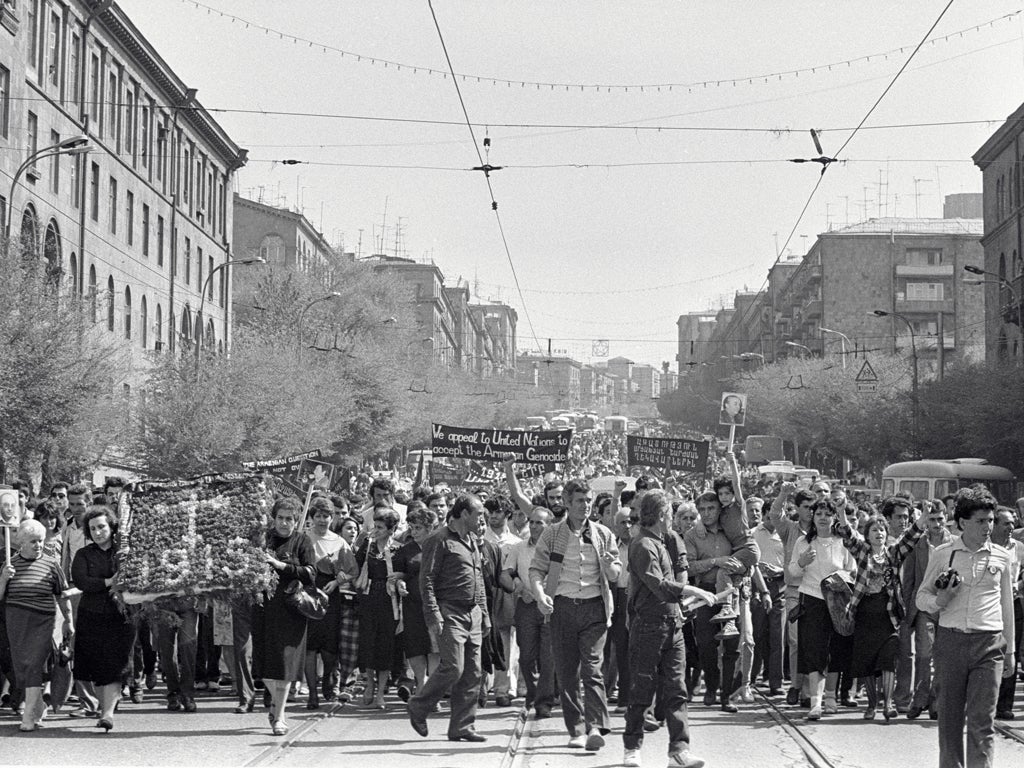
Just for a moment, put aside the current Franco-Turkish war over the 20th century's first Holocaust – of the Armenians – and remember that Nicolas Sarkozy's electoral venality (500,000 French-Armenian voters want to hear him tell the truth) and Turkish nationalism (which feeds on holocaust denial) make a bad cocktail.
So here's a story of good cheer. I've just completed 21 interviews on Turkish radio, television and in newspapers, on the Armenian genocide. Not all of my talks were about the deliberate mass murder of a million and a half Armenian Christians by the Ottoman Turks in 1915 – there was much discussion of Syria and Kurdistan and whether Turkey should be a "role model" for the Arab world (another 24-hour wonder produced by the Washington dream team) – but there was some serious discussion about that most unmentionable subject.
The occasion was the launching of the Turkish-language edition of my book The Great War for Civilisation – which includes an entire and detailed chapter on the genocide – and which has just appeared in Turkey without any imposition of the infamous law 301 (the "anti-Turkishness" law) nor any threats to Ithaki, my Turkish publishers. The chapter on the Armenians, which states repeatedly that this first Holocaust of the 20th century was planned and executed by the Turkish authorities in Constantinople (Istanbul), is titled in Turkish "The First Genocide". And, for the most part, Turkish journalists and television presenters simply didn't question the veracity of what I wrote.
And I think I know why. For many hundreds of thousands of Turks, the Armenian genocide is now a fact of history. The Turkish government still officially denies these atrocities, claiming that they were the outcome of a "civil war", that some Armenians were aiding the Tsarist anti-Ottoman army (true – though hardly the excuse for a genocide), that only historians "from both sides" could conclude whether or not this was a genocide. And imagine, as I always say, if "historians" were to decide whether the Nazi genocide of the Jews actually took place. But that's not the point.
Thousands of Turks are digging into their own family histories. Why, they are asking, did they have Armenian grandmothers and great-grandmothers? What is this secret history that has to be guarded by laws which can imprison you for merely discussing in public Turkey's responsibility for this genocide? And I asked, repeatedly, on Turkish television and in the press, why a strong and brave country like Turkey – whose victory at Gallipoli remains one of the world's great military achievements, whose soldiers were the only UN unit in the Korean war who refused to be brainwashed – cannot acknowledge the terrible deeds which took place before almost all of them were born? There are no surviving murderers – though there are a pitifully few surviving Armenian victims – and there can be no trials. Turkey still wants to join the EU and in four years the world will commemorate the 100th anniversary of the Armenian genocide.
Why not acknowledge this history now? The Germans have apologised 1,000 times to the Jews; the US has apologised to native Americans for their 19th-century ethnic cleansing; the Australians to the Aborigines, the British to the Irish, the Ukrainians to the Poles for their mass rape, pillage and massacres under German occupation after 1941. What is it with the Turks? But as I say, many Turks believe their country should own up to its history, however inglorious.
Only a few weeks ago, Recep Tayyip Erdogan acknowledged that the Turkish army had massacred thousands of Kurds in the 1930s. The newspaper Zaman asked whether this might open the way to an acknowledgement of the Armenian genocide – and the newspaper did not use the word "alleged". It treated the genocide as fact. The only journalistic denial I came across was in a pre-interview discussion, when a producer described 1915 as a "mutual massacre". Like Bosnia, I asked? Silence.
Within the military police elite, of course, denial remains. After the Armenian-Turkish editor Hrant Dink was murdered by a nationalist youth from Trabzon in 2007, hundreds of thousands of Turks marched in his memory. They believed Turkish law would deal with his murderers. But cops were photographed posing beside the suspected killer after his capture. And Bahattin Hayal, the father of one of the suspected conspirators, now says that his son was mixed up with police informers, and that after the murder the Trabzon police chief, Yahya Ozturk, told the boy that he was "serving his country". An intelligence official, Hayal claimed, later sent him a message: "I pay my respects to you. You have raised a patriotic son." The court case has now turned into a scandal. Papers have been lost. Government departments unaccountably decline to help the trial prosecutors.
Not to mention the whole Kurdish catastrophe – and the Kurds, I should add, have acknowledged their own role in the Armenian genocide in a way that the Turks have not – and the threats against freedom of speech, let alone the Hrant Dink trial, Turkey is scarcely a nation which the Arabs should treat as a "role model". But as I repeatedly pointed out in Turkey, Erdogan was the first Muslim leader to recognise and admire the Arab awakening. Never could I have imagined the Turkish flag flying once more in Gaza and Cairo. Turkey is a changed country.
There are miserable sides to all this. Pakistani journalist Ahmed Aziz has written to tell me that an article of his on the genocide "got heavily edited because in Pakistan we have this fallacy about the Ottoman Empire being the last great Caliphate made up of saints and it might have hurt some [sic] people". Online, "it did manage to get my point across judging by the number [sic] of hate mail that I got...". Aziz asked, "Why do human beings, when denying something of which they are at fault, use personal attacks to refute the criticism?"
But as I say, be of good cheer. At one of my Istanbul book autograph sessions, a young man asked me to sign a copy for his father who had seen me on television and liked what he heard. I signed the book. "My Dad," the man said, "is the chief of police for Istanbul."
Join our commenting forum
Join thought-provoking conversations, follow other Independent readers and see their replies
Comments
Bookmark popover
Removed from bookmarks