Ilan Pappé: The deadly closing of the Israeli mind
The decline in Israel's reputation since the brutal attack on the Gaza flotilla is unlikely to influence the country's leaders
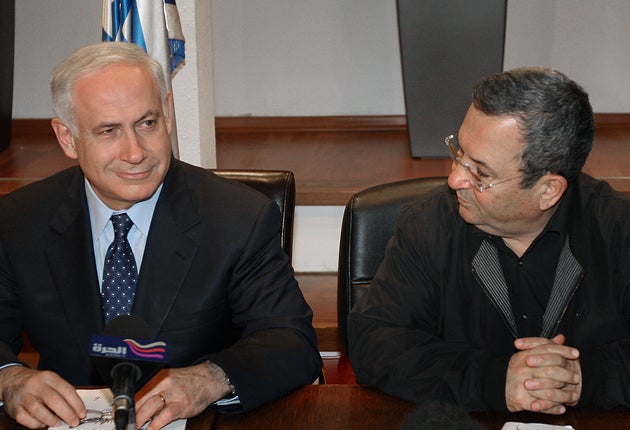
At the top of Israel's political and military systems stand two men, Ehud Barak and Benjamin Netanyahu, who are behind the brutal attack on the Gaza flotilla that shocked the world but that seemed to be hailed as a pure act of self-defence by the Israeli public.
Although they come from the left (Defence minister Barak from the Labour Party) and the right (Prime Minister Netanyahu from Likkud) of Israeli politics, their thinking on Gaza in general and on the flotilla in particular is informed by the same history and identical worldview.
At one time, Ehud Barak was Benjamin Netanyahu's commanding officer in the Israeli equivalent of the SAS. More precisely, they served in a similar unit to the one sent to assault the Turkish ship last week. Their perception of the reality in the Gaza Strip is shared by other leading members of the Israeli political and military elite, and is widely supported by the Jewish electorate at home.
And it is a simple take on reality. Hamas, although the only government in the Arab world elected democratically by the people, has to be eliminated as a political as well as a military force. This is not only because it continues the struggle against the 40-year Israeli occupation of the West Bank and the Gaza Strip by launching primitive missiles into Israel – more often than not in retaliation to an Israel killing of its activists in the West Bank. But it is mainly due to its political opposition for the kind of "peace" Israel wants to impose on the Palestinians.
The forced peace is not negotiable as far as the Israeli political elite is concerned, and it offers the Palestinians a limited control and sovereignty in the Gaza Strip and in parts of the West Bank. The Palestinians are asked to give up their struggle for self-determination and liberation in return for the establishment of three small Bantustans under tight Israeli control and supervision.
The official thinking in Israel, therefore, is that Hamas is a formidable obstacle for the imposition of such a peace. And thus the declared strategy is straightforward: starving and strangulating into submission the 1.5 million Palestinians living in the densest space in the world.
The blockade imposed in 2006 is supposed to lead the Gazans to replace the current Palestinian government with one which would accept Israel's dictate – or at least would be part of the more dormant Palestinian Authority in the West Bank. In the meantime,Hamas captured an Israeli soldier, Gilad Shalit, and so the blockade became tighter. It included a ban of the most elementary commodities without which human beings find it difficult to survive. For want of food and medicine, for want of cement and petrol, the people of Gaza live in conditions that international bodies and agencies described as catastrophic and criminal.
As in the case of the flotilla, there are alternative ways for releasing the captive soldier, such as swapping the thousands of political prisons Israel is holding with Shalit. Many of them are children, and quite a few are being held without trial. The Israelis have dragged their feet in negotiations over such a swap, which are not likely to bear fruit in the foreseeable future.
But Barak and Netanyahu, and those around them, know too well that the blockade on Gaza is not going to produce any change in the position of the Hamas and one should give credit to the Prime Minister, David Cameron, who remarked at Prime Minister's Questions last week that the Israelis' policy, in fact, strengthens, rather than weakens, the Hamas hold on Gaza. But this strategy, despite its declared aim, is not meant to succeed or at least no one is worried in Jerusalem if it continues to be fruitless and futile.
One would have thought that Israel's drastic decline in international reputation would prompt new thinking by its leaders. But the responses to the attack on the flotilla in the past few days indicate clearly that there is no hope for any significant shift in the official position. A firm commitment to continue the blockade, and a heroes' welcome to the soldiers who pirated the ship in the Mediterranean, show that the same politics would continue for a long time.
This is not surprising. The Barak-Netanyahu-Avigdor Lieberman government does not know any other way of responding to the reality in Palestine and Israel. The use of brutal force to impose your will and a hectic propaganda machine that describes it as self-defence, while demonising the half-starved people in Gaza and those who come to their aid as terrorists, is the only possible course for these politicians. The terrible consequences in human death and suffering of this determination do not concern them, nor does international condemnation.
The real, unlike the declared, strategy is to continue this state of affairs. As long as the international community is complacent, the Arab world impotent and Gaza contained, Israel can still have a thriving economy and an electorate that regards the dominance of the army in its life, the continued conflict and the oppression of the Palestinians as the exclusive past, the present and future reality of life in Israel. The US vice-president Joe Biden was humiliated by the Israelis recently when they announced the building of 1,600 new homes in the disputed Ramat Shlomo district of Jerusalem, on the day he arrived to try to freeze the settlement policy. But his unconditional support now for the latest Israeli action makes the leaders and their electorate feel vindicated.
It would be wrong, however, to assume that American support and a feeble European response to Israeli criminal policies such as one pursued in Gaza are the main reasons for the protracted blockade and strangulation of Gaza. What is probably most difficult to explain to readers around the world is how deeply these perceptions and attitudes are grounded in the Israeli psyche and mentality. And it is indeed difficult to comprehend how diametrically opposed are the common reactions in the UK, for instance, to such events to the emotions that it triggers inside the Israeli Jewish society.
The international response is based on the assumption that more forthcoming Palestinian concessions and a continued dialogue with the Israeli political elite will produce a new reality on the ground. The official discourse in the West is that a very reasonable and attainable solution is just around the corner if all sides would make one final effort: the two-state solution.
Nothing is further from the truth than this optimistic scenario. The only version of this solution that is acceptable to Israel is the one that both the tamed Palestine Authority in Ramallah and the more assertive Hamas in Gaza could never ever accept. It is an offer to imprison the Palestinians in stateless enclaves in return for ending their struggle.
Thus even before one discusses either an alternative solution – a single democratic state for all, which I support – or explores a more plausible, two-state settlement, one has to transform fundamentally the Israeli official and public mindset. This mentality is the principal barrier to a peaceful reconciliation in the torn land of Israel and Palestine.
Professor Ilan Pappé directs the European Centre for Palestine Studies at Exeter University and is the author of The Ethnic Cleansing of Palestine
Join our commenting forum
Join thought-provoking conversations, follow other Independent readers and see their replies
Comments
Bookmark popover
Removed from bookmarks