Ivan Massow: 'I felt their mutual relief as I saw him lift the syringe'
Our writer risks arrest by admitting that he stood by as gay friends helped their partners to die
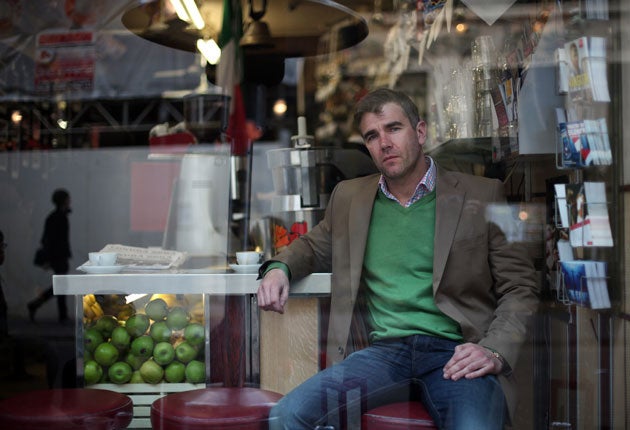
I have never been one to keep quiet when I sense an injustice. Indeed, some would say I have forged a career out of pointing out things that many would consider professional suicide. Whether it's losing my business after pointing a finger at the homophobia of insurers such as Zurich Life for their Draconian treatment of gay men, or calling "time" on conceptualism, which cost me my job as chairman of the Institute of Contemporary Art, or sacrificing my seniority within the Tory party when I coined the phrase "nasty party" in a desperate bid to bring the party to the central ground it now enjoys under David Cameron. But I have resisted writing this article, like a frightened child. Because this time, I run the risk of getting arrested.
A few weeks ago, I read about Ray Gosling who described a pact he'd had with his lover who was dying of Aids 20 years ago, and was suffering dreadfully. Mr Gosling agreed to help him end his life, smothering him with a pillow. I felt sorry for Mr Gosling, but more, I felt guilty for keeping quiet. Like many gay men of a certain age, I too have witnessed assisted suicides. Many, in fact.
Aids dominated my twenties. It can be hard for those who weren't there to understand what it was like. Although we had fantastic Aids wards (the best at the time being St Mary's Hospital, London), little was known about the virus and panic was everywhere. We didn't even really know how it was spread and, while we talked of condoms constantly, we were only guessing, and prayed that you couldn't catch it from saliva or even by air.
My involvement with the world of HIV happened by chance. I moved to London to start my first business at the age of 19, with little money and nowhere to live. I was directed to a squat run by a guy called George, who told me on my arrival that he was HIV-positive. As he introduced me to my fellow housemates I learned that the others living in this Camden-licensed squat were also HIV-positive. Camden had let them live there together because no one else would have them. It was as if they'd been quarantined.
I remember the fear that I felt as I wondered whether I was at risk simply by living there. To my endless shame, on being offered a slice of cake my host had baked as a welcome gift, I took it to my room and threw it away, too scared to eat it. It only took me a couple of weeks to realise how naive I'd been. It took me years to confess to George what I'd done. From that day, I started what can best be described as a living amends. That cake became the catalyst for a business that would provide insurance and mortgages for people in HIV highrisk groups, and free advice to anyone with HIV. We handled thousands of HIV-related inquires, often sent to us by the Terrence Higgins Trust, and were inundated with personal finance horror stories, as newly positive individuals saw their worlds disintegrate and all options close.
Although I remain free of the HIV virus myself, the 1990s found me at the centre of the London Aids scene and fighting the discrimination that gay men faced because of Aids. I was a regular visitor to Aids wards and people's homes, often paying for special care and treatment. I also took people in the final stages of the disease on holiday, in the hope that getting them away from the misery of it all would give them an extra lease of life.
Aids was so stigmatised 15 years ago that people hid the truth from everyone, including friends. Banks and insurers would close your accounts if they heard. Employers would sack you. Parents disown you. Even death certificates were routinely altered to say "cancer" or "pneumonia", despite these being only symptoms. Religious fundamentalists told us that "Aids was God's punishment for homosexuality". Aids was rarely mentioned at the funerals.
It is harder still to describe how terrifying the disease was and why "assisted suicide" pacts were necessary. But let me try. First, we knew nothing: the disease was terrifying because anything could go wrong and often would. Opportunist infections ranged from horrible skin cancers to huge red blotches engulfing the face and nose. Large lumps and swellings and the risk of any simple cold or flu turning into something that could kill you in weeks – like a breeze turning into a tornado.
The drugs we pumped into their systems – AZT in particular – were believed to cause more harm than the virus. I remember friends finding it hard to locate veins because they, along with the bones in their arms, had started to disintegrate as this toxic slew travelled along them. Blindness and an Alzheimer's-like state would usually engulf victims for the last month or two of life, leaving these poor immobile souls, covered in horrible sores, locked in a dark prison of pain and fear.
How could they be helped to bring it to an end? Usually, an overdose of morphine was the answer. I have never heard of anyone ending another's suffering by smothering them (as in the case of Mr Gosling), but it must have taken tremendous courage. However, I did hear about, and even witness, doctors overprescribing morphine on numerous occasions for just such a purpose. They would usually do this by leaving the carer a "slightly increased" surplus amount each week, so there was eventually enough for an overdose, but without arousing any suspicion.
Certain doctors and local GPs would get a reputation for being more sympathetic and found themselves taking on all the Aids cases in their catchment area. I suspect this informed their attitude towards assisted suicide and how much to do and being prepared to show how to do it. Helping someone to die isn't easy.
Gay men were unable to marry in those days. But no one could take from us how we chose to die. If the dose couldn't be administered by the doctor, it was usually a quiet and deeply private moment shared between two lovers who'd been through hell together. I remember going outside to the garden on one occasion after hearing the man's partner ask, "Are you ready?" and seeing a slow painful "nod" in reply. I felt their mutual relief as I saw him lift the syringe, and I left the two to share this intensely private moment. Although I heard of many such incidents and was present at a few, I had no appetite to watch this moment, which on the few times I was actually there always found me in tears. In this instance, the surviving partner knew that this gruesome fate also awaited him.
On one occasion, the partner and patient held a party (I recollect this was at St Mary's). The two lovers and other friends brought balloons, ate cake and we sat round the bed in celebration – a living wake – at the end of which the patient said his goodbyes and when we'd all left took the final dose. Living wakes became quite a frequent occurrence, although this was the only one where the outcome was made clear to us in advance.
This was Aids London. Stoic and unsung; modern-day lepers. There was a kind of blitz spirit. This option was the only control they had.
I have often heard people say, "I'd kill myself if I ever caught Aids", and likewise, I have heard people predict the level of pain or immobility that would persuade them to take the final dose. On the whole, we are far more resilient than we ever imagine. Most people who thought they'd take the dose when incontinent and bed-ridden usually go on to the bitter end.
One friend of mine, in the final throes of an extreme agony, finally turned to his partner and gave him "the nod", even though he wouldn't have survived another night. We had all gathered to see him, having been told that he "wouldn't be around for much longer". From what I heard, usually this kind of mercy is rarely supplied more than a day or even a few hours before what would have been the "natural" time of death.
But having the option there provides enormous comfort because it allows the patient a degree of control over the torture. It allows them to sustain the agony on their terms knowing that the decision to go on is theirs alone. And, in a strange sort of way, the blind-eye policy that has enabled doctors and patients to make this decision when the time comes has worked. But for the vast majority who haven't got doctors prepared to take those kinds of risks, or with relatives who are opposed, this is not an option. And those who opt to fly to Switzerland are required to buy a flight and make an appointment for a date which might turn out to be sooner than they are ready. The existing "blind-eye" option gives people as long as they can bear.
Ray Gosling, my new hero, stands alongside so many unsung heroes who have had to agree to do what must be one of the most distressing things they will ever do, and at the price of potential imprisonment or being struck off. I write this article by way of support.
Ivan Massow is CEO of compareforgood.com and a parliamentary candidate for the Conservative Party
Join our commenting forum
Join thought-provoking conversations, follow other Independent readers and see their replies
Comments
Bookmark popover
Removed from bookmarks