James Moore: The world expects the US to do its duty
In confronting a natural disaster, Barack Obama has avoided the mistakes of his predecessor – so far. But he has to deliver
America often has a unique and curious role in the aftermath of any great tragedy. Because nations know the US has abundant resources, the survivors of tsunamis, earthquakes and floods in distant lands tend to raise their weary eyes expecting to see Americans extending a hand. We have always embraced this as a responsibility of our culture and, indeed, consider it central to our character as a people. Further, we expect our presidents to lead and inspire our citizens and the rest of the globe when there is a need to provide relief. If they fail in this regard, they will suffer politically.
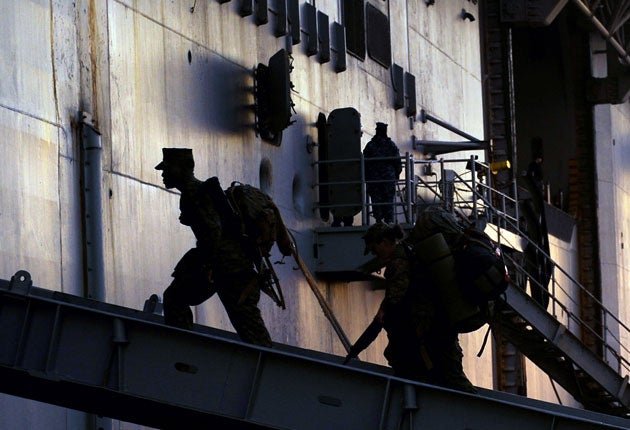
In the Haitian crisis, President Barack Obama did not falter when the news made clear that American assistance was critical to saving lives and stabilising the impoverished nation. Immediately, troops from the 82nd Airborne Division were dispatched to secure the airport for incoming flights with food, medicine and water. Five thousand soldiers and $100m were promised and Mr Obama professed a determination to use "every element of our national capacity". Although the words are easier to say than commitments are to keep, the emotional president told Haitians they will "not be forgotten in their hour of greatest need". As he spoke, the aircraft carrier the USS Carl Vinson was on station off the coast of Haiti with 20 helicopters onboard for airlifting water and medical supplies to shore.
The President's actions were only slightly more convincing than the emotional freight of his words. Instead of delegating the co-ordination of bureaucracies, Mr Obama has been chairing inter-agency meetings to convey his vision for expeditious assistance. The Secretary of Defence, Robert Gates, was promptly called back from Australia to manage the military airlift and troop deployment, and Secretary of State Hillary Clinton was also summoned home from the Pacific Rim to co-ordinate American relief efforts. The president quickly appointed Rajiv Shah as the co-ordinator of the government's outreach. With his cabinet assembled around him, Mr Obama stood before cameras and told Haiti, "Much, much more help is on the way."
Many Haitians, however, are claiming there is not yet any meaningful assistance. They hear words but do not see food. Television news programs are showing numerous huge cargo planes being offloaded with hundreds of crates of supplies but they do not appear to be getting out into the city and countryside. Five days after the earthquake there are uncountable people without nutrition, water or medicine, and witnesses describe hearing voices of people still trapped in the rubble. Haitians have begun to wonder if help will ever arrive and now armed gangs are reportedly beginning to roam the ruins in a post-apocalyptic landscape.
The shortage of relief supplies may be a consequence of horrid logistical challenges and not a failure to act. In Port-au-Prince, roads are shown covered with bodies and fallen masonry, and there may be no simple way to quickly get provisions to the hundreds of thousands of victims. There is a possibility the magnitude of what has happened in Haiti is beyond the ability of America and the rest of the world to respond quickly enough to that number of people. There also exists a reasonable probability that good intentions are being bungled through poor co-ordination among relief agencies and the US government. There is not, however, a failure of effort, concern or commitment.
What we can all see, hear and read is that America is trying. In this instance, however, trying without succeeding means more death, and neither destiny nor plate tectonics will get the blame; the President of the United States will. The political complications for Mr Obama in a failed relief project can harm him with a different kind of aftershock. After putting billions more into a Wall Street bailout, struggling to get any kind of meaningful healthcare bill passed, even with a super majority for his party, and committing to the expense of more American treasure and lives in Afghanistan, the President will be politically staggered if his plans to assist Haiti are perceived as a mess. The optimism from his historic election has waned with a record of achievement that has not equalled the hope his candidacy engendered.
Leaders tend to be defined by their grace under pressure and response to crisis, and Mr Obama appears to have learnt much from the failure of his predecessor during Hurricane Katrina. Although the storm that drowned New Orleans was predictable, emergency response was slow and American citizens unnecessarily suffered. The enduring images of that tragedy come from live camera shots of African-Americans stranded on rooftops and at the Superdome sporting arena while President George Bush circled 3,000ft overhead in Air Force One on his way back from a fundraising event.
A force of nature, however, is not what made Mr Bush a lame duck; he was undone by how he reacted to the storm. Historians suggest his effectiveness as a president began to diminish almost as soon as the winds died down in New Orleans and the waters began to recede, and the reason was nothing more than his inadequate leadership in an hour of profound crisis. Mr Obama's challenge is no different regarding Haiti. If Haitians have nothing to eat or drink and are dying of disease while healthcare is being debated in Washington, America's young President will endure his own wounds.
Politics just now, however, are irrelevant. Human life is the issue. A well-known Haitian proverb says, "Beyond the mountains, there are mountains." In this instance, the saying speaks to the endless struggle of the country and its people, and the peaks that have now risen before Haitians cannot be surmounted without great help.
James Moore is author of Bush's Brain: How Karl Rove made George W. Bush Presidential
Join our commenting forum
Join thought-provoking conversations, follow other Independent readers and see their replies
Comments
Bookmark popover
Removed from bookmarks