Jerome Starkey: The deadly task of fighting against an invisible enemy
Analysis
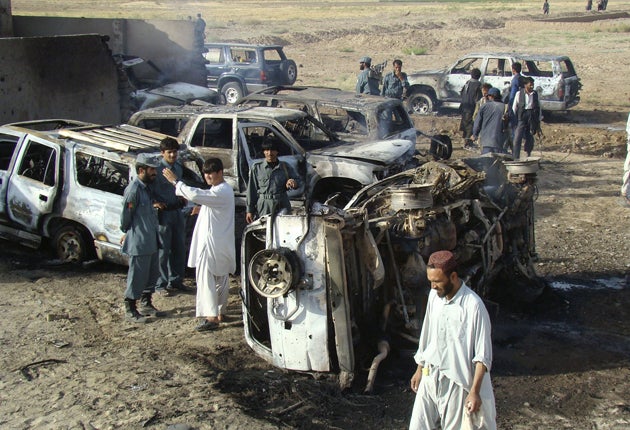
The grim toll of soldiers coming home from Afghanistan in coffins is testimony to the brutal contest being waged in the poppy fields of Helmand. For three years, British troops have been massively undermanned, underequipped and overstretched as they have tried to convince a deeply cynical population that they are safe from the Taliban.
Most of the province was beyond the reach of British forces. When the troops did come, they rarely stayed. Far from feeling safe, the people watched as the Taliban grew stronger. But the arrival of 8,000 US Marines in Barack Obama's surge is threatening to change the balance – and the Taliban are fighting back.
Helmand is their heartland, its opium is their war chest, and they are desperate to stay in control. When I was in Lashkar Gah, the capital of Helmand, last month many people struggled to understand why Britain and Nato, with all its might, were unable to defeat these ragtag insurgents. I met a shopkeeper selling drinks just 100 metres from the British headquarters. Afghan police had found two improvised explosive devices buried in a culvert in front of his shop.
"When the international troops first came here, they cleaned up all over Afghanistan within a month," said Khan Mohammed. "Now I discover that there's a mine exploding in front of my shop."
Like many people, he had bought into the wild conspiracy theories which flourish in Lashkar Gah's bazaars. "The British must be supporting the Taliban," he said.
But the Taliban know different. More than 3,000 British troops are involved in an operation to clear the roads between Lashkar Gah and Gereshk, Helmand's second largest town. It's an operation that Brigadier Mark Carleton-Smith, who led Taskforce Helmand last summer, hoped to complete, but never did. Without the extra Americans it would have been impossible to succeed because too many of Britain's fighting troops were pinned down in combat outposts dotted along the central section of the river, which runs the length of the valley. The extra US Marines are evidence of hard lessons learnt in Iraq. Senior commanders insist it will "tip the balance". But counter-insurgency experts have already issued a warning that they may not be enough to rout the Taliban completely.
John Nagl, who was recently appointed to the Pentagon's defence policy board, said: "We do not have enough troops to hold what we have cleared in Helmand. The additional American troops are a help, but they are insufficient."
The Taliban have also learnt lessons. Homemade bombs have become their weapon of choice. Where they used to try to overrun British platoon houses, or out-gun them in a firefight, today they watch and wait.
They look at how the soldiers patrol and they watch how they fight. The irrigation ditches that line most of the roads have become a favourite place for improvised explosive devices (IEDs) because the Taliban know that soldiers instinctively dive there for cover when the fighting starts.
Places like Garmsir, where the Marines are deployed, and Babaji, where the British are involved in Operation Panther's Claw, have become so-called "strongholds". The Taliban have been all but free to manufacture IEDs, process poppies into heroin, and terrorise local people.
Students living in the districts have fled to Lashkar Gah. I met three who said the Taliban had closed their schools, the fighting had destroyed their homes, and all three had lost innocent relatives in crossfire.
For the British soldiers on the ground, it's an impossibly frustrating and dangerous mission. They are fighting an enemy they rarely see and trying to win over a population who have suffered terribly since the foreign troops arrived.
The British and the Americans are following an old Nato doctrine of clear, hold and build, but the extra troops means this is the first time they have been able to fulfil it. Both forces have promised to stay in the areas they clear until the Afghan security forces are ready to take over. If it works, it should at least mean that British troops won't have to die clearing these areas a second time.
View all comments that have been posted about this article.
Offensive or abusive comments will be removed and your IP logged and may be used to prevent further submission. In submitting a comment to the site, you agree to be bound by the Independent Minds Terms of Service.
- Print Article
- Email Article
-
Click here for copyright permissions
Copyright 2009 Independent News and Media Limited


Comments
the opposite is true! the government have tried to convince a deeply cynical population that they are UNsafe from the Taliban - maybe you made a typo.
Have you thought this through?
You have people holding British passports, dressed in uniforms, well armed, flown over to a foreign land, to take part in an illegal invasion, killing Muslims daily - these are the British soldiers.
Your title could be rewritten "Sick British soldiers are killing Islamic boys".
I assume you have a list.
Excellent! At last someone capable of intelligent & rational comment.
First, it is not UK's job to control and restructure failed states it its image.
Most Muslims in the world look on the Taliban's version of Islam with disgust. But, rightly, the vast majority are unwill to support an illegal invasion of Iraq and Afghanistan.
The Taliban made the mistake of allowing al-quaeda to live with them. But now, al-quade has disappeared. We are left fighting the wrong enemy.
But then, no one (Muslim or not) is going to support illegal invasions and the installment of puppet leaders like Karzai.
The sad part is the the British soldiers have signed up to protect the UK.
But they are being sacrificed as pawns as part of Bush's/Blair's ambitions. Republicans have been kicked out, Labour is on its way out.
Either way, there is no way to win this war. As its an illegal war - its not a great disappointment to most of the world. Just the loss of inncoent life of both sides is.
We will have to see who wins in Afghanistan. It wont be the West...
This war cannot be won.
Need plan B.
If you send people to war then lives will be lost, period. Are they in some sort of dreamland in that they only expect the 'enemy' to die in conflict and that our soldiers are somehow immune? The other side can fight as well, we should not be surprised by that.
Afghanistan is where superpowers go to get humbled - in any century.
"our boys" are well-fed, well-trained and armed to the teeth. They're taking part in a cynical invasion of someone else's country and, unsurprisingly, the natives are getting angry and fighting back. I'd be doing exactly the same.
It has nothing to do with Islamic extremism and everything to do with Western infuence in a chaotic yet militarily important region.
"Our boys" aren't protecting us from Jack Shit. What they are doing is waging war against people without the hardware to fight back on equal terms.
Now that's what I call bravery.
What cracker did you come out of we have 3,500 troops in a country with over 32,000,000 people LOL
No our troops are fighting the Taliban who let Afghanistan become the world capital for terrorist training camps some of which were visited by those truly evil British muslims who murdered 52 people on 7/7. So yes OUR BOYS are doing a brilliant job not only for Britain but for all other countries that value democracy. Let's face it you would not be able to write your rubbish if the Taliban were controlling the media.
True: Operation Cyclone (which I know about and agree with you when you say the Taliban are the hangover of this operation)
Rubbish: 'this war has nothing to Islamic extremism'
Rubbish: the Afghan people want the Taliban
Maybe the answer lies in my own story.
Not long ago, I was a flag waving reactionary who had no truck with "bleeding-heart liberals" and the like until I looked a little closer at what's going on and listened to the people who are actually in these places.
I realised that the people we have been brought up to trust (the media, the government, the armed forces etc.) are not just capable of lying, they have adopted it as their default policy. To come to terms with that, to accept that you were born in one of the most ruthless, greedy and duplicitous nations in the world is really hard to do, but brave people do it and, I think, are wiser for it.
The cowards just keep on waving their flags and huff and puff about "democracy" whilst the very institution gets taken apart in front of their eyes.
It's easier to sing Rule Britannia and to call the rest of us simpletons.
It's braver to face up to the truth.
It's not about singing Rule Britannia; it's about taking a position based on reality. The type of reality that is clearer after more than 25 (long) visits to the region starting back in the 70s, throughout the 80s (when the Russians were there) and more than armchair knowledge of the cultural, religious & political powers at play in the region.
ps being a simpleton is not terminal; we are priviledged in the fact that we have access to information to enlighten us. It's just those that who are comfortable in their ignorance and not willing to consider that they might not, actually, know everything about everything.
Those simpletons are a burden on the planet.
Exactly - correct.
As the Americans are contributing so much to this, should we not commit to their leadership?
Or do we? Does anybody know?
As far as I know (assuming there hasn't been any change recently);
There are 2 'operations' in Afghanistan:
(1) Operation Enduring Freedom: which was launched in 2001 and is aimed at targeting the extremists and also to train the Afghan security forces.
(2) NATO International Security Assistance Force (ISAF): also established in 2001, it focuses not on the terrorists but rather the civilian population, in that the ISAF aims to stablise the country so that reconstruction can take place and that infrastructure can be established for the civilan population.
And, to answer your question, US Army General Stanley McChrystal commands both organizations; he's the top dog.
Interestingly, he came from Iraq where he led the Joint Special Operations Command for the past 5 years; many experts believe his approach & strategy led to the decrease in violence in Iraq (and that the decrease was not only the result of the 'surge' of troops in that country).
I was only reflecting that some believe he was also influential - I never said it was either the absolute truth or that it was the only factor in the reduction of violence.
I think it's you with the Einstein complex if you think that the decrease in violence was only because of the (good) point you mention.
Trial them and send them behind bars.