Joan Smith: Obama – the idealist turns assassin
The US president has approved the targeted killing of a fellow American. So what has changed the principled politician?
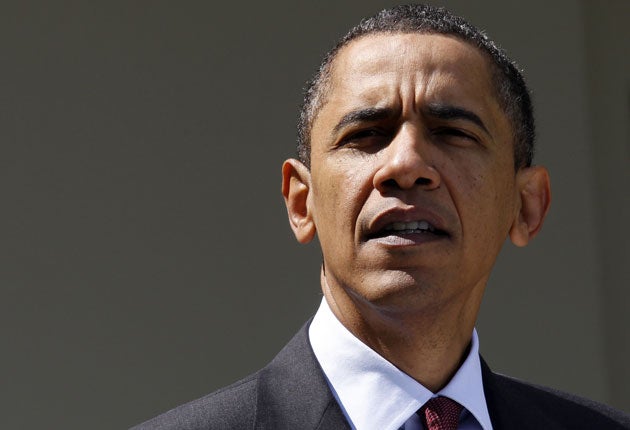
Back in the old days, when Barack Obama was one of the hopefuls trying to get his party's presidential nomination, he was asked a specific question: does the American constitution permit a president to detain US citizens without charge as unlawful enemy combatants? The would-be candidate's response was unequivocal, rejecting the idea that there was any such power. No wonder, then, that so many people were startled when it emerged last week that the Obama administration has authorised not only the detention but the "targeted killing" of an American citizen, the extremist Muslim cleric Anwar al-Awlaki.
For decades, the CIA was suspected of covertly plotting political assassinations, but the practice was believed to have been banned by President Gerald Ford. Under the Bush administration, such an admission would have caused more outrage than astonishment, but isn't Obama supposed to be more principled than his predecessor?
Perhaps we shouldn't have been caught off guard. The ground for the announcement was prepared in February when the director of national intelligence, Dennis Blair, said that targeted killings of American nationals were theoretically possible: "We take direct actions against terrorists in the intelligence community. If we think that direct action will involve killing an American, we get specific permission to do that." He must have had Awlaki in mind: the Muslim cleric was born in New Mexico and was an imam in the US before he went to Yemen, where he's believed to be hiding.
President George W Bush famously talked about wanting Osama bin Laden "dead or alive" after the 9/11 attacks. Congress approved the use of military force against al-Qa'ida after the suicide-bombings and its operatives are considered to be enemies of the US, exempting them from Ford's ban on assassinations. Now Awlaki finds himself in the same category, accused of escalating from verbal threats to getting involved in actual plots, with counter-terrorism officials claiming he has recruited individuals to attack US interests. But specific details of what he's accused of have not been released.
None of this is to suggest that Awlaki is anything other than a religious fanatic who has set himself up as a poster-boy for naive young men who see Muslims as victims. Anyone who doubts it should read the interview conducted with him in 2007 by the former Guantanamo detainee Moazzam Begg, who on Awlaki's release from prison in Yemen, invited him to meet his supporters in the UK and confronted him with challenging questions such as this: "What was your response to the outpouring of support and concern, the campaigns, petitions, Facebook groups and the messages that you've received since your release?"
A more accurate portrait of Awlaki emerged two months ago from an interview with al-Jazeera in which he admitted that Umar Farouk Abdulmutallab, the Nigerian man who tried to blow up a plane on its way to Detroit on Christmas day, was "one of my students". Awlaki denied issuing a fatwa telling Abdulmutallab to bomb the plane but said: "I support what Umar Farouk has done."
Three months earlier, Awlaki hailed US army psychiatrist Nidal Malik Hasan, currently facing 13 charges of murder following a massacre at Fort Hood in Texas, as a "hero"; Hasan attended the Dar al-Hijrah mosque in Virginia Falls when Awlaki preached there and the two men exchanged emails before the killings. Awlaki is also accused of being spiritual leader to three 9/11 hi-jackers.
It's not hard to see why American counter-terrorism officials have lost patience with the cleric, whom they now accuse of being a senior operative of the organisation al-Qa'ida in the Arabian Peninsula.
"The United States works, exactly as the American people expect, to overcome threats to their security, and this individual – through his own actions – has become one," an unnamed official said. None of which explains how Awlaki poses an imminent threat to the US, which is the sole justification for adding someone's name to a capture-or-kill list.
At the beginning of his presidency, Obama appeared to row back from the Bush administration. Even Bush himself has had second thoughts, admitting a couple of years ago that he regretted his emotional post-9/11 outburst about bin Laden. Now the Obama administration has taken the risk of announcing a possible assassination of an American citizen in advance, a move so extraordinary that it prompts several lines of speculation.
One is that Obama is deliberately trying to break with the CIA's murky past; if the President has been persuaded that such desperate measures must be adopted, he may believe it's better to have the whole thing out in the open rather than risk a series of damaging leaks.
Another possibility is that an operation to seize or kill Awlaki is imminent, and public opinion is being prepared for its inflammatory consequences in Muslim countries.
But whatever lies behind the announcement, it does not remove the moral problem of political assassination as official policy for dealing with a country's enemies when it is not, strictly speaking, at war. (Most people would say that trying to assassinate Hitler in 1938 is quite different from attempting it in 1942.)
A young civil rights lawyer called Barack Obama would have had strong views, I suspect, about imposing an extra-judicial death penalty on an American citizen who hasn't even had a trial. But that was in another country, so to speak; and besides, that idealistic youth is now President of the United States.
Join our commenting forum
Join thought-provoking conversations, follow other Independent readers and see their replies
Comments
Bookmark popover
Removed from bookmarks