Johann Hari: Amid dark times, meet the most inspiring people of 2009
Newsman Wes Nisker said if you don't like the news, make your own. These people did
It was a dark year, 2009, sealing a dark decade. It began with the world in economic free-fall and the Gaza Strip being bombed to pieces (again). We watched the vicious crushing of a democratic uprising in Iran, a successful far-right coup in Honduras, and the intensification of the disastrous war in Afghanistan. It all ended at Brokenhagen, where the world's leaders breezily decided to carry on cooking the planet.
But in the midst of all this there were extraordinary points of light, generated by people who have refused to drink the cheap sedative of despair. The left-wing newsman Wes Nisker said in his final broadcast: "If you don't like the news, go out and make some of your own." I want – in the final moments of 2009 – to celebrate the people who, this year, did just that: the men and women who didn't slump, but realised that the worse the world gets, the harder people of goodwill have to work to put it right.
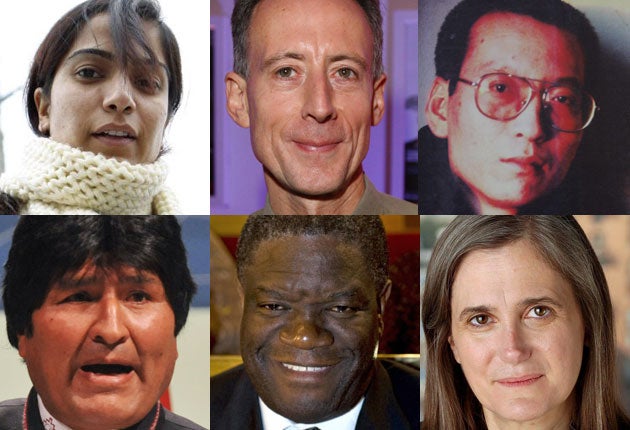
Inspiration One: Denis Mukwege. The war in the Congo is the worst since Adolf Hitler marched across Europe: it has killed more than 5 million people and counting. As I witnessed when I reported on the war in 2006, the violence has been turned primarily on the country's women: one favourite tactic is to gang-rape a woman and then shoot her in the vagina. For years these women were simply left to die in the bush. But one man – a soft-spoken Congolese gynaecologist with a gentle smile – decided to do something mad, something impossible. With scarcely any equipment and no funding, he set up a secret clinic for these women.
He was told he would be killed by the militias for undoing their "work". The threats said his own daughters would be murdered if he didn't stop. Everyone thought he was mad. But he knew it was the right thing to do. He became the Oscar Schindler of the Congolese mass rapes, saving the lives of tens of thousands of women. In the midst of a moral Chernobyl, he showed that the best human instincts can survive and, in time, prevail. It is rumoured he was number two in the Nobel Committee's list for the Peace Prize. He should have won.
Inspiration Two: Liu Xiaobo. A year ago, a petition began to circulate in China demanding that its one billion citizens be allowed to think and speak freely. "We should end the practice of viewing words as crimes," it said. As if they were the Irony Police, the Chinese authorities promptly arrested the authors and many of its signatories. One of the most articulate and brave – Liu Xiaobo – was sentenced to 11 years in a re-education camp for "subversion".
The Chinese authorities believe human rights are a "plot" to weaken China. In fact, China will be immeasurably stronger when it stops persecuting its citizens when they try to develop their minds and defend each other.
Liu is not alone. Hu Jia is in prison for warning about China's hidden Aids crisis. Huang Qi is in jail for warning that the poor construction of school buildings in Sichuan – because the builders bribed the local authorities – meant hundreds of children died unnecessarily in the earthquake. There is a long list, and for every prisoner, thousands more are too frightened to speak. But these dissidents stand as models of the truly great nation China will be one day, when it stops persecuting these people and starts electing them.
Inspiration Three: Evo Morales and Malalai Joya. Although they were born thousands of miles apart, these two people embody what real democracy can mean. When Evo Morales was a child, the indigenous peoples of Bolivia weren't even allowed to set foot in the capital's central square, which was reserved for white people. Today, he is the President, and for the first time in his country's history, he is diverting the billions raised from the country's natural resources away from the pockets of US corporations. It is building schools and hospitals for people who had nothing, and poverty is being eradicated in a stunning burst of progress.
Malalai Joya is the youngest woman ever to be elected in Afghanistan, and she was swiftly banned from taking her seat because she kept speaking up for the people who elected her – against the violent fundamentalist warlords our governments have put in charge of the country. They keep trying to murder her, but she says: "I don't fear death, I fear remaining silent in the face of injustice ... I am ready, wherever and whenever you might strike. You can cut down the flower, but nothing can stop the coming of the spring."
She and Morales are authentic democrats, in contrast to the parody of it offered by Hamid Karzai and – too often – our own leaders.
Inspiration Four: Amy Goodman and the team at Democracy Now! It's not hard to despair of the US at the moment, when even the silver-tongued King of Change seems unable to get real healthcare and cuts in warming gases through his corrupt Senate, and he is ramming harder into Afghanistan. A large part of the problem is the atrocious US broadcast media. The TV news is one lengthy blowjob for the powerful, seeing everything from the perspective of the rich, and ridiculing arguments for progress. It serves its owners and its advertisers by poisoning every political debate with death-panel distractions and silence for the things that matter.
But there is one remarkable exception. Broadcasting from a tiny studio in New York, on a budget raised entirely from its viewers, comes Democracy Now! Every day, the hour-long broadcast – hosted by the wonderful Amy Goodman – tells the real news. While the nightly news fills up with junk and gossip, they calmly, cleverly explain what is really happening. For example, while ABC and NBC were fixating on Tiger Woods' genitals, Democracy Now! was in Copenhagen, explaining how the world's rainforests were being stiffed. They, at least, can tell the trees from the Woods. It is the best single source for making sense of the world that I know – and it is a model of what the American media could be if it treated its viewers with respect.
Inspiration Five: Peter Tatchell. Long before it was trendy to support gay equality, there was Peter Tatchell, taking huge risks for what was right. As one of the pioneers of direct action to oppose bigotry against gay people, he was never afraid to put his own body in the path of bigots. In 1999, he performed a citizen's arrest on the murderous Zimbabwean dictator Robert Mugabe, and was beaten so badly by his bodyguards he has never recovered. This year, he went to Moscow to defend the gay rights march there from viciously anti-gay police, and was beaten again. This year, he announced he had to withdraw from running as the Green candidate in Oxford East because the damage was so severe.
Almost unbelievably, some people who claim to be on the left have attacked Tatchell because he criticises homophobes who happen to be black, Arab or Asian in exactly the same way he criticises people who are white. (He tried to arrest Tony Blair and Henry Kissinger for war crimes just as surely as he tried to get Mugabe.) But the real racism would be to hold non-white people to lower standards, as if their bigotries were less real or less deadly. A person who chooses to persecute gay people is monstrous and should be stopped – whatever their skin colour, and whatever their culture. Tatchell has dedicated his life to that cause, and he deserves our endless thanks, not dishonest abuse.
What do they all have in common, all these people? When Mukwege built his clinic, they said he'd be dead within a week. When Tatchell said gay people could be equal, they laughed in his face. When Morales and Joya ran for office, they said people like them could never win. They dismiss Liu and Goodman now; but their arguments will win, in time.
They show that when the world gets worse, that's not a reason to slink away in despair. On the contrary: it's a reason to work harder and aim higher. As the essayist Rebecca Solnit says: "Hope is not a lottery ticket you can sit on the sofa and clutch, feeling lucky. It is an axe you break down doors with in an emergency. Hope should shove you out the door, because it will take everything you have to steer the future away from endless war, from the annihilation of the earth's treasures and the grinding down of the poor and marginal... To hope is to give yourself to the future – and that commitment to the future is what makes the present inhabitable." That should be the epitaph for these remarkable people – and for 2009.
Join our commenting forum
Join thought-provoking conversations, follow other Independent readers and see their replies
Comments
Bookmark popover
Removed from bookmarks