Johann Hari: Could we be the generation that runs out of fish?
The process of trawlering is an oceanic weapon of mass destruction
In the babbling Babel of 24/7 news – where elections, bailouts and beheadings blur into one long shriek – the slow-motion stories that will define our age are often lost. An extraordinary documentary released next week, The End of the Line, forces us to stop, and see. Its story is stark. In my parents' lifetime, we have killed 90 per cent of the world's fish. In my lifetime, we will finish off the rest – unless we change our ways, fast. We are on course to be the people who wiped fish from the earth.
The story begins in the sleepy Canadian resort of Newfoundland. It was the global capital of cod, a fishing town where the scaly creatures of the sea were so abundant they could be caught with your hands. But in the 1980s, something strange happened. The catches started to wane. The fish grew smaller. And then, in 1991, they disappeared.
It turned out the cod had been hoovered out of the sea at such a rapid rate that they couldn't reproduce themselves. But the postscript is spookier still. The Canadian government banned any attempts at fishing there, on the assumption that the few remaining fish would slowly repopulate the waters. But 15 years on, they haven't. The population was so destroyed that it could never recover.
A growing number of scientists are warning that we could all be living in Newfoundland soon. Professor Boris Worm of Dalhousie University published a detailed study in the prestigious peer-reviewed journal Nature saying that at the current rate, all global fish populations will have collapsed by 2048. He says: "This isn't some horror scenario, it's a real possibility. It's not rocket science if we're depleting species after species. It's a finite resource. We'll reach a point where we run out."
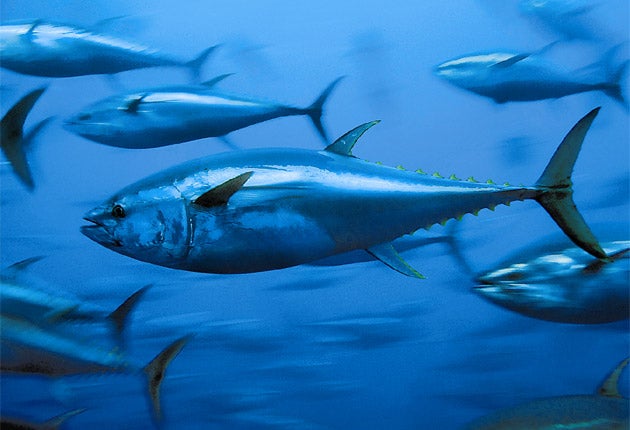
The species in the frontline is bluefin tuna, the pinnacle of the evolutionary chain for fish. This little creature can swim at 50mph, and accelerate faster than the swishest sports car. It has even developed warm blood. Yet every year, a third of the remaining population is ripped from the seas and slapped onto our plates. Soon, it will be gone.
All over the world, from the Bay of Bengal to Lake Victoria to the shores of South America, I have heard fishermen say their catches are shrinking, in size and in number. Industrial-scale fishing only began in the 1950s. By the standards of the news cycle, this is slow – but by the standards of the planet or of settled fishing communities, this is a click of the fingers. The effects of the new industrial fishing are uniform. Professor Ransom Myers found that whenever the vast industrial trawlers are sent in, it takes just 15 years to reduce the fish population to a 10% shadow of its former self.
This process of trawlering is an oceanic weapon of mass destruction, ripping up everything in its path. Charles Clover, who wrote the book on which the documentary is based, has a good analogy for it. Imagine a band of hunters stringing a mile of net between two massive all-terrain vehicles and dragging it at speed across the plains of Africa. Imagine it scooping up everything in its way: lions and cheetahs and hippos and wild dogs. The net has a massive metal roller attached to its leading edge, smashing down every tree that gets in its way. And in the end, when the hunters open up the net, they pick out the choicest creatures and dump the squashed remains in the sun as carrion for the vultures.
But we need fish. Our brains don't form properly without their fatty Omega-3 acids. So why do our governments allow this process of destruction to continue? Why do they actively encourage it, with $14bn of subsidies for fishermen to keep on trawling every year?
A small number of people are making a lot of short-term profit out of this destruction – and they are using this cash to ensure they can carry on hunting, down to the last fish. In 1992, an attempt to get the bluefin tuna listed as an endangered species was scuppered by the US and Japanese governments at the urging of the tuna lobby – who happen to give large campaign donations to all parties. A similar corruption has eaten into European politics.
Add to this the fact that fishermen are a determined and demanding constituency with an equally short-term agenda. They demand the maximum quotas today – even if that means no quotas tomorrow.
Our societies are structured to put these short-term cries for money for a few ahead of the long-term needs of us all. A small determined group with hard cash almost always beats a diffuse group with good intentions – until they get angry and fight back.
Yet today, ordinary people in rich countries are being insulated from the fish crisis. As we exhaust our own fish stocks, our corporations are sailing out across the world to steal them from the poor. Today, there are armadas of industrial European and American fishing boats across the coast of West Africa, leaving the small fishermen who live on its coasts to starve. Professor Daniel Pauly says: "It is like a hole burning through paper. As the hole expands, the edge is where the fisheries concentrate, until there is nowhere left to go."
We are not only stealing fish from Africans; we are stealing them from future generations. In the age of limits, we are hitting up against the capacity of the planet to provide for us – yet we are reacting with blank denial. This story is unfolding, in one form or another, in the rainforests, the air, and in the planet's climate itself.
It has left us at a strange crossroads. We will either be a despised generation who left behind a depleted husk-planet – or a heroic generation who, at five minutes to ecological midnight, turned back to the light.
With fish, the solution is even simpler and more straightforward than with the other ecological crises ensnaring us. The scientific experts say we need to follow two steps. First, expand the 0.6 per cent of the area of the world's oceans in which fishing is banned to 30 per cent. In these protected areas, fish can slowly recover. Second, in the remaining 70 per cent, impose strict quotas on fishermen and police it properly, as they do in Alaska, New Zealand and Iceland.
The cost of this programme? $14bn a year – precisely the sum we currently spend on subsidising fishermen. At no extra cost, we could turn them from the rapists of the oceans into their guardians.
Yet The End of the Line has one flaw – and it is one that riddles current environmental thought. It presents us with a great earth-altering crisis, and then says our primary response should be to change our own personal consumption habits. It urges people not to buy from Nobu, which shamefully still sells bluefin tuna, and to ask if the fish we buy is sustainably produced. It's like the end of An Inconvenient Truth, where the primary response Al Gore presses on us is to shop green and change our lightblubs.
Of course this is valuable – but it is only an anemic and minor first step. It is rather like, in 1937, reacting to the rise of Nazism by urging people to make sure that they personally weren't killing any Jews or gays or Jehovah's Witnesses, or buying from any Nazi-owned companies. We needed collective action that would stop other people from killing these minorities – just as today we need collective action that prevents anyone from irreparably trashing the means of life.
At the moment, many good people get anxious about environmental issues, and hear the message that The Response is to scrub their own lifestyle clean. Yet individual voluntary action by a minority of nice people will not save the bluefin tuna, never mind the ecosystem. But if all these honourable people act together – by volunteering for, and donating to, organizations like Greenpeace, Friends of the Earth and Plane Stupid – they can change the law, so everybody will be required to change their behaviour, not just a benevolent 10 per cent. It was just such determined minorities armed with the facts that spurred the fights against slavery, colonialism and fascism. When you respond as a consumer, you are weak; when you respond as a citizen, you are strong.
The voice of millions of people can drown out the concentrated power of the fishing industry – and all the other industries with a vested interest in trashing our planet – but not with the swipe of a credit card.
The alternative to collective action today is catastrophe tomorrow. As Charles Clover explains: "When the human population comes under pressure on land because of global warming, when we are running out of ways to feed ourselves, we [will] have just squandered one of the greatest resources on the planet – wild fish." The epitaph for the human species would turn out to have been scripted by Douglas Adams: so long, and thanks for all the fish.
View all comments that have been posted about this article.
Offensive or abusive comments will be removed and your IP logged and may be used to prevent further submission. In submitting a comment to the site, you agree to be bound by the Independent Minds Terms of Service.
- Print Article
- Email Article
-
Click here for copyright permissions
Copyright 2009 Independent News and Media Limited


Comments
It is true that irresponsible, politically dominated mismanagement has destroyed the cod fishery, as it has largely destroyed the salmon fishery on the Canadian west coast.
Despite the sloppy and rather incomplete analysis, the conclusions are correct, and are, if anything, understated.
I suggest one long term modification when the fisheries recover. It is "ROLLING BAN".
Rolling Ban cycles a complete ban through each fishery. For example, there would be a complete ban in the Atlantic for 5 years followed by a complete ban in the Pacific for 5 years followed by a complete ban in the Indian Ocean for 5 years.
A complete ban allows the entire ecosystem to recover. The only exceptions would be for fishermen fishing with a single line for their own consumption from land.
.
To a Brussels desk jockey, it no doubt seems plausible that if stocks of certain fish species are low, you should set quotas on how many may be caught. The trouble is, in the real world fishermen can't choose to catch only the kind of fish they have a quota for. Nor is this just because of industrial trawling methods, the same would be true of anglers with a rod and line (as if commercial fishing could ever be carried out that way). A fisherman who lands catch for which he has no quota faces stiff fines and even jail, so what does he do? He throws back into the sea, already dead, any fish he can't land, and the Brussels desk jockey wonders how he managed to decimate both the fishing industry and fish stocks at the same time.
But of course these are sensitive times for the EU, so Hari would rather go for the easy applause line by attacking "big business" instead.
You are right. It's another attempt by the author to show his right-on moral superiority whilst avoiding one of the central causes of the problem.
As the costs of fishing rise and as technology improves it will become incresingly cost effective to produce farmed fish rather than to catch wild fish. Farmed fish was once and in many cases is still problematic due to the high levels of antibiotics fed to the fish and also due to the feed which is often made from fish taken out of the food chain. However, things are changing, and with sufficient investment and public pressure things can only get better. Rearing fish in less concentrated conditions allows them to grow with less antibiotics, it would be nice if they could be grown without any at all! And regards the feed for farmed fish, well I have heard of a company called Clean Seas who are farming Blue Fin Tuna, fed entirely on feed produced and grown in-house. In conjunction with MSC certified fish, which is rigorously monitored to ensure it is caught in a sustainable manner we have the beginnings of a solution. I think the sooner 'wild fish reserves' become a reality the sooner the seafood industry will push more effort into farming fish sustainably and in a manner which suits our modern predilection for uncorrupted, wholesome foods. There is also shellfish, such as crab, scallops, mussels, oysters and whelks, full of protein and invariably sustainable if you opt particularly for rope grown mussels, diver caught Scallops and British Crab.
Even the fact our supermarkets have changed here towards more sustainable food is probably more thanks to Greenpeace's behind the scenes campaigns or celebs like Jamie Oliver and Hugh FW lobbying them and exposing them than consumer demand - unless that demand is organised on a mass scale a la Jamie Oliver and chickens.
Also if we battery farm fish, rather than catch them in the wild we can create a sustainable source of fish.
The problem is that we cannot DO anything about it. I'm a vegetarian purely for moral / environmental reasons, I do not own a car and I try not to wreck the planet. There is nothing more I can do except watch humanity wreck this world and await the news that I (and my children) are about to die while you lot post utter irrelevancies like whether this salmon on your plate is the last in the world. Then you stuff your face with it regardless. Screw the world eh? At least you got your fish supper.
People talk about regulation, well I am sick and tired of hearing that argument as it's been the same old song for decades and yet nothing ever changes because you lot are too stupid / disingenuous / hypocritical to actually change your comfy little habit of cramming your gobs as full as you can with anything you can fit into it, then turning your central heating up full blast because you are too fat and lazy to exercise. Then driving to the shop for a pint of milk.
The vast majority of humans disgust me. Screw the lot of you. Screw this planet. Screw the kids who are about to die due to your greed and stupidity. I've given up even trying to explain any more, sick of hearing people talk a good fight, then doing nothing.
Good luck Johann.
Of course we depleated the resources, we went from 2bil people to over 6 bil people in 30 years. Even the veggies you like to munch on are running out. To grow them for your healthy family, the forrests must be cut.
We need birth control, not spending more money on protecting animal spieces. We have enough of our spieces own dying in Africa and Asia. Would you rather save fish or those dying children?
It is Johann's job to sell the paper and cause the debate, not to present the full picture. Nobody buys the full picture.
Why not be smarter.
Understand the life cycle of the endangered species as well as all the other good measures suggested.
Rear their young in their zillions in captivity...and then release....
Nature __should__ theoretically take care of the rest...and even if that is not
the case, we can learn until we can master a reliable population augmentation
strategy given a few iterations of the above.
The Iranian govt countered the sturgeon crisis brought on by the collapse of the
soviet union and the poaching by doing exactly that...albeit in the Caspian Sea that
is an enormous lake rather than an ocean.
All the signs for the "end of days" scenario are valid now.
So you arent too far wrong.
Only humans seem to be capable of killing until there is nothing left to kill, no other animal does this. And the excuse of some of these fishermen is ridiculous when you watch them hauling up tons of fish killing them all and discarding the so called trash fish.
That some form of sickness and total disrespect for the marine environment itself.
Force fish farming on the fishing communities or ban them from fishing completely.
as soon as some jerk had the idea of hoovering fish out of the sea and using fish meal as a fertilizer aand as chicken and cattle food, fish stocks started to plummet
we forgot to be careful and loving stewards of our planet to worship the great god MONEY
it makes me weep
Bluefin tuna is being over-fished and its numbers can't be sustained, scientists say.
Johann. I read this with interest and I fail to see the speed of the tunas and the swishest sports car. My English is bad, lousy and I do not have the swiftest car . However trying to tell me that we all will have to go to (A growing number of scientists are warning that we could all be living in Newfoundland soon.) when you also complain of the fish going away tell me vey little. If I do go, there, what do I get? Soon, it will be gone. This little creature can swim at 50mph, and accelerate faster than the swishest sports car. Do we have to catch these? All over the world, from the Bay of Bengal to Lake Victoria to the shores of South America, I have heard fishermen say their catches are shrinking, in size and in number. Size from 25 inches to 4 inches? Lake Victoria tunas. New Twitter Research: Men Follow Men and Nobody Tweets. You see we are like the birds.
We're singing in tuna. Read this. It is oil that is needed not the fish
Steve Cooper
March 11, 2009
AUTUMN is a favourite time of year for anglers. The weather is generally kinder, in that the wind eases and the days start to cool, and this means more opportunities on the water.
As far as the fish go, they seem to agree. Autumn has so much fishing on offer that anglers have difficulty deciding which species to chase.
This autumn has been especially kind to saltwater anglers. The biggest news is the run of southern bluefin tuna and albacore in Victoria's southwest, from Port Fairy through to Port MacDonnell, over the border in South Australia.
The tuna run is early and has attracted anglers from as far afield as Port Stephens in NSW. In one day, more than 189 boats were counted at the Portland boat ramp, and when you work out fuel, accommodation and general spending, it is injecting bucket loads of money into the city.
Bob McPherson reported that most of the bluefin were up to 36kg but anglers fishing out from Port MacDonnell caught a 112kg fish. It was one of three big tuna hooked on the same day, the other two breaking free.
Anova Victoria Perch and Tuna both naturally rich in Omega 3
Both Victoria Perch and Tuna from Anova whether purchased fresh or frozen are excellent sources of Omega 3, supplying around 5% total oil of which 20% is Omega 3. Along with other natural sources of Omega 3, they can provide a really healthy addition to your diet. We recommend you consult our recipes for some suggestions on preparing these fish for a healthy and tasty diet.
Consult with your dietician or physician when using any food as part of a medically advised dieting plan, to check the suitability of fish for your specific dietary purpose.
No where I see the Newfoundland.
I thank you
Firozali A Mulla
I thank you
Firozali A Mulla
Do you say that the rain forest is being "bulldozered" or "bulldozed"?
A: Its Light-bulbs not Lightblubs! (Don't newspaper computers have spell checkers?)
B: "Inconvenient Truth" was full of lies.
C: Greenpeace is now morally corrupt and has been taken over by lunatic politically motivated individuals
B: Lies? That implies intention. Inaccuracies are not lies. Seems you find a little technical mistake in a warning and therefore disregard it?
C: Who cares? Still we need some individuals to counter act the corrupt politicians running our countries. You should blame the people who destroy our environment.
You are a funny chap. If your doctor tells you that you have a heart problem which you could die from, would you disregard that warning if he or she pronounced it wrong? I will never get people like you who got their priorities so sickeningly wrong..
It is simply not true that we need fish. We can get Omega-3 from plant sources. For example, flax oil is rich in Omega-3s.