Johann Hari: Don't kill the planet in the name of saving the economy
The collision of the credit crunch and the climate crunch could be a boon
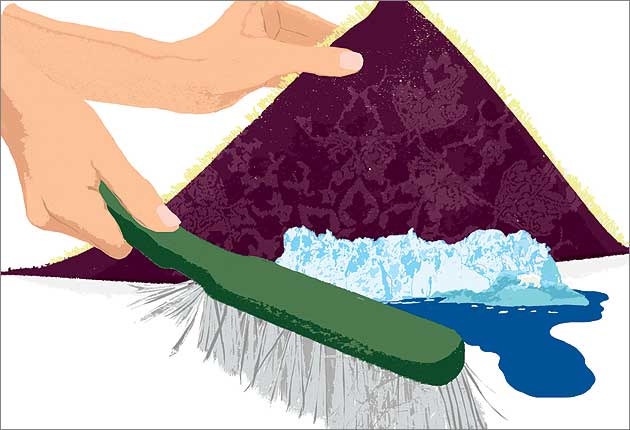
We are living through two great meltdowns – the credit crunch, and the climate crunch. The heating of the planet is now happening so fast it's hard to pluck a single event to fix on, but here's one. By the summer of 2013, the Arctic will be free of ice. How big an event it this?
The Wall Street Crash hadn't happened for 80 years. The Arctic Crash hasn't happened for three million years: that's the last time there was watery emptiness at the top of the world. The Arctic is often described as the canary in the coal mine. As one Arctic researcher put it to me this week: the canary is dead. It's time to clear the mine, and run.
We now have higher levels of warming gases in the atmosphere than at any point in modern geological history. The last time they were higher than this was during the ecocene, 50 million years ago. Sea levels were 300 feet higher than today, and crocodiles swam at the poles.
So it seems strange that even here in Europe – the continent that has taken the evidence about global warming most seriously – many of our leaders are trying to use the credit crunch as an excuse to drive us deeper into the climate crunch. Last year, all the EU leaders agreed to carry out the bare minimum scientists say we need to prevent catastrophe. By the year 2020, they agreed to a 20 per cent cut in carbon emissions, a 20 per cent rise in energy efficiency, and to get 20 per cent of our energy from renewables. This meant the EU could stroll into the talks for a successor treaty to Kyoto in the strongest position to pressure the world. The continent that gave the world the Enlightenment and modern science was upholding those values – and offering our species the path out of a dead-end.
Until last week. At the EU summit to bail out the banks, several leaders began to quibble about bailing out the climate. The British Government has been trying to punch holes in it, demanding exemptions for aviation and other accounting tricks. The eastern European bloc – led by Polish PM Donald Tusk – said the deal was "too much" during a recession, but they need a Western European country if they're going to totally break the deal. Italian Prime Minister Silvio Berlusconi took a break from finger-printing gypsies to say: "We don't think this is the moment to push forward on our own like Don Quixote. We have time."
But time is exactly what we don't have. The key to understanding why lies in grasping the difference between a two-degree celcius rise in global temperatures and a three-degree rise. At first glance, neither sounds like a big deal. If you go out for a picnic and the temperature rises by three degrees, you take off your jacket. But if your body heats up one or two degrees, you get sick and take to your bed. If it heats by three degrees and doesn't go back, you die. The ecosystem isn't a picnic; it's more like your body. Small variations in global temperatures have vast consequences. The last Ice Age was only six degrees colder than today. A global rise of just 0.8 degrees has melted the Arctic.
Soon, we will have belched so many warming gases into the atmosphere that a two-degree rise will be locked-in and certain. That condemns Bangladesh and the islands of the South Pacific to drowning. But if we choose, we can stop there, and stabilise the climate at this higher temperature.
But if we go beyond two degrees, the climate begins to unravel, and the brakes won't work. At three degrees, almost all the world's ice is gone, and so it stops reflecting a third of the Sun's ray back into space – making the world hotter. At three degrees, the Amazon rainforest burns down, releasing all its stored carbon – making the world hotter. At three degrees, the Siberian peat-bogs melt and release vast quantities of methane into the atmosphere – making the world hotter. So three degrees turns inexorably to four and five and six. Screw the grandchildren and the polar bears: we're on course to heat by three degrees in my lifetime. I wish the deniers were right: I'd be on the first plane to Honolulu. But we can't live for long in an euphoric dream. Two degrees is the point of no return, and we're about to hit it.
The collision of these two crunches could be a boon. Just as the banking system imploded when it was left unregulated, the current carbon-spewing economy is on course to ecologically implode. The path out of both crunches is the same: concerted state action and re-regulation. To get out of the credit crunch, we need a big package of job creation and economic stimulus. To get out of the climate crunch, we need an army of millions of new workers – and billions in public spending – to insulate every home, construct millions of new renewable energy sources, and work on endless innovations that help us to decarbonise. See any overlap? Europe would get a head-start in green technologies – the great boom-market of the 21st century, if the world sees sense.
The belief we can't deal with global warming because we need to pursue growth is pulverised by a Stern fact: global warming will smother economic growth. When the British Government commissioned the economist Sir Nicholas Stern to study the economic impact of Weather of Mass Destruction, he found that warming could slash 20 per cent off the global economy in my lifetime – while it costs just 3 per cent of GDP to stop it now. People who won't stop warming for the sake of growth are like a man who won't stop his house burning down because he makes a living toasting marshmallows on the flames.
Yes, we could choose business-as-usual. Then, as the climatologist Professor Marty Hoffert says: "Somebody will visit in a few hundred million years and find there were some intelligent beings who lived here for a while, but just couldn't handle the transition from being hunter-gatherers to high technology." Feeling pessimistic yet? Don't be. There is another way.
This is, perversely, a dazzling time to be alive: every human being who ever lives will deal with the decisions we make here. If we disregard the voices of denial, Europe has a chance to do something extraordinary. We could be the people who saw this threat to our species coming and remade our societies to stop it. The story of Europe's 2020 vision could be heroic, but only if we fight now to save it from the vandals.
Join our commenting forum
Join thought-provoking conversations, follow other Independent readers and see their replies
Comments