Johann Hari: Fat cats and evangelicals: what a Tory win would really mean
With Cameron in power, largely unnoticed shifts will affect all our lives
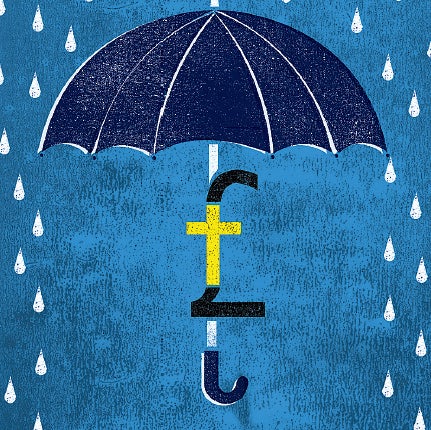
Every political party is a jangling coalition of interest groups and ideas and paymasters, all rubbing against each other under one umbrella: think of it as the Rihanna principle. These coalitions shift over time: some groups get shunted out into the rain; others get to huddle at the middle, snug and smug. Under David Cameron, the Conservative coalition has subtly shifted. Two groups who have long held sway in the party now have a firmer hold on the umbrella than ever before – and if the Tories win power in just a few weeks' time, these largely unnoticed shifts will affect all our lives.
The financial services industry – you remember: the people who just crashed the global economy – have almost always been part of the Tory tent. They regularly poured funds into the party throughout the 20th century, and hyperventilated with pleasure at the Thatcher revolution, wobbling only when Tony Blair created New Labour. But the hot dish of City cash was always one food group among many for the Tories. They have never been their biggest provider of funds – until now.
According to the Financial Times, donations from the financial sector have "quadrupled" on David Cameron's watch to an unprecedented proportion of the party's income. The City has given Cameron £16m since 2006, compared to just £3.7m under the previous three leaders combined.
It was decades of lobbying and donations from the City that pushed politicians to deregulate almost everything the financial services industry indulged in. Previously impossible scams – from sub-prime mortgages to credit default swaps – became scattered through the system. The resulting economic implosion can be seen in every shuttered window on your high street.
The sector is now fighting a rearguard action against reregulation – using the same tactics and the same arguments. Boris Johnson, the most senior elected Conservative in Britain, has shown the Tory MO: he took large wodges of City cash and told the British people to stop "whingeing" and succumbing to "neo-socialist claptrap". Given a choice between City spin and the facts, he chose the corporate propaganda every time. For example, he claimed the puny 50 per cent top rate of tax would drive 9,000 City workers to Switzerland: in fact, the rate of workers leaving has fallen by 9 per cent. He even still says sub-prime mortgages were a good thing.
So it's highly significant that Cameron is choosing to fund his run for the premiership with City money, even inhaling funds from hedge funds that engaged in short-selling the collapsing share price of Bradford and Bingley. While he assures the public that he will slap "tough regulations" on this sector, privately he is eager to woo them. Speaking recently to the heads of Goldman Sachs, Barclays and an array of hedge funds, he assured them that protecting the City was in his blood, saying: "My father was a stockbroker, my grandfather was a stockbroker, my great-grandfather was a stockbroker." They cheered.
Cameron claims that he is not affected in any way by the money, but his donors put it differently. Andrew Perloff, of the property speculators Panther Securities, says: "It's a foot in the door. There is definitely an advantage ... because they know you're a supporter."
Cameron's biggest paymaster of all is Michael Ashcroft, a man who became a billionaire in the financial services sector. He has a base in the tax haven of Belize. He has been made deputy chairman of the party, accompanies William Hague on visits to foreign leaders, and is paying for marginal constituencies to be carpet-bombed with Tory election materials. Yet he won't even tell us if he is domiciled in Britain, or pays taxes here.
The attempts to get the Tory frontbench to explain whether their election campaign is being funded through the fruits of tax avoidance have become like a Monty Python sketch. The Information Commissioner has ruled that the party is being "evasive and obfuscatory" – a neat euphemism for dishonest.
The City of London is providing the fuel that the Tory party runs on, and these hard-headed businessmen will expect a return on their political investments. They clearly believe Cameron will be significantly softer on regulating them than even Labour's pitiful efforts. The result? We will all be left more vulnerable to 2008 redux. Can you afford to risk another crash and another bailout?
At the same time, a very different force is swelling within the Tory ranks – with an agenda of their own. Evangelical Christian fundamentalists have preferred the Conservatives to the other parties for a very long time – but it is only now that their relative weight within the party is swelling so rapidly that one panicked Tory MP recently told the FT (in a separate story): "They're taking over the party."
As the Conservative Party has shed its mass membership – like every other party – even a relatively small number of people with a determined agenda can become dominant. So evangelicals have been signing up as Cameron's Militant Tendency. Where the Tories have held open primaries to select its candidates, they pack the meetings to secure one of their own. Candidates are increasingly frightened to take on their agenda. A ConservativeHome poll of candidates selected to fight marginal seats for the Party found that large majorities want to curtail a woman's right to choose an abortion, and say it's OK to discriminate against gay couples who want to provide a home for an orphan.
While David Cameron has defied the evangelicals on a few issues – to his credit, he supports civil partnerships, for example – he is poised to deliver them the biggest gift they will have received in generations. He will provide state funding for any group of parents who want to set up a school and can attract pupils. We know from Sweden – where this idea was taken from – that one sector is always waiting with the willpower and the organisation and the disgust with the existing schools system: religious fundamentalists.
As the National Secular Society has shown, Cameron's proposals will cause an explosion in fundamentalist schools. This will, over time, subtly alter the shape of Britain. Far more kids will be taught that abortion is evil, homosexuality is sinful, and evolution didn't happen. (Gay kids are 10 per cent more likely to be attacked in faith schools, a Stonewall study found.) And the horrible effects caused by New Labour's expansion of faith schools will get even worse.
More children will be segregated according to their parent's religion: the kids of Christians packed off to one school, Jews to another, Muslims to another still. They won't get to know each other at the most formative ages, when prejudices can be wiped out so easily. After the 2001 race riots in Oldham, David Ritchie – chair of the investigation – warned that faith schools were one of the biggest factors "contributing institutionally to divisions within the town."
Now Cameron is clearing the way for even more, in the most blessedly irreligious country on earth. When I interviewed him recently, he angrily said criticisms of faith schools were "a load of tosh". It's as if he looks at Northern Ireland's segregated school system, and thinks it is an inspiration, rather than a disgrace.
A small twist in a political party's composition can swirl its national policies. It's time we paid attention to the unsavoury groups who are beaming as David Cameron choruses: "Now that it's raining more than ever/ Know that we'll still have each other/ You can stand under my umbrella- ella -ella...
Join our commenting forum
Join thought-provoking conversations, follow other Independent readers and see their replies
Comments
Bookmark popover
Removed from bookmarks