Johann Hari: The dark side of Andrew Roberts
This historian's work elaborately defends the crimes of a white man's empire
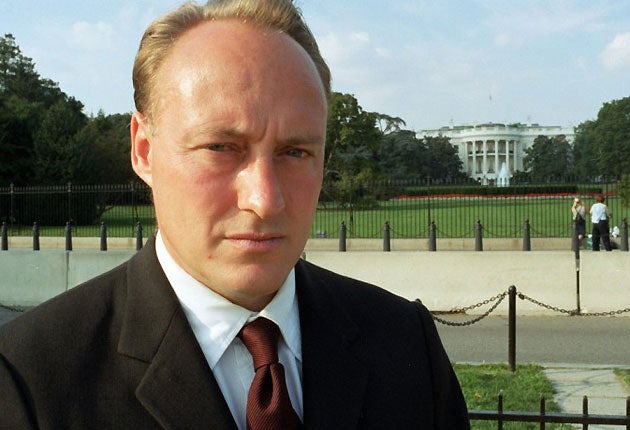
Jonathan Hackitt, BBC
Andrew Roberts is routinely described in the British press as a talented historian with a penchant for partying
What does it say about Britain that today we merrily laud a historian who celebrates the most murderous acts of the British Empire – and even says women and children who died in our concentration camps were killed by their own stupidity?
Andrew Roberts is routinely described in the British press as a talented historian with a penchant for partying. They affectionately describe how the 46-year-old millionaire-inheritee sucks up to the English aristocracy. He brags: "To [the] charge of snobbery I plead guilty, with pride," saying he has "an exaggerated sense of – and tak[es] an unapologetic delight in – class distinctions." But all this Evelyn Waugh tomfoolery masks the toxic values that infuse Roberts's works of "history".
Roberts, who has a new book out this week, describes himself as "extremely right-wing". To understand him, you need to look at a small, sinister group of British-based South African and Zimbabwean exiles he has associated with. In 2001, Roberts spoke to a dinner of the Springbok Club, a group that regards itself as the shadow white government of South Africa. Its founder, a former member of the neo-fascist National Front, says: "In a nutshell our policy can be summed up in one sentence: we want our countries back, and believe this can now only come about by the re-establishment of civilised European rule throughout the African continent."
The club, according to its website, flies the flag of apartheid South Africa at every meeting. The British High Commission has accused the club of spreading "hate literature".
The dinner was a celebration of the 36th anniversary of the day the white supremacist government of Rhodesia announced a unilateral declaration of independence from Great Britain, because it was pressing the country to enfranchise black people. Surrounded by nostalgists for this racist rule, Roberts, according to the club's website, "finished his speech by proposing a toast to the Springbok Club, which he said he considered the heir to previous imperial achievements".
When I first pointed out this connection, Roberts said he gave a "historical speech", hadn't realised the Springbok Club was a racist organisation, and didn't recall anyone saying anything racist. Wasn't the apartheid flag, and the fact they were there specifically to celebrate the anniversary of a white supremacist declaration, a hint?
That Roberts would cheerfully lap up the applause of the Springbok Club is not surprising: it is perfectly logical to anybody who has read his writing, which consists of elaborate defences for the crimes of a white man's empire – and a plea to the US to continue its work.
How should this empire exercise its power? One useful tactic, Roberts appears to believe, is massacring civilians. The Amritsar massacre is one of the ugliest episodes in the history of the British Raj. In 1919, Brigadier-General Reginald Dyer opened fire on 10,000 unarmed men, women, and children who were peacefully protesting, and about 400 died. Dyer was even repudiated by the British government. As Patrick French, an award-winning historian of the period, explains: "The biographies of Dyer show that he was clearly mentally abnormal, and there was no way he should have been in charge of troops."
Yet Dyer has, at last, found a defender – Andrew Roberts. In his book A History Of The English-Speaking Peoples Since 1900, he says that after Dyer shot down the peaceful crowd, "[i]t was not necessary for another shot to be fired throughout the entire region". He later comments: "Today's reactions to Dyer's deed are of course uniformly damning ... but if the Amritsar district, Punjab region or southern India generally had carried on in revolt, many more than 379 people would have lost their lives."
It is an extraordinary rationalisation for killing women and children in cold blood, and rejected by virtually all other historians. It was only after I exposed this passage that Roberts finally said: "I have never approved of massacring civilians."
But in his writings Roberts is even supportive of politicians who take mass punishment to its most extreme conclusion: concentration camps. His political hero is Lord Salisbury, the British prime minister who, during the Boer War, constructed concentration camps in South Africa that inspired Hermann Goering. Under Salisbury, the British burned Boer civilians out of their homes and farms and drove them into concentration camps, so they could grab control of one of the most strategically important parts of Africa. The result was that about 34,000 people – some 15 per cent of the entire Boer population – died in the camps, mainly of disease and starvation.
Roberts presents a very different picture. He says the British introduced "regime change" in Pretoria out of a concern "for human rights". Far from being a "war crime", the concentration camps "were set up for the Boers' protection". The mass deaths there were not a result of British policy. No: they were primarily the prisoners' own fault, because they didn't know how to take medicine or treat disease, and deliberately spread lice.
The "evidence" he gives for this is the word of a single British doctor who worked in the camps. What would our picture of the German camps look like if we relied on the words of a Nazi-employed doctor? Professor Mike Davis, an academic expert on the British Empire, says: "His arguments about the Boer concentration camps are similar to the arguments of the apologists about the Nazi camps."
This is not merely a matter of the past. Roberts sees his histories as road maps to the future, advising George W Bush, at a White House dinner to celebrate his histories, to adopt "the whole idea of mass internment", saying: "I think it is the way the administration of Iraq should go." Incredibly, he cited Ireland as a model of how internment can work, a claim that provokes incredulity in Irish historians.
This man is a high-society yob and he would be shunned in a culture that took human rights seriously. But it appears that in Britain today justifying mass murder will be cheerfully overlooked, provided the killing was carried out under the flapping of the Union Jack, and you can sprinkle some tart gossip into the pages of Tatler afterwards.
View all comments that have been posted about this article.
Offensive or abusive comments will be removed and your IP logged and may be used to prevent further submission. In submitting a comment to the site, you agree to be bound by the Independent Minds Terms of Service.
- Print Article
- Email Article
-
Click here for copyright permissions
Copyright 2009 Independent News and Media Limited


Comments
The deaths of thousands of Boer women and children in the British camps cannot be excused. However I think that it is fair to argue that this was not a result of a deliberate policy of genocide, but rather of poor administration, lack of supplies, and lack of concern by the British high command. Thus one should not, as Hari does all too blithely, associate these camps with the Nazi extermination camps. The British camps were formed for military, not genocidal, reasons. There was no policy to exterminate the Boers, there were no gas chambers, or medical experiments, etc.
I don't want to defend Andrew Roberts's writings, as I have not read his work. However, I think that Niall Ferguson's 'Empire' presents quite a good, and balanced, argument for the positive contribution of the British Empire.
people in the higher echelons still believe such a thing as 'proof' exists?
You are so tiresome the Ben Elton of journalists ranting on about ideals of formed in the 1960's and so so out of date today, the Polly Toynbee ( Bolly drinking, loves her villa in Tuscany socialist) of the Independent .
How many times did your head disappear down the toilet bowl at school, I bet you hold the world record.
Get over it we all have and move on.
Anyone here want to defend Roberts' claim that the Amritsar massacre was "necessary", or the people who died in the Boer concentration camps died because they were stupid?
A little less screaming and a little more coherent response to the article would be useful. At the moment, you sound like insane people at a bus stop yelling "It's wasn't us that killed the darkies!"
Frankly, I find almost anyone out of Africa who is white deeply worrying. They almost all share a disturbingly racist view of life, a love of authoritarianism, thinking hanging is too good a punishment and flogging improves character.
Roberts does indeed move in murky waters.
Perhaps I show my ignorance, but until I read this article I had never even heard of the guy - and from the sound of things I haven't missed bery much.
Sounds like just another classic proof that there is no such thing as unutterable nonsense.
Oh dear... Hari wrote that Roberts attended an event in 2001, which marked the 36th anniversary of the UDI declaration. That puts UDI, on Hari's account, at errr... 1965
Rather amateur arithmetic.
Ta ta.
I suggest you go back to the beginning and try again.
I have lived and worked in some of the remoter and more difficult regions of Africa for years and grand standing egoists who think parliamentary jollies in Kivu mean they know what they are talking about piss me off. I wonder if Hari woul be willing to live and work here for years, dealing with the reality day in, day out.
The British Empire was a mixed bag. It did some bad things (seen as much worse by modern standards) and it undoubtedly did some very good things. The record of many sovereign governments is the same, a mixed bag. Much of what Hari holds up as evidence of British intent was more often the result of muddle and incompetence. Not an excuse, but at the same time lazy and silly comaprisons between the Brits and the Nazis show that Hari is not a serious writer. Some rational balanced analysis based on the full range of evidence would be welcome. As it is all we get is Mr Hari massaging his own ego:
"It was only after I exposed this passage."
Alongside this he quots secondary sources as if they were authoritative. This bloke got a double first? I heard Cambridge is not what it was but this really does represent a sad decline in standards.
I often find myself thinking the same. Of all the great empires and civilisations where are the Africans. I remember several years ago a professor declaring his black students were not as capable as his others. A truth but not a politically correct one.
Well, a Mau-Mau fanboy like Hari should know all about how to rationalise and excuse the brutal murder of women and children.
Editor, how about getting back to the standard of journalism this newspaper enjoyed after launching, when it truely was "Independent".
I agree with lush.laroo that Hari must have (and probably still has) been targetted by individuals who cannot stand his pathetic whining, I am happy to say I would be one of them and would gladly stick his head in the toilet.
Sack the pratt.
Roberts emodies the worst kind of element of this 'darned savages don't know whats good for them' attitude.
Also no matter what way many of you try and spin it, the Nazis were indeed inspired by many policies of the british empire.
Can some one please help me on these? Left extremist, right, center, Front benchers, Last benches, Right wingers, left winger, right wingers, And so many of these.
The British High Commission has accused the club of spreading "hate literature".
A History Of The English-Speaking Peoples Since 1900, he says that after Dyer shot down the peaceful crowd, "[i]t was not necessary for another shot to be fired throughout the entire region". He later comments: "Today's reactions to Dyer's deed are of course uniformly damning ... but if the Amritsar district, Punjab region or southern India generally had carried on in revolt, many more than 379 people would have lost their lives."
I thank you
Firozali A Mulla
Keep it up!
If it was a fine piece, the parochial and ignorant amongst us would enjoy a debate, unfortunately Hari is incapable of "fine writing" as has been proven time and again, which is why his ignorant and parochial critics here cannot be bothered to stoop so low as to make him feel he is anything other than a silly schoolboy who has never grown up. Toilet, head, flush, result.
Another form or ignorance is accepting any old b*****s someone tries to sell you. Get out of the house once in a while.
Try Uganda, Tanzania or Kenya, where many of the older people look back fondly on British rule. Whether you like it or not these places were far better governed under the Brits. Botswana had the wit not to rush to independence. Doing quite nicely because of it.
Many Congolese will say they wished they had been colonised by the Brits.
Colonialism relative to modern governance in Africa was not all bad, indeed much of it was better than the corrupt and incompetent regimes Bono and Geldoff want us to give aid to today.
And Robinson is the Mary Poppins of this nursery of red-faced bawling brats.
And look up the Congolese Empire, you ignorant, racist cretins.
And Robinson is the Mary Poppins of this nursery of red-faced bawling brats.
And look up the Congolese Empire, you ignorant, racist cretins.
In my experience many of the older 'people' who look back fondly on the colonial experience were the type of Marshal Petáin types who had it very good under the 'noble' colonists and now their benefactor is gone they are merely left to sit and reminisce how they used to love beating their fellow countrymen whilst in the pay of the foreigners.
Many of the corrupt regimes you speak of were established by people who learned their trade in the pay of their former colonial masters. Idi Amin for instance.
Colonialism was not enitrely bad, on that I agree. But I detest the 'savage natives' attitude you seem to support. Britain, France, Spain etc had no business whatsoever in those countries.