Johann Hari: There's real hope from Haiti and it's not what you expect
When people live so close to the edge, even small price increases can break them
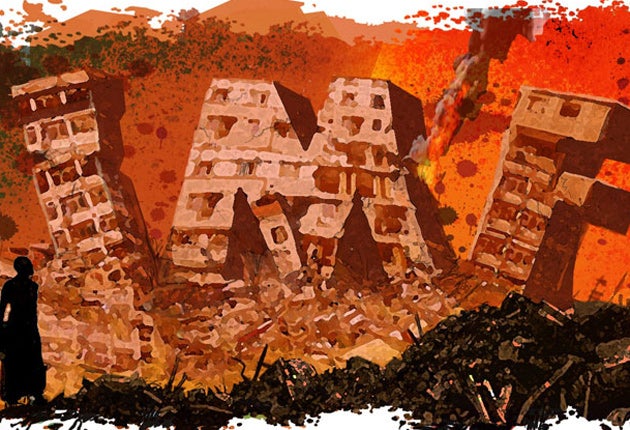
In the weeks after a disaster like the Haiti earthquake, journalists always search for an upbeat twist to the tale. You know it by now – the baby found alive after a week under wreckage. But this time, a shaft of light has parted the rubble and the corpses and the unshakeable grief that could last for years. In the middle of the Haitian people's nightmare, a system that has kept hundreds of millions like them poor and broken might just have shown its first fracture.
To understand what has happened, you have to delve into a long-suppressed history – one you are not supposed to hear. Since the 1970s, we have been told that the gospel of the Free Market has rolled out across the world because the People demand it. We have been informed that free elections will lead ineluctably to people choosing to roll back the state, privatise the essentials of life, and leave the rich to work their magic for us all. We have seen these trends wash across the world because ordinary people believe they offer the best possible system.
There's just one snag: it's not true. In reality, this gospel has proved impossible to impose in any democracy. Few politicians have believed in its core tenets more than Ronald Reagan and Margaret Thatcher – yet at the end of their long terms, after bitter battles, the proportion of GDP spent by the state remained the same. Why? Because these doctrines are extremely unpopular, and wherever they are tried, they are fiercely resisted. There are majorities in every free country for a mixed economy, where markets are counter-balanced by a strong and active state.
The gospel spread across the poor world because their governments were given no choice. In her masterpiece The Shock Doctrine, Naomi Klein shows how these policies were forced on the world's poor against their will. Sometimes rich governments did it simply by killing the elected leaders and installing a servile dictator, as in Chile. Usually the methods were more subtle.
One of the most marked came in the form of "loans" from the International Monetary Fund (IMF) and the World Bank. The IMF would approach poor countries and offer them desperately needed cash. But from the 1970s on, they would, in return, require the countries to introduce "structural adjustments" to their economy. The medicine was always the same: end all subsidies for the poor, slash state spending on health and education, deregulate your financial sector, throw your markets open.
Here's a typical example of what happened next. In Malawi, the country's soil had become badly depleted, so the government decided to subsidise fertiliser for farmers. When the IMF and World Bank came in, they called this "a market distortion", and ordered Malawi to stop at once. They did. So the country's crops failed, and famine scythed through the population. Tens of thousands starved to death. The Malawian government eventually listened to the cries of its people, kicked out the IMF, and reintroduced the subsidies – and the famine stopped that year. The country is now an exporter of food again.
When people are living so close to the edge, even small increases in prices can break them. The IMF systematically disregards the fact that every country that has lifted itself out of poverty has done the opposite of its commands. For example, South Korea went from poverty to plenty in just two generations by protecting and heavily subsiding its industries and jacking up state subsidies – to the IMF's horror.
Even Professor Jeffrey Sachs – one of their former lackeys – calls the IMF "the Typhoid Mary of emerging markets, spreading recessions in country after country". So why do they carry on like this? Primarily, it is because IMF programmes work very well – for the rich. They ensure that we get access to the cheapest possible labour and can help ourselves to the glistening resources that inexplicably ended up under their soil.
The serve-the-rich ideology that caused our economy to crash in 2008 has been crashing poor countries for a long time. But there's a sting. After decades of ordering poor countries to slash subsidies and state spending, the IMF reacted to the recession by urging rich countries ... to spend a fortune subsidising the banks, and to increase state spending. They wouldn't dream of drinking the medicine they have been serving out to the poor for so long. It's not as if the IMF has learned from its mistakes: it has just forced countries from El Salvador to Ukraine to Pakistan to sign deals committing themselves to leave the state inert in the face of severe external shocks to their economies. No: the IMF only imposes its deadly prescriptions on those too weak and too distant to matter.
Here's where Haiti comes in. The IMF agenda has often been forced on populations when they are least able to resist – after a military coup, a massacre, or a natural disaster. For example, the people of Thailand fought for years against clearing their locals off their beaches to make way for holiday resorts, and voted against the privatisation of water and electricity. But immediately after the tsunami, both were pushed through.
After the earthquake, something similar was poised to happen to Haiti. The IMF announced a $100m loan, stapled on to an earlier loan, which requires Haiti to raise electricity prices, and freeze wages for the public-sector workers who are needed to rebuild the country. So when people emerged from the rubble, they would find an economy rigged even more heavily against them.
There is no doubt about what the Haitian people would think: they know the IMF. Until 1994, the country at least grew its own staple crop: rice. But the IMF came in and ordered the government to cut its rice tariff from 35 per cent to 3 per cent. Suddenly the market was flooded with rice grown in the US by hugely subsidised farmers, and Haiti's rice farmers went bust. Hundreds of thousands swelled to the slum-cities and sweat shops of Port-au-Prince, where they built mud huts – and were buried in 2010. The IMF reduced the country from self-sufficiency to dependency, in a move known locally as "the Plan of Death". It was one of the external political earthquakes that made this natural earthquake far more deadly.
But something new and startling happened this month. For the first time, the IMF was stopped from shafting a poor country – by a rebellion here in the rich world. Hours after the quake, a Facebook group called "No Shock Doctrine For Haiti" had tens of thousands of members, and orchestrated a petition to the IMF of over 150,000 signatures demanding the loan become a no-strings grant. After Naomi Klein's mega-selling exposé, there was a vigilant public who wanted to see that the money they were donating to charity was not going to be cancelled out by the IMF.
And it worked. The IMF backed down. It publicly renounced its conditions – and even said it would work to cancel Haiti's entire debt. This is the first sign that exposing and opposing the IMF's agenda works. Klein says it is "unprecedented in my experience, and shows that public pressure in moments of disaster can seriously subvert shock doctrine tactics." Of course, the IMF needs to be watched vigilantly. Already it seems to be rolling back some of its panicked initial rhetoric and saying that "beyond the emergency phase" it may go back to business as usual. Very powerful interests want the IMF to continue to dance to their tune.
But thanks to all the ordinary Europeans and Americans who pushed back, Haiti will not be IMF-ed up now, in its darkest hour. Not this time. Not these people. Not again. These should be the first baby-steps of a campaign to finally stop the IMF's poverty-promoting machine steam-rolling across continents. On the political Richter scale, that would mark a 7.0 – for the causes of democracy and justice.
Join our commenting forum
Join thought-provoking conversations, follow other Independent readers and see their replies
Comments