The Independent's journalism is supported by our readers. When you purchase through links on our site, we may earn commission.
Johann Hari: We're not being told the truth on Libya
Look at two other wars our government is currently deeply involved in - because they show that the claims made for this bombing campaign can't be true
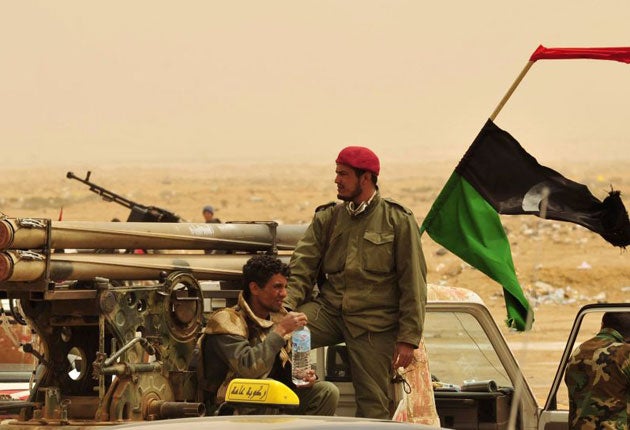
Most of us have a low feeling that we are not being told the real reasons for the war in Libya. David Cameron's instinctive response to the Arab revolutions was to jump on a plane and tour the palaces of the region's dictators selling them the most hi-tech weapons of repression available. Nicolas Sarkozy's instinctive response to the Arab revolutions was to offer urgent aid to the Tunisian tyrant in crushing his people. Barack Obama's instinctive response to the Arab revolutions was to refuse to trim the billions in aid going to Hosni Mubarak and his murderous secret police, and for his Vice-President to declare: "I would not refer to him as a dictator."
Yet now we are told that these people have turned into the armed wing of Amnesty International. They are bombing Libya because they can't bear for innocent people to be tyrannised, by the tyrants they were arming and funding for years. As Obama put it: "Some nations may be able to turn a blind eye to atrocities in other countries. The United States of America is different". There was a time, a decade ago, when I took this rhetoric at face value. But I can't now. The best guide through this confusion is to look at two other wars our government is currently deeply involved in – because they show that the claims made for this bombing campaign can't be true.
Imagine a distant leader killed more than 2,000 innocent people, and his military commanders responded to evidence that they were civilians by joking that the victims "were not the local men's glee club". Imagine one of the innocent survivors appeared on television, amid the body parts of his son and brother, and pleaded: "Please. We are human beings. Help us. Don't let them do this." Imagine that polling from the attacked country showed that 90 per cent of the people there said civilians were the main victims and they desperately wanted it to stop. Imagine there was then a huge natural flood, and the leader responded by ramping up the attacks. Imagine the country's most respected democratic and liberal voices were warning that these attacks seriously risked causing the transfer of nuclear material to jihadi groups.
Surely, if we meant what we say about Libya, we would be doing anything to stop such behaviour? Wouldn't we be imposing a no-fly zone, or even invading?
Yet, in this instance, we would have to be imposing a no-fly zone on our own governments. Since 2004, the US – with European support – has been sending unmanned robot-planes into Pakistan to illegally bomb its territory in precisely this way. Barack Obama has massively intensified this policy.
His administration claims they are killing al-Qa'ida. But there are several flaws in this argument. The intelligence guiding their bombs about who is actually a jihadi is so poor that, for six months, Nato held top-level negotiations with a man who claimed to be the head of the Taliban – only for him to later admit he was a random Pakistani grocer who knew nothing about the organisation. He just wanted some baksheesh. The US's own former senior military advisers admit that even when the intel is accurate, for every one jihadi they kill, as many as 50 innocent people die. And almost everyone in Pakistan believes these attacks are actually increasing the number of jihadis, by making young men so angry at the killing of their families they queue to sign up.
The country's leading nuclear scientist, Professor Pervez Hoodbhoy, warns me it is even more dangerous still. He says there is a significant danger that these attacks are spreading so much rage and hatred through the country that it materially increases the chances of the people guarding the country’s nuclear weapons smuggling fissile material out to jihadi groups.
So one of the country's best writers, Fatima Bhutto, tells me: "In Pakistan, when we hear Obama's rhetoric on Libya, we can only laugh. If he was worried about the pointless massacre of innocent civilians, there would be an easy first step for him: stop doing it yourself, in my country."
The war in the Congo is the deadliest war since Adolf Hitler marched across Europe. When I reported on it, I saw the worst things I could have ever conceived of: armies of drugged and mutilated children, women who had been gang-raped and shot in the vagina. Over five million people have been killed so far – and the trail of blood runs directly to your mobile phone and mine.
The major UN investigation into the war explained how it happened. They said bluntly and factually that "armies of business" had invaded Congo to pillage its resources and sell them to the knowing West. The most valuable loot is coltan, which is used to make the metal in our mobile phones and games consoles and laptops. The "armies of business" fought and killed to control the mines and send it to us. The UN listed some of the major Western corporations fuelling this trade, and said if they were stopped, it would largely end the war.
Last year, after a decade, the US finally passed legislation that was – in theory, at least – supposed to deal with this. As I explain in the forthcoming BBC Radio 4 programme 4Thought, it outlined an entirely voluntary system to trace who was buying coltan and other conflict minerals from the mass murderers, and so driving the war. (There are plenty of other places we can get coltan from, although it's slightly more expensive.) The State Department was asked to draw up some kind of punishment for transgressors, and given 140 days to do it.
Now the deadline has passed. What's the punishment? It turns out the State Department didn't have the time or inclination to draft anything. Maybe it was too busy preparing to bomb Libya, because – obviously – it can't tolerate the killing of innocent people. (Britain and other European countries have been exactly the same.) Here was a chance to stop the worst violence against civilians in the world that didn't require any bombs, or violence of our own. If the rhetoric about Libya was sincere, this was a no-brainer. It would only cost a few corporations some money – and they refuse to do it. So the worst war since 1945 goes on.
This all went unreported. By contrast, when the Congolese government recently nationalized a mine belonging to US and British corporations, there was a fire-burst of fury in the press. You can kill five million people and we'll politely look away; but take away the property of rich people, and we get really angry.
Doesn't this cast a different light on the Libya debate? We are pushed every day by the media to look at the (usually very real) abuses by our country's enemies and ask: "What can we do?" We are almost never prompted to look at the equally real and equally huge abuses by our own country, its allies and its corporations – which we have much more control over – and ask the same question.
So the good and decent impulse of ordinary people - to protect their fellow human beings - is manipulated. If you are interested in human rights only when it tells you a comforting story about your nation's power, then you are not really interested in human rights at all.
David Cameron says "just because we can't intervene everywhere, doesn't mean we shouldn't intervene somewhere." But this misses the point. While "we" are intervening to cause horrific harm to civilians in much of the world, it's plainly false to claim to be driven by a desire to prevent other people behaving very like us.
You could argue that our governments are clearly not driven by humanitarian concerns, but their intervention in Libya did stop a massacre in Ben Gazhi, so we should support it anyway. I understand this argument, which some people I admire have made, and I wrestled with it. It is an argument that you should, in effect, ride the beast of NATO power if it slays other beasts that were about to eat innocent people. This was the argument I made in 2003 about Iraq – that the Bush administration had malign motives, but it would have the positive effect of toppling a horrific dictator, so we should support it. I think almost everyone can see now why this was a disastrous - and, in the end, shameful - argument.
Why? Because any coincidental humanitarian gain in the short term will be eclipsed as soon as the local population clash with the real reason for the war. Then our governments will back their renewed vicious repression - just as the US and Britain did in Iraq, with a policy of effectively sanctioning the resumption of torture when the population became uppity and objected to the occupation.
So why are our governments really bombing Libya? We won't know for sure until the declassified documents come out many years from now. But Bill Richardson, the former US energy secretary who served as US ambassador to the UN, is probably right when he says: "There's another interest, and that's energy... Libya is among the 10 top oil producers in the world. You can almost say that the gas prices in the US going up have probably happened because of a stoppage of Libyan oil production... So this is not an insignificant country, and I think our involvement is justified."
For the first time in more than 60 years, Western control over the world's biggest pots of oil was being rocked by a series of revolutions our governments couldn't control. The most plausible explanation is that this is a way of asserting raw Western power, and trying to arrange the fallout in our favour. But if you are still convinced our governments are acting for humanitarian reasons, I've got a round-trip plane ticket for you to some rubble in Pakistan and Congo. The people there would love to hear your argument.
Join our commenting forum
Join thought-provoking conversations, follow other Independent readers and see their replies
Comments
Bookmark popover
Removed from bookmarks