John Kampfner: For Russia and China, the Arab Spring only offers a warning
Russia has benefited hugely from trade deals with Syria. It is its main weapons supplier
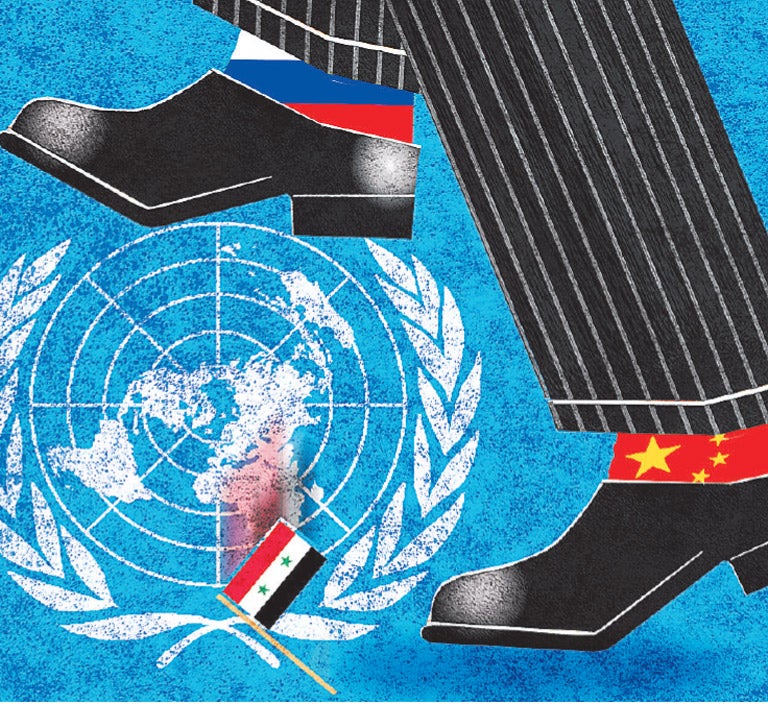
At least the authoritarian regimes have the benefit of clarity. They know what they don't want. Everyone knows where they are coming from. The only surprise about this weekend vote at the United Nations, with Russia and China vetoing a motion condemning the Assad regime's violent repression in Syria, is that anyone is surprised.
Beijing's approach to diplomacy, while less strident than Moscow's, is transparent – an onus on state-imposed "stability", hard-headed national economic benefit and non-interference. From the suppression of dissent to trading partnerships with emerging powers, China is dismissive of what it regards as Western priorities at the UN.
Its global power insulates it from the wrath of the United States. Not so Russia, a former superpower with delusions of grandeur and an iron will. The fury expressed by US diplomats appeared genuine – "disgusted" was the word used by US Ambassador to the UN, Susan Rice. Hillary Clinton had tried to persuade the Russians to take a more emollient line when she met senior figures at the Munich security conference, but to no avail.
President-to-be Vladimir Putin has several reasons to stick it to the Americans. Russia has for decades benefited hugely from trade deals with Syria. It is the country's main weapons supplier, with contracts worth at least $3bn, including anti-ship cruise missiles, fighter jets and short-range air-defence systems. A major shipment was delivered only a few weeks ago, while three Russian warships visited the port of Tartous in what a former navy chief said was a show of force to discourage NATO involvement in Syria.
Tomorrow's visit to Damascus by Russia's Foreign Minister, Sergei Lavrov, is designed to demonstrate that there is an alternative to Western "belligerence". It is possible that Russia will try to put together a Syrian transition deal like the one that forced the departure of Yemen's president, Ali Abdullah Saleh.
The second cause of Russia's defiance is Libya. They felt they were double-crossed by the UN resolution, from which they agreed to abstain, rather than veto. Putin's hard-nut crowd seethed at what they saw as the gullibility of President Medvedev. What was supposed to be a no-fly zone became a full-scale military attack, with NATO airstrikes clearing the way for a land advance which eventually drove Colonel Gaddafi from power.
This, in Russia's characteristic world-view of grievance, was only the latest example of deceit by the West. When, after 9/11, Putin allowed the Americans to borrow bases in Uzbekistan and elsewhere in Central Asia for the war in Afghanistan he expected some form of quid pro quo. Instead he got the "colour" revolutions in Georgia and Ukraine.
All of this plays into Russia's increasingly fraught domestic politics. Next month's presidential elections may well lead to a dangerous upsurge in protest by the small but significant minority despairing of the perpetual rule by Putin and his exceedingly rich cronies. As in the recent parliamentary elections, everything will be done to secure only one result – skewing television coverage, threatening opposition candidates, pressurising voters to do their patriotic duty, and, if necessary, stuffing ballots.
Once restored to the top job (not that he ever really left it), Putin will seek to guarantee himself unrivalled power for the next decade and more. The fear is that the targeted intimidation by his security forces will be replaced by serious bloodshed if crowds take to the streets. Putin was, for a fleeting moment early last decade, open to blandishments from the West. Not now. He knows that this sense of grievance plays well among voters – not the "middle-class" effete protesters he so disparages – but the hardy loyal Russians he insists constitute a clear majority.
After March, along with a further domestic clampdown, Western governments can expect an escalation of Russian rhetoric and the tension. If Israel attacks Iran's nuclear programme – something the US Defence Secretary last week suggested was now very close – the consequences for international relations will be dire. The Russians, however, will comfort themselves that the oil price will soar.
So what can the West do, particularly in Syria? The short answer is not very much. With Assad's forces killing hundreds in Homs, the omens are grim. Assad will feel emboldened by Russia and China's vetoes and the West's haplessness. He knows that external military action is almost impossible and that his only chance of survival is the use of force.
Western support for the opposition will increase. Here lies the rub. In any post-Assad Syria, the various Islamist factions would see their power increase. It has happened in Egypt, Tunisia and Libya, although there the constellation remains unclear, just as the stability of the democratic settlement remains shaky. There is nothing ignoble in this. The idea that countries which have lived under dictatorship for decades can suddenly emerge into a brave new world of democracy, stability and economic progress was always the stuff of fantasy. It would always take more than one "spring" to get there.
Just as the Russians and Chinese know what they don't want, the Americans in particular, and the West in general, struggle to know what they do want. As events of the past two decades show, liberal interventionism has been, to put it politely, less than consistent. As for promoting democracy, the West struggles to define it. Does it mean allowing the peoples of each country to decide their own fate? Or does it suggest, as in the Palestinian elections in 2006, the purpose is to produce the West's desired outcome?
Questions such as these are not going to be answered quickly, if at all. They weaken complaints about the brutality of dictators, but they do not render them null and void. For all the inconsistencies and hypocrisy of Western behaviour, the position taken at the UN was laudable. The hope, if not the expectation, is that even after the reprehensible Russian and Chinese vetoes, Assad's regime will implode as his own people summon yet greater strength to stand up.
Join our commenting forum
Join thought-provoking conversations, follow other Independent readers and see their replies
Comments
Bookmark popover
Removed from bookmarks