Joss Garman: We need to talk about the planet
The three largest parties agree climate change is important. But their shiny green consensus is alarmingly lacking in urgency
The world-leading climate scientist Professor James Hansen of Nasa, said recently, "The predominant moral issue of the 21st century, almost surely, will be climate change, comparable to Nazism faced by Churchill in the 20th century and slavery faced by Lincoln in the 19th century. Our fossil fuel addiction, if unabated, threatens our children and grandchildren, and most species on the planet." When it comes to this climate crisis, the next crop of politicians will be a key determinant in whether or not we solve it.
Since most climate scientists agree we need global emissions to peak and start to go down in the next decade, the next government will decide on whether we slash pollution and build a new, clean energy economy, or instead continue with the dirty industries of the past. Yet judging by the election campaign so far, you could be forgiven for thinking the level of National Insurance or the outfits of our leaders' wives, is the issue that defines our generation. The IoS's poll today shows 59 per cent of voters think the environment is being ignored in this election.
With a third of our power stations coming offline, Britain is at an energy crossroads and the next government will direct the billions of investment flow that will inevitably be needed to keep the lights on. Either we'll see it go into more of the same dirty fossil fuel power stations, or it will go into clean energy sources. This, in turn, has huge implications for our nation's carbon footprint – but also for our energy security, our economy and our energy bills. You might think it would merit a bit more discussion on the campaign trail; especially as clean energy is so popular with voters. A YouGov poll last week found that two-thirds of us agree the next government should boost investment in green industries. So why does it go undiscussed?
All three main party leaders have described the need to deal with the rapid shifts in our climate as "the great challenge of this generation". But do we know if any of them have a strategy and a vision to address it?
Take cleaning up the power sector. In his State of the Union address, President Obama recognised what's at stake: "The nation that leads the clean energy economy will be the nation that leads the global economy." China's £34bn investment into clean technology speaks for itself. The economic benefits on offer from these new global markets are clear. If politicians choose to push ahead and make sure we hit our renewable energy target to produce 15 per cent of our heat, transport and electricity fuels from renewable sources by 2020, it will lead to the creation of about 70,000 new jobs and carry a net economic worth of roughly £65bn over the next 40 years. According to Ofgem, ending our reliance on dirty fuels would also benefit consumers through cheaper energy bills. But first, more than £150bn will need to be invested in energy infrastructure and efficiency measures in the next 10 years. That's a staggering investment, unprecedented in modern British history, just when we're told we need drastic cuts in public spending. So how will they square the circle?
On the face of it, there is cross-party agreement. All three main parties say we should create a new infrastructure investment bank to fund energy projects. That certainly sounds good, and made headlines when first Vince Cable, then George Osborne, and finally Alistair Darling, announced they would make it happen. But at a time of austerity, would this be the first new bank with no money in it?
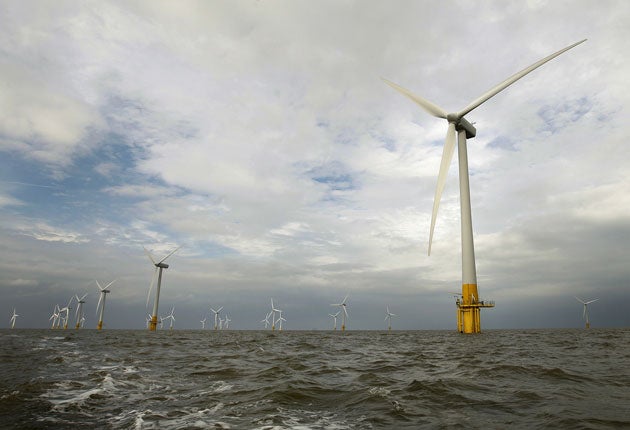
On Monday, Nick Clegg announced he would plough £3.1bn into a fresh green stimulus, including £400m to re-purpose our shipyards for the offshore wind industry. That's more than twice what Labour has promised and three times the Tories' offer. Alistair Darling put forward £1bn for the new infrastructure bank, plus £60m for the upgrade of ports on the east coast to accommodate the new wind energy industry, and to help to leverage another billion in private equity. In contrast, there has been no assurance from David Cameron on protecting or increasing clean energy spending – only ideas to reshuffle existing funds. None of the three parties is pledging the sort of money most energy experts agree will be needed to make the green switch, and no one is explaining how they would leverage funds from private sources such as pension and sovereign funds either.
Yet Labour's relatively tiny cash injection is already beginning to assist our economic recovery. Siemens reacted to the announcement by putting up £75m for a new wind factory with the creation of 700 new jobs, plus 1,500 further down the supply chain. It said that it wouldn't have done this without the new money. General Electric, too, put up £100m and proposed the creation of 2,000 new jobs by 2020, to produce hundreds of wind turbines. There have been similar announcements from Mitsubishi and Clipper. Since nearly all of the companies leading the global clean-tech race are American, Chinese and German, their investment will be at risk without public money. Companies need incentives to come here.
Going green is also about regulation. The Government's advisers, the Committee on Climate Change, argue that unless all coal power plants are operating with fully functioning carbon capture and storage (CCS) technology by the early 2020s, we will not hit the targets outlined in the Climate Change Act. Equally, the committee says we'll need to constrain the demand for flights – we cannot rely on erupting volcanoes. Here, the Conservatives and Lib Dems do better. David Cameron and Nick Clegg have both ruled out new runways at Heathrow, Gatwick and Stansted, and have championed new emissions standards for power stations to stop the most polluting coal plants. But behind the shiny green consensus, even the Conservative leadership is pretty mealy-mouthed about Britain hitting its clean energy target.
According to one poll, only 7 per cent of Tory candidates support onshore wind farms, despite around 80 per cent support for them from the public. Scepticism about the climate science is rife in the party at large. Cameron might need to rely on opposition parties to ensure his climate polices didn't get derailed altogether. Meanwhile, neither Labour nor the Lib Dems can explain how they would raise the investment for a green transition – there is a multibillion-pound black hole that none is being asked to explain.
Those who really "get" climate change are a minority in the three largest parties. That's why for Labour, Ed Miliband's "low carbon transition plan" is the most comprehensive suite of green policies – but why new runways and motorway widening undermine his efforts. The Tories' unique idea to reform the rules that currently force us to destroy the rainforests to put biofuels in our petrol tanks, deserves credit – but where's the support for clean energy? The Lib Dems offer deeper carbon cuts and easily the most progressive policies of the three, overall – but they still want to exploit every drop of North Sea oil.
The truth is that none of the political parties have the policies that will cut emissions as deeply as scientists such as Professor Hansen suggest we need to – and that, surely, is something we need to talk about.
Join our commenting forum
Join thought-provoking conversations, follow other Independent readers and see their replies
Comments
Bookmark popover
Removed from bookmarks