Kim Sengupta: Throwing cash at a corrupt government shows how the West is desperate for an exit
The Afghan military 'being responsible' does not mean Western troops will be out of the country in four years
The projected image was of international statesmen gathering in solidarity with an Afghanistan marching forward. But the alacrity with which they headed for their planes after spending the briefest of times in Kabul seemed to mirror the West's haste to get on the exit route from this costly war.
There had, in the many previous conferences on Afghanistan's future, been an air of expectation and even optimism. But the gathering for the "Kabul process" was permeated with an undercurrent of past disappointments and trepidation for the future.
The pledges made, already well-trailed, were trotted out without much conviction, the declaration of support for Hamid Karzai who had been accused by some of his Western backers of stealing last year's election, delivered with little enthusiasm. Nine years after the fall of the Taliban, Hillary Clinton, the US Secretary of State, talked of the road ahead "being full of challenges" and "questions by many on whether success was even possible".
So what did really come out of this "landmark" summit? Some are aspirations which may not be fulfilled, others proposals which may indeed lead to more concrete measures but are also full of potential pitfalls. All the measures, however, are meant to point the way for the US and European countries to withdraw from the conflict. Mr Karzai declared that Afghan security forces would "be responsible" for providing security by 2014, at the same time a programme of "reintegration" of Taliban fighters would get under way, subsidised by $180bn (£118bn) from the West.
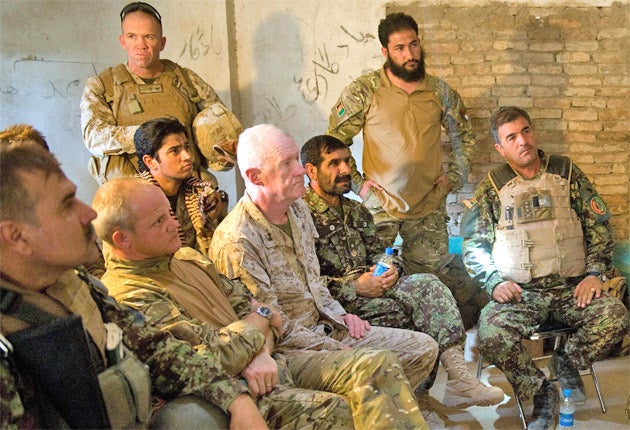
At the same time the Afghan President would like at least half of the massive amount of international aid pouring into the country – $40bn so far – to be put through his government rather than, as has been happening, donor countries directly funding projects. The President stated, not for the first time, that he did indeed intend to root out corruption and a tribunal would be set up for this. However, the Afghan military "being responsible" does not mean British and Western troops would be out of the country in four years. I accompanied Afghan troops in the first such operation, "Omid Du", last week and the Afghan force of 680 was accompanied by about 170 British "advisers" and Nato air power. Western and Afghan commanders are in agreement: this type of involvement is likely to continue for a long time.
The reintegration process for the Taliban had long been on the agenda and was bound to get a boost with the arrival of General David Petraeus as head of Nato forces. Petraeus, who took over after the sacking of Stan McChrystal by President Obama, had used fighters who turned in the so-called "Sunni Awakening" to combat the insurgency in Iraq, also with copious amounts of money on offer. The problem is that the reintegration process is being conflated in the eyes of many Afghans with Mr Karzai's new-found enthusiasm for cutting a deal with the insurgents. There is deep anxiety especially among the Tajiks and Uzbeks that this will include hardline Pakistani-backed factions such as the Haqqani network and the Taliban Quetta Shura of Mullah Omar, the head of the former Taliban regime.
These are the forces the Northern Alliance had fought against during the bitter years of the civil war and there are warnings from former commanders that a "sell out" will lead to the return of those days. At the same time there is also deep concern that this will lead to sacrificing human rights, especially female emancipation, which had already been eroded in recent years.
It is, however, a sign of the Obama administration's pressing desire to disengage from the war that it may now waive previous caveats about talks only being held with militant groups which have renounced violence. In the future they will only have to promise to break links with al-Qa'ida.
This desire to make compromises is also echoed in the likelihood that America and Japan, the two biggest aid donors to Afghanistan, may change their position of being in control of aid money by agreeing to pass a large portion of it to the Karzai government in order to "empower" it.
This is particularly remarkable as US Congress recently suspended $4bn in reconstruction funding, followed by similar action from the European Union on a $200m annual subsidy after evidence of widespread graft by officials. But, in the desperate attempt to find a way out of the conflict, vast sums are likely to be handed over to a government labelled by international watchdogs as one of the most corrupt in the world.
Join our commenting forum
Join thought-provoking conversations, follow other Independent readers and see their replies
Comments