Just stop trying to end child poverty
Notebook
Much cooing across the nation, I've no doubt, at the photos of a devoted David Cameron and baby Florence – though you might want to ask why we didn't get to see Samantha, too. Maybe No 10 did not want to present too conventionally perfect a picture of family bliss, lest it be deemed to imply criticism of others, single parents, for instance, at a time when families of all kinds fear the effect of "the cuts".
Not that the Camerons will need to worry about tax credits (to be withdrawn from mid- and higher earners), or child allowance (which stays for everyone), or the Child Trust Fund (they surely have their own). Whatever turn her father's political fortunes may take, Florence Rose Endellion will grow up a very privileged little girl. It's those at the other end of the scale the taxpayers need to worry about.
I wonder, though, whether we need to worry about these children quite as much as their advocates would like us to, at least in the narrowly financial way they present it. "Child poverty" is the leitmotif of every "cuts" story. And it was again last week, when the trusted Institute for Fiscal Studies published a study for the End Child Poverty campaign, saying pretty much what it wanted to hear: that George Osborne's emergency Budget, if you projected the effects far enough ahead, was harder on those at the bottom than at the top, and hardest of all on those with children.
In fact, any rebalancing – the new catchphrase – is almost bound to subtract just a little from children, because the childless among us were among those most conspicuously omitted from the previous government's largesse. As Chancellor and then Prime Minister, Gordon Brown held to the admirable principle that, so far as possible, no child should be at a disadvantage because of parental poverty. Having a child now attracts all sorts of benefits, quite far up the income scale. In fact, for someone without a partner and/or work, a child can be quite a valuable addition, if you look at what else comes too: housing points, higher housing benefit and, for mothers, no obligation to work.
You can say that this is as it should be, and that some of the scams it encourages – the fathers who see babies as cash-cows; those who bring an unrelated child into the country as a passport to extra benefits – are few and far between. On the other side, though, I think, something has been lost: there is now no disincentive to bringing a child into the world in unpropitious circumstances.
There used to be a moral stigma: that has gone. But the economic deterrent has largely vanished, too. So long as young women or workless households are no worse off having children, and in many cases better off, hopes of reducing child poverty – except through expensive state intervention – are vain. I'm not saying that poor parents should not have children. I am saying that, unless there is a cost attached to having a child – for everyone, rich or poor, in work or out – the unintended consequence of trying to end child poverty will be more babies, not fewer, born poor.
Joanna Lumley v The Ministry of Defence – round two
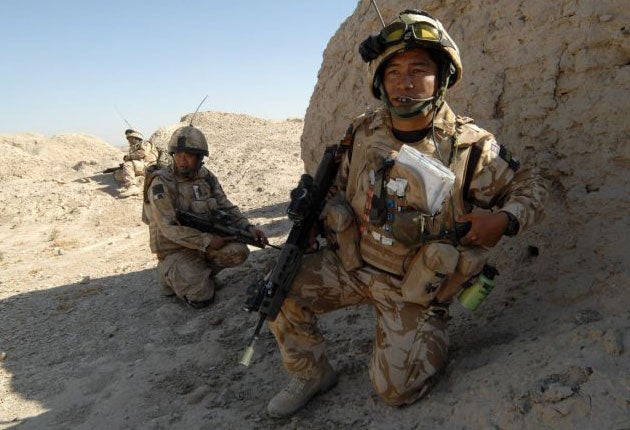
It's not just children facing the unintended consequences of an action that was designed to help. The Gurkhas, who won the right to retire to the UK after a tear-jerking social justice campaign waged by Joanna Lumley, are now threatened with being disbanded after almost 200 years of fierce and loyal service to the Crown.
In a defence review required to think the unthinkable, this option is entirely thinkable. After all, what is a post-imperial nation doing recruiting soldiers from another sovereign state? Should not young Nepalese be fighting for Nepal? But that, alas, is not the reason why the Gurkha regiment may be doomed. By qualifying for UK retirement, for themselves and their (often large) families, the Gurkhas have crossed from the credit to the debit column. In seeking to do the right thing by her father's saviours, Ms Lumley may well have closed off a source of security for Nepalese families. Will she, I wonder, be fronting a new campaign, to save the Gurkhas?
Yes, foreign languages are hard, and they don't pay
This year's exam results demonstrate once again that, as a Briton competent in several foreign languages, I belong to an endangered species. As such, I might be expected to take issue with those who question the usefulness for native English speakers of learning a foreign language – including recent letter-writers to this newspaper. But to all those linguists who wrote protesting that they had drawn no benefit from their hard-won skills, I can only say: I agree.
I'm one of relatively few of my contemporaries to have used my languages professionally. Has my languages degree paid off? Personally, of course, it's a cultural and social plus. Professionally? It can work almost as a trap. You become the tame – unpaid – office and social translator. Monolingual reporters posted abroad (oh yes they are) receive an allowance for interpreting. I've never been paid more for not needing one – and, yes, I did have the nerve to ask. Many employers treat languages as a free luxury, not a necessity to be rewarded at a professional rate.
The only way to change this is to make competence in a foreign language a requirement for university entrance, and enforce it. That would send the message that familiarity with another language is integral to a decent education. Until that happens, the monoglot majority will continue to laugh off their linguistic incompetence in the same way people joke about being bad at maths – and then turn to you, with a sense of entitlement, when they're hungry and can't understand the menu.
Join our commenting forum
Join thought-provoking conversations, follow other Independent readers and see their replies
Comments
Bookmark popover
Removed from bookmarks