Nawal Fenwick: I believed nothing could be worse than Saddam's regime. I was wrong
After 20 years away, she returned to find a nation full of questions that she doubts any inquiry will ever answer
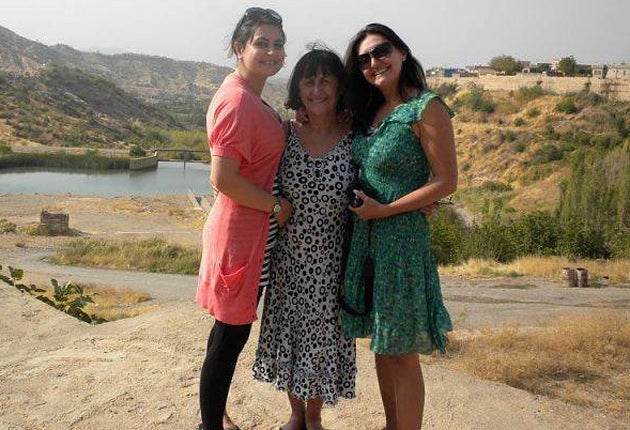
I knew going back to my country of birth would be emotional. I had not seen my family for 20 years. I had hoped that after all the bloodshed and violence, there might be some positive signs. Unlike many, I was not against the war in 2003; neither were my family. We thought there was a proper post-invasion plan. And we believed nothing could be worse than Saddam Hussein's regime. We were wrong on both counts. Seven years later, there still seems little in Iraq to be hopeful about.
I left Baghdad and came to this country to study in 1963. I later married and stayed; I feel Britain is my home. Over the years, I have watched my old country from afar, on television, being crippled first by a brutal dictator, his wars with Iran, his invasion of Kuwait, then by UN sanctions and the war that followed.
I went back because I wanted to see my older brothers before they die. And I wanted my two daughters to meet their relatives. All of them have now been driven out of their homes in Baghdad's "red zone", due to poor security and utilities. Without exception their stories were harrowing.
My brother's home was taken over by insurgents and we were told that a murder took place inside. My sister-in-law died because by the time they got permission to take her to hospital during the night-time curfews in Baghdad, it was too late. My other brother's family home now stands empty, regularly hit by ill-directed insurgent rockets fired from Sadr City towards the nearby Department of Security. My nieces spoke of women they know who have been attacked for not covering their heads.
All of this ruled out our visiting Baghdad. We were told our British passports would have made us certain kidnap targets. So we flew to the Kurdish north. My family are now dispersed all over the world – Jordan, USA, Scandinavia – and in northern Iraq. They left because of the lack of security after the 2003 invasion. Many would consider them fortunate. But all of them miss Baghdad.
My brothers desperately wish it was safe enough to return so they can live and die in their own land, not as a stranger in a foreign country. For them, being abroad is like prison. They can't speak the language; they don't know the system. They are lonely and their still-active minds are slowly deteriorating as a result of having very little to do.
The 2003 invasion made my brothers the third generation of refugees in our family. Back in 1915, my father escaped south-east Turkey, after his parents were shot in front of him. We are Syrian Orthodox Christians and at that time the Ottomans and Kurds in that area had begun to massacre the Christian communities. My father, who was just 10, walked hundreds of miles, hand in hand with his 12-year-old sister, following the river to safety and finally arriving in Mosul in Iraq.
In 1948, an arrest warrant was issued for my cousin, who had been active in student politics. The women in the family mobilised, creating a network across the country to get him out of Iraq. He got himself to Brazil where he began by selling flip- flops from a wheelbarrow and later made his fortune.
Hearing these stories as we grew up, we didn't know that there would be yet more fleeing from unrest. In the past seven years, my relatives have again been forced to plan escape routes. I cannot tell you how depressing it is to see such a close family so broken and scattered. But even more depressing than that is what has happened to women in Iraq since the invasion. Blair and Bush perhaps didn't foresee the consequence of creating a political vacuum after removing Saddam. It has largely been filled with religious sectarianism and women's rights have regressed in the process.
My nieces told me about women who had had their throats cut for not covering their heads. In one case, they told me, a female doctor was murdered for going to work. These might be extreme cases but it shows the trend away from the moderate.
Saddam Hussein, for all his evils, was relatively secular. I was in high school in the early 1960s in Baghdad. I was friends with girls from different religions and sects. Nobody wore their faith on their sleeves back then; there wasn't a headscarf in sight. Yet now in the streets of every town through which we travelled, we saw girls as young as 10 covering their heads. In her day, my mother campaigned for women not to have to wear the abbaya – I'm glad she is no longer here to realise her battle was in vain.
My family, like most educated Iraqis, aspire to Western freedoms and have always longed to live under the rule of law in a country that respects human rights, democracy and free speech. But now they just despair at the mess and, depressingly, even they feel that life under Saddam was preferable to the present situation. Under Saddam, they told me, they weren't free but they knew how to stay out of trouble. Now there may be elections, but everyone lives in fear of where and when the next car bomb will strike. They do recognise that the vast majority of violence in their country comes from insurgents, not foreign troops. But there is still growing anger towards Britain and America for creating the situation and for impacting their lives. This feeling is replicated in thousands of households across Iraq.
When my sister-in-law died, her relatives, scattered around the globe, were unable to attend her funeral. Since the invasion, they say, they cannot even bury their dead properly. My niece, who lived in Basra before moving to the north, told me that whenever there was an explosion or a tip-off about a bomb, the British soldiers would blow up all the cars on the street to be on the safe side. No compensation, of course, and Iraqis would simply watch their property going up in smoke. It is these seemingly disproportionate acts and a feeling of powerlessness in their own country that frustrate ordinary people.
I heard stories of UK and US troops smashing down doors and breaking windows to search houses, after ignoring the offer of keys. Of course, these accounts are all hard to confirm and I have no doubt the soldiers involved would have been desperately frightened, having seen friends die and not knowing who to trust. But such stories of gung-ho attitudes, and worse still, abuse, have left many Iraqi people at best disgruntled, at worst full of hatred.
On the positive side, our friends told us, people can now openly criticise the government without being jailed. This was unheard of before 2003. There are also elections scheduled for March. But these achievements are overshadowed by day-to-day realities. As one taxi driver put it, you can't eat and drink freedom of speech, and it doesn't produce regular electricity and clean water. '
Throughout my trip, I was asked the same two questions over and over again by friends, relatives and strangers: why did Britain and America launch the invasion? And what gains have been made that can be measured against the loss of thousands of young US and British lives and hundreds of thousands of Iraqis? I am saddened to say I could not give them any answers. And as I watch the Chilcot inquiry unfold, I wonder if indeed there will ever be any.
Join our commenting forum
Join thought-provoking conversations, follow other Independent readers and see their replies
Comments
Bookmark popover
Removed from bookmarks