Nicolas Bratza: Britain should be defending European justice, not attacking it
It is unfortunate that the issue of prisoners' votes has been used as a springboard for attack

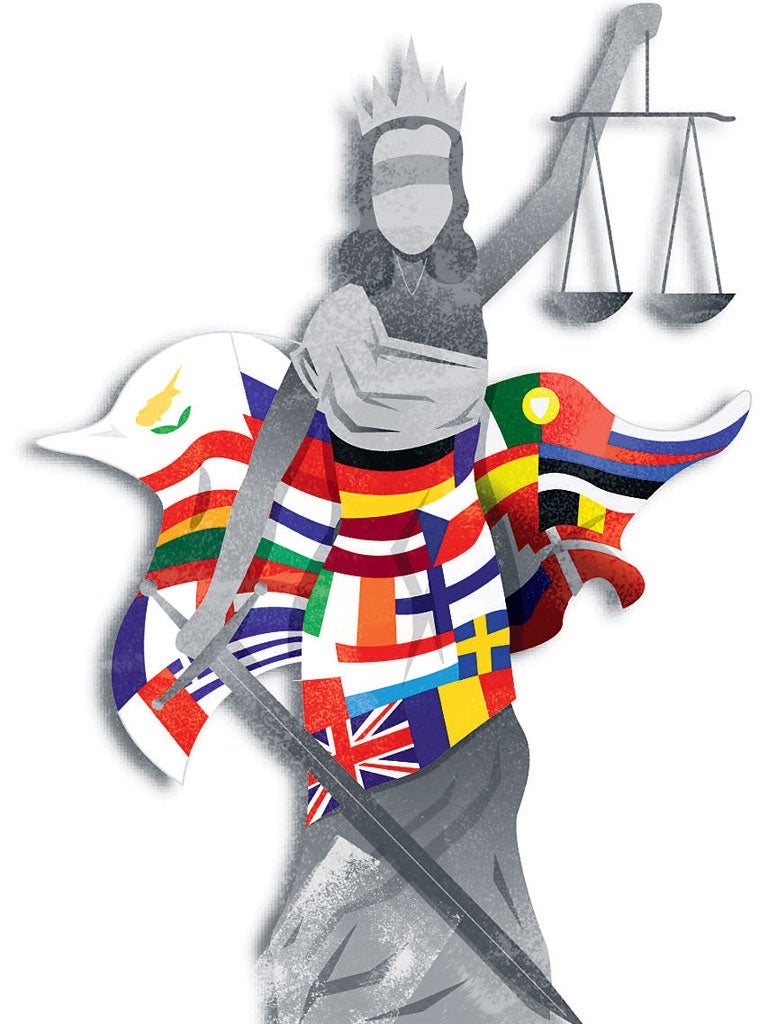
The United Kingdom's contribution to the European Convention on Human Rights has been immense. British parliamentarians and lawyers played a key role in its conception and its drafting. British lawyers and, since the entry into force of the Human Rights Act, British courts have exerted a major influence on the way in which the convention evolves. This judicial dialogue is a key element in the proper operation of the convention, in which the role of national courts is critical.
At the same time, the influence of the Strasbourg court on the development of fundamental rights protection in the UK has been overwhelmingly positive. It would, however, be surprising if all its decisions were popular with the Government of the day, or indeed understood and accepted by public opinion.
Yet, looking back at the landmark cases concerning Britain, few people today would dispute Strasbourg's 1978 ruling that the birching of a Manx schoolboy as a criminal sanction was unacceptable. Few would contest that the rules on contempt of court in operation at the time of the Thalidomide case were unsatisfactory, or deny that a journalist's right to protect his sources is a cornerstone of a free press.
Nor does it seems strange in 2011 to suggest that child perpetrators, even of the most heinous offences, like the Jamie Bulger killers, should not be tried in an adult court. Rulings on the legal recognition of transsexuals and the lifting of the ban on homosexuals in the armed forces meanwhile, are surely examples of where domestic UK law was lagging behind societal changes and was brought up to date as a direct consequence of the court's judgments. More recently, the finding that the indefinite retention of DNA samples of persons never convicted of an offence violated the right to private life, was widely applauded in British political and legal circles.
There are many other examples concerning the UK, but, of course, the court's jurisdiction extends to 46 other European states, covering a total population of 800 million. The court has overseen the slow but steady consolidation of the rule of law and democracy in Central and Eastern Europe. Much remains to be done, but the court can be proud of what it has achieved over the past 10 years. It has all but eliminated practices in many former communist countries which undermined the rule of law, such as the power of the executive to reopen court proceedings ad infinitum until the "right" result was achieved. The freedom of association of minority groups in the Balkans has been upheld. Its judgments have prompted greater awareness of the problems facing Roma and their right to be protected against pogroms and police brutality are now being addressed. Freedom of religion has been established in many previously intolerant countries. Journalists no longer face criminal sanctions when they criticise politicians. Homosexuality has been decriminalised across Europe. The victims of domestic violence and trafficking are increasingly receiving enhanced protection.
Two principal criticisms of the court have been voiced in Britain in recent years – that it has allowed a backlog of cases to grow to the point that it has currently more than 150,000 pending cases; and that it has shown itself too ready to interfere with domestic decision-making by substituting its own view for that of national courts and authorities.
With the accession to the convention of new states, the court has indeed had to deal with a massive increase in its caseload. The backlog is not, as has often been suggested, the result of inefficiency. The volume of incoming cases has risen on average by 10 per cent a year since 1998. In 2011, the court decided more than 52,000 cases; however, in the same year it received more than 64,000 new applications. It is a regrettable fact that more than 30,000 of the pending cases relate to repetitive violations of the convention by member states which have failed to remedy an underlying systemic problem previously identified by the court. The backlog has understandably led to calls for reform, but reforming an institution set up by international treaty is a slow and complex process. An amending protocol which came into force in 2010 reduced the number of judges required to adjudicate the most straightforward cases. Further reform is being discussed under the UK chairmanship of the Council of Europe's Committee of Ministers.
The criticism relating to interference is simply not borne out by the facts. The Strasbourg court has been particularly respectful of decisions emanating from courts in the UK since the coming into effect of the Human Rights Act, and this because of the very high quality of those judgments. To take 2011 as the most recent example: of the 955 applications against the UK decided, the court found a violation of the convention in just eight cases.
In the context of reform, the court itself has sought new solutions. It has rationalised procedures to maximise relatively scarce resources. Thus, it has established a pilot judgment procedure for structural or systemic violations generating the large numbers of repetitive cases. It has adopted a prioritisation policy and has used the new single judge procedure to great effect, achieving an increase of more than 30 per cent in the number of applications dealt with in this way in 2011.
There are, therefore, reasons for optimism, not only because the court's judgments continue to help to maintain and improve human rights standards throughout the wider Europe, but also because the seemingly insuperable problem posed by the sheer quantity of cases appears less daunting than a few years ago.
Against this background, it is disappointing to hear senior British politicians lending their voices to criticisms more frequently heard in the popular press, often based on a misunderstanding of the court's role and history, and of the legal issues at stake. It is particularly unfortunate that a single judgment of the court on a case relating to UK prisoners' voting rights, which was delivered in 2005 and has still not been implemented, has been used as the springboard for a sustained attack on the court and has led to repeated calls for the granting of powers of Parliament to override judgments of the court against the UK, and even for the withdrawal of the UK from the convention.
The European Court of Human Rights is an institution of inestimable value not just for Europeans, but for all those who throughout the world look to its judgments for guidance, and particularly those who do not have the benefit of democratic institutions operating within the rule of law. The UK can be proud of its real contribution to this unique system and its influence in bringing about effective human rights protection throughout the European continent. It would be deeply regrettable if it were to allow its commitment to that system to be called into question by a failure to defend it against its detractors or to offer its strong support for the vital work of the court.
Sir Nicolas Bratza is President of the European Court of Human Rights
* Europe's top judge: Cameron is wrong about human rights
* Nicolas Bratza: Britain should be defending European justice, not attacking it
* Leading article: Mr Cameron must act the statesman in Strasbourg
Join our commenting forum
Join thought-provoking conversations, follow other Independent readers and see their replies
Comments
Bookmark popover
Removed from bookmarks