Paddy Ashdown: Afghanistan's future lies in strengthening its tribal structures, not in its corrupt government
No one should doubt what the new vote will cost - not just in treasure but in blood
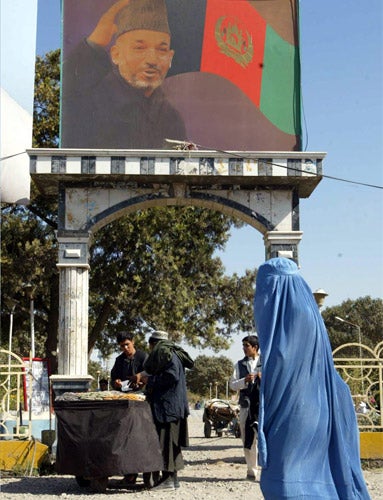
After all the political manoeuvrings in Kabul over the last few months, what do we say to those in Britain who wonder why our young men should be dying for an Afghan President whose support is plummeting – and taking ours with it – because of corruption? For a man whose attempt to get re-elected has been, to say the least, questionable?
That President Hamid Karzai has now reluctantly agreed to accept the findings of the international audit of the recent election and to participate in a run-off vote is clearly to be welcomed. I'm glad, too, that the new elections are going to be held in November and not pushed back into next year.
But no one should be in any doubt what the new vote will cost, not just in treasure but in blood. A new election may do something for President Karzai's legitimacy, but it won't alter the problem he poses if, as Mrs Clinton at least seems to expect, he is re-elected. What then?
Some say that Karzai II must be very different from Karzai I and the international community (and especially Washington) must make sure it is so.
He must be persuaded – whether before or after the run-off – to have a government of national unity (GNU), which would include his main rival in the election, Abdullah Abdullah, and also the representatives of all ethnicities in multi-ethnic Afghanistan. He must then reach out and run an administration for the whole country, rather than one whose primary driver is the Pashtun interest.
Then, Karzai II must at last begin a serious programme to tackle the endemic corruption that is eating away at his support.
This all makes perfect sense and we should certainly try it. But we should be aware that it is far from certain to work. A GNU is precisely what Karzai I started out with. He was genuinely elected by all sections of Afghanistan and his first government was a genuinely national one. President Karzai has not proved very good at holding together broad coalitions and it was not long before his early allies, especially in the Northern Alliance, became his most determined opposition. I am not convinced he would be any more able to make a success of what he so signally failed to make a success of previously.
To ask him to tackle corruption seriously would be to ask him to knock away one of the principle props of his government. He has not proved keen on doing this in the past, despite heavy pressure from the US and others. I am not at all sure that this is likely to change in the future.
So, could we find a more subtle way of responding to the election of President Karzai Mark II? One of the major problems we have faced in Afghanistan is the mismatch between the theory and the practice of Afghan government. Thanks, in large measure, to the intervention of the West, Afghanistan is, in theory, a centralised-governed country in the model of the classic Western nation state. But, in practice, Afghanistan is what it has always been for the last 1,000 years – a deeply decentralised country based around tribal structures.
Could this be the opportunity to tackle that issue head on, by shifting our emphasis from building up Kabul structures, to building up local ones, running with, rather than against, the grain of Afghanistan's tribal system? Next year there are local elections in Afghanistan and these could offer a perfect moment to make this shift of emphasis, by switching much of the aid we are currently pouring in to help President Karzai build up his government, towards increasing the capacity of local and regional government.
This switch could have three fairly immediate beneficial effects. First, it would mean that we were, at last, working with Afghanistan's decentralised and tribal nature. Second, it would deal with the problem of President Karzai, not by rejecting his election but by the simple expedient of making him matter less. I don't suppose we could get to the position of Switzerland – where everyone knows there is a president, but no one knows who it is – but we could at least travel several large steps in that direction.
And lastly, shifting the government towards the local and tribal level would create a much better context for an energetic pursuit of the new policy of "Taliban reconciliation" that everyone, from President Obama down, now seems to recognise has to be a key part of the future mix if we are to begin to turn things round in the country.
When it comes to contemplating a second Karzai presidency in Afghanistan, we have a real chance to turn a problem into an opportunity. We should grasp it.
Lord Ashdown, the former leader of the Liberal Democrats, 1988-1999, was High Representative of the International Community in Bosnia and Herzegovina, 2002-06. He withdrew his nomination as the UN's super envoy to Kabul in January 2008 in the light of opposition from the Afghan government
Join our commenting forum
Join thought-provoking conversations, follow other Independent readers and see their replies
Comments
Bookmark popover
Removed from bookmarks