Patrick Cockburn: President's return moves Yemen nearer to all-out war
World View: Ali Abdullah Saleh's call for a truce after his reappearance in Sanaa is likely to fall on deaf ears, unless he rapidly begins to transfer power

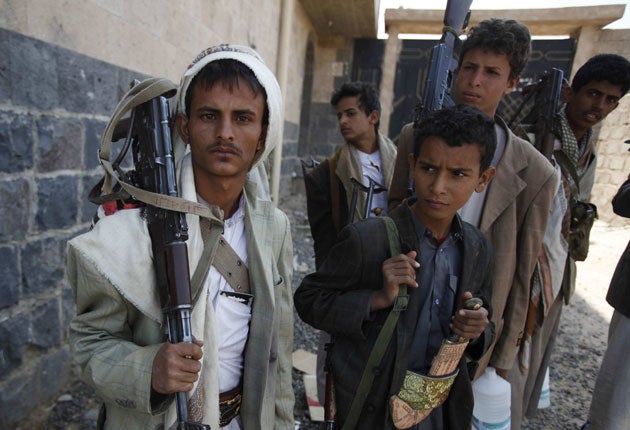
President Ali Abdullah Saleh unexpectedly returned to Yemen yesterday in a move likely to further divide his country and shift it towards all-out civil war.
Mr Saleh made no mention in his statement of any intention of resigning as president, a job he has held for 33 years. But he did call for a truce and a return to negotiations, saying the solution to the eight-month crisis "is not in the barrels of guns and cannon, but in dialogue".
Mr Saleh had been receiving medical treatment in Saudi Arabia for almost four months after he was almost killed in an assassination attempt on 3 June, when the explosion of a bomb or a rocket left him with burns all over his body.
It had been expected that the Saudi government would not let him go back to Yemen unless he promised to hand over power, but at dawn yesterday he returned to the capital, Sanaa, in a private plane.
In the capital, opponents and supporters of Mr Saleh fired their weapons into the air in rage or celebration as news that he was back in the country was dramatically announced on Yemen television.
Both sides, who control different parts of the city, held parallel demonstrations. Supporters chanted "we love you Ali", while protesters shouted "prosecute the killer". He is to give a further speech on Sunday spelling out his intentions.
If Mr Saleh does not start to transfer power to his opponents, ranging from pro-democracy demonstrators in the streets to senior tribal and military leaders, then the crisis in Yemen is likely to worsen rapidly. The long stand-off has already seen Yemen's traditionally weak central state further disintegrate. Food and petrol prices have soared. Nine out of 23 million Yemenis are not getting enough to eat and the number at risk of starvation is increasing, according to the UN.
Mr Saleh's call for a ceasefire and negotiations will be seen as peculiarly hypocritical by protesters since his forces have been responsible for most of the shooting. These include about 100 people killed by snipers and shelling in the past week, with most of the dead hit when they were demonstrating. Hospital doctors treating the wounded said that many suffered from head wounds, indicating that the pro-regime troops were shooting to kill. Mr Saleh engaged in prolonged negotiations before the assassination attempt against him, but balked at the last minute from signing any agreement under which he would step down.
The collapse of the central state and the economy has led UN officials to compare Yemen to Somalia, a country in a permanent state of warfare, but with no faction able to score a decisive victory.
Even before the crisis, Yemen was the Arab world's poorest country with one-third of the labour force unemployed, falling oil revenues and a shortage of water. Yemen has never recovered economically from the expulsion of one million Yemeni workers from Saudi Arabia in 1990-91 because of Yemen's failure to denounce Iraq's invasion of Kuwait.
Mr Saleh showed during his near four months outside Yemen that he does not have to be personally present to hold power and can do so through members of his family. His son, Ahmed Ali Saleh, previously designated as the next president, commands the well-trained Republican Guard units.
But, although the opposition has not been able to dislodge Mr Saleh, he probably does not have the strength to defeat them. Part of Sanaa is held by the tribal militiamen of the powerful Ahmar family and by troops of the First Armoured Division led by General Ali Mohsen, a powerful military figure who defected to the opposition in March, after pro-regime gunmen, shooting from rooftops, killed 52 protesters.
The circumstances of Mr Saleh's return remain something of a mystery since it was expected that Saudi Arabia, backed by the US, would prevent him going back unless he began to transfer power. Given his record of reaching agreements only to refuse to sign them at the last moment, the only peace deal possible is probably one in which he steps down early in the process.
At the same time Mr Saleh has been skilful in the past in manipulating the US by putting himself forward as America's ally against terrorism and, in particular, against Al-Qa'ida in the Arabian Peninsula (AQAP), based in Yemen. This group is only about 300 strong according to Yemeni officials, but pursuing it and trying to kill its leaders is a US priority.
The regime in Sanaa is suspected of withdrawing its troops to allow an AQAP affiliate briefly to capture Zinjibar, the capital of Abyan province in the far south, so as to increase Washington's sense of unease about what would happen if Mr Saleh were no longer president.
Join our commenting forum
Join thought-provoking conversations, follow other Independent readers and see their replies
Comments
Bookmark popover
Removed from bookmarks