Patrick Cockburn: Why must Britain always try to 'punch above her weight'?
World View: Getting sucked into America's wars in Afghanistan and Iraq was the result of our delusions of influence. Now we're repeating the mistakes in Libya
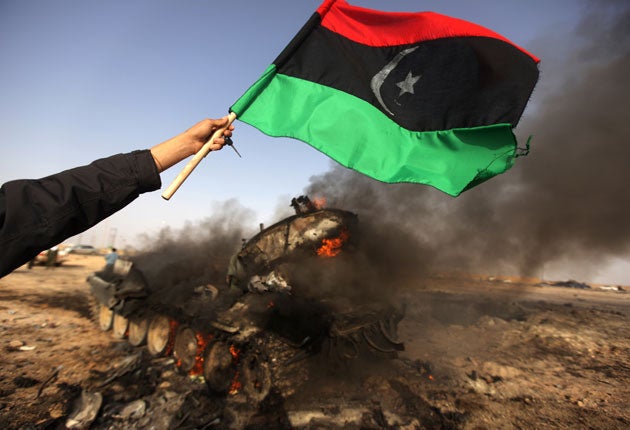
The horrible Foreign Office cliché, used for decades by diplomats and politicians to justify Britain's military alliance with the US, claims that "it enables Britain to punch above her weight internationally". A moment's reflection on this dictum should lead to the conclusion that a boxer who persists in getting into the ring with bigger opponents is likely to end up in hospital.
Britain has become involved in wars in Iraq, Afghanistan and Libya over the past decade and none has gone well politically or militarily. The Iraq war divided Britain far more and for longer than almost any conflict, including the Suez crisis. The British Army spent years failing to get control of Basra and the area around it. For all this commitment, Britain never had much influence on US policy in Iraq or the rest of the Middle East.
Afghanistan has seen a repeat of the pattern. Starting confidently in 2006, the British Army, partly in order to compensate for failure in Iraq, fought a long, draining and unsuccessful guerrilla war to defeat the Taliban in Helmand province. Again, although Britain has been America's most important foreign military ally in Afghanistan, its influence on US actions has been minimal. The extremely limited British clout in Washington, with numerous examples of Britain's marginalisation in the making of Afghan policy, is tellingly described in Cables from Kabul, the highly informed account of the West's Afghan campaign by Sir Sherard Cowper-Coles, who was British ambassador in Kabul and the Foreign Secretary's special representative for Afghanistan and Pakistan until 2010. After detailing his efforts, he says: "I never quite understood why Britain took it upon itself to act as principal cheerleader for the American-led effort in Afghanistan."
One of the strangest aspects of British foreign policy is that, even after bloody and costly experiences in Iraq and Afghanistan, the Government blithely plunged into a similar morass in Libya. It was expected that the Libyan leader, Muammar Gaddafi, would fall quickly and that would be the end of the affair. In February, the Foreign Secretary, William Hague, was even suggesting that Gaddafi was already on a plane to exile in Venezuela. Once again, what was expected to be a short conflict has turned into a long war with no end in sight. A show of strength has become a demonstration of weakness.
Why did David Cameron get it so wrong? As in Afghanistan and Iraq, Britain has become involved in a complicated civil war. The initial humanitarian intervention, to stop Gaddafi's tanks reaching Benghazi, rapidly transmuted into an expanded war aim of overthrowing the Tripoli regime. This was to be done by rebel forces backed by Nato air power, which was largely provided by France and Britain, with the participation of Canada, Denmark, Norway, Belgium and Italy, and the US giving crucial support.
Though Nato has conducted 14,931 air sorties and 5,623 air strikes since 31 March, Gaddafi has stubbornly held on. Rebel militiamen, like militias the world over, fight hard on their home turf in defence of their families and communities – as the rebels did during the siege of Misrata by pro-Gaddafi forces. Otherwise, they are something of a rabble, their pick-ups, with machine guns in the back, darting backwards and forwards over Libya's vast spaces. As in Iraq and Afghanistan, British policymakers, and certainly the Army, failed to take on board the feebleness of their local partners.
When I was in Ajdabiya, a frontline town south of Benghazi, three months ago, one of the dangers was being run over by rebel trucks in panicky retreat whenever a few shells landed. Last week, similar flight was taking place at a village called Al-Qawalish, 60 miles south of Tripoli, where a posse of foreign press and TV reporters had described the rebels as advancing inexorably towards the capital. "We were moving forward when suddenly we were ambushed," cried one fighter as he fled the village, while another screamed, "Go! Go! It is not safe here!"
In Washington, meanwhile, credulous journalists were regurgitating claims by intelligence officials that Gaddafi's regime was on the verge of collapse, citing poor morale, lack of fuel and shortage of money. A Russian peace envoy pointed out that Gaddafi has yet to use any of his many ground-to-ground missiles, suggesting that he is a long way from defeat.
Overall, the foreign media coverage of Afghanistan and Libya is lower in quality than it was in the Iraq war. In the latter, a careful reader of the foreign press would have had a good idea what was going on from the middle of 2003. The same is not true of Afghanistan and even less of Libya. A little of this can be attributed to the financial battering suffered by US news organisations in recent years, but the system of "embedding" and the militarisation of reporting has a lot to answer for. The US and British military machines decide who will be embedded, and therefore get colourful copy, thereby encouraging deferential attitudes towards soldiers and military solutions to political problems.
Objectivity is damaged in other ways. Skirmishing, however dramatic, is only part of what is happening, but reporters often exaggerate its importance. They also identify with the soldiers around them. "Morally, it is difficult, having been under fire with extraordinarily courageous young men, to write negative things about what they have done, or call into question the point of it all," writes Cowper-Coles, adding: "that is, of course, why defence ministries are eager to embed journalists." With the military invariably portrayed as heroes, it is difficult for politicians to know what is happening or, if they do know, to do anything about it.
Similar bonding has developed between media and rebel militiamen in Libya. In Iraq, it was journalists who exposed the torture of prisoners at Abu Ghraib. In Libya, the foreign media has trumpeted atrocity stories such as mass rape by pro-Gadaffi forces and the regime's use of mercenaries. It has been left to Amnesty International and Human Rights Watch (HRW) to reveal that there is no evidence for these stories. Last week, HRW exposed the fact that rebels in the west of Libya had looted homes, shops and hospitals in four towns they had captured.
Paucity of information explains a lot about British failures and mistakes in these three wars. Under Tony Blair, there was a contempt for professional expertise and a willingness to support US policy uncritically. Unfortunately, Blair gave total backing to the US just as it was reaching the apogee of its power in 2003. In Iraq and Afghanistan, the turnover of British officers and diplomats was so fast that they seldom acquired the experience to be effective. British cabinet ministers, frequently politicians all their lives, were often comically ill-informed. Cowper-Coles relates how one minister, who had dealt with Afghanistan for three years, "asked me quietly to remind him of the difference between a brigade and a battalion".
Join our commenting forum
Join thought-provoking conversations, follow other Independent readers and see their replies
Comments
Bookmark popover
Removed from bookmarks