Paul Vallely: War on Iran has begun. And it is madness
The parallels with Iraq are disturbing: we are convinced of a sinister threat to the West and we have a dodgy dossier to prove it

One of the more embarrassing features of the internet is that, from time to time, I find myself being confused with a namesake. Paul E Vallely is not me. He is a retired US major-general who is now the senior military analyst for Rupert Murdoch's outrageously right-wing Fox News. Among other things, he wants to bomb Iran, which I decidedly do not.
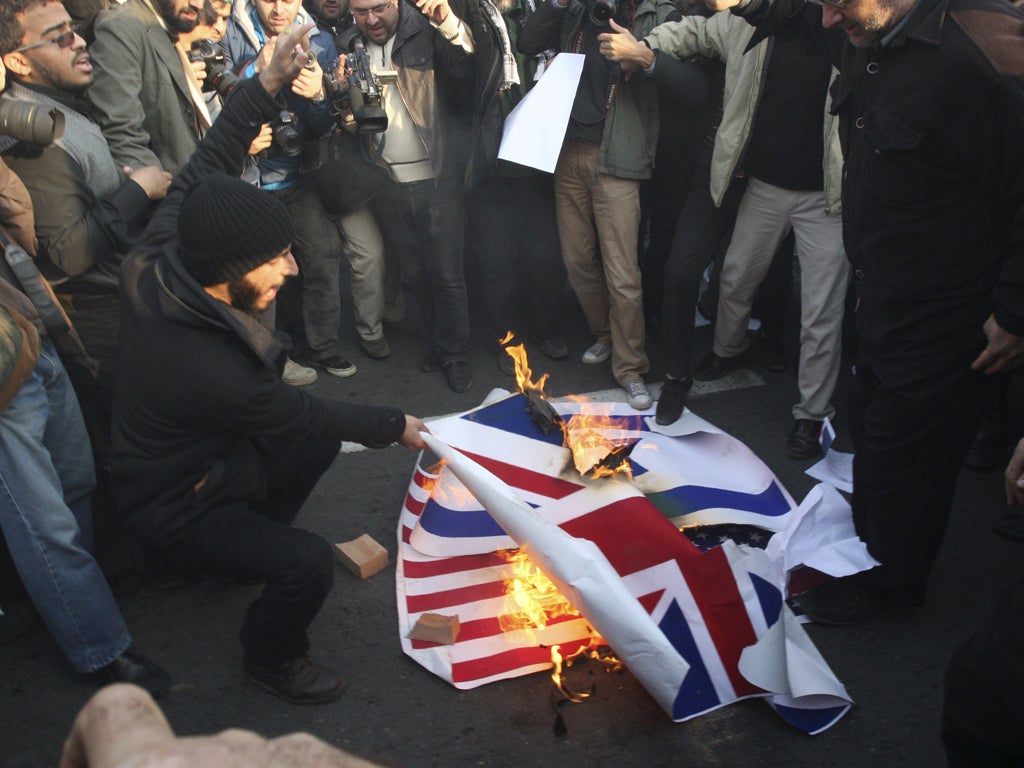
There is something deeply disquieting about the deterioration in relationships between the West and Iran in recent days. William Hague was well within existing protocol to expel all Iran's diplomats from Britain after a mob sacked the British embassy in Tehran. But what is proper is not always wise.
Paranoia has long characterised Anglo-Iranian relations. An old Persian proverb warns: "If you trip over a stone in the road, it was put there by an Englishman." British memories may stretch back to 1989 when Iran's then Supreme Leader, Ayatollah Khomeini, issued his fatwa ordering Muslims to kill Salman Rushdie for his blasphemous novel The Satanic Verses. But Persian memories are longer still.
It was MI6, along with the CIA, which orchestrated the overthrow in 1953 of the popular, democratically elected, secular prime minister Mohammad Mosaddeq. He had brought about major social reforms but had also had the temerity to nationalise the petroleum company which became BP. Through the Sixties and Seventies, Britain backed the Shah of Iran, a man whose regime rested on secret police and torture but who was seen as a plausible counterweight to Soviet influence.
And so it continued. Britain consistently backed the wrong leader. We favoured Saddam in the Iran-Iraq war. We derided the reactionary mayor of Tehran, Mahmoud Ahmadinejad, so much that when he was elected President, another Supreme Leader, Ayatollah Kham-enei, talked about the British as "the most evil" of diplomats. In 2009, the BBC World Service Persian channel so annoyed Tehran that anyone interviewed on it was harassed or arrested. During the post-election protests that year a member of the British embassy's Iranian staff was jailed. For the past year, Iran has had no ambassador in London and has failed to explain the vacancy.
So Britain taking the lead in international opinion against Tehran's nuclear programme – arguing that its goal is not nuclear fuel but nuclear weapons – is perceived in Iran in the context of a long history of British perfidy. London is seen as an intelligence-gathering stooge for Washington, which has no embassy in Tehran. Britain is "the Little Satan" in contrast to the United States, which is "the Great Satan".
It was the Little Interventionist Tony Blair who first began sanctions on Iran. And the build-up of hostilities has unnerving parallels with the case for war conjured by Blair and George Bush against Iraq. We have another dodgy dossier, in the shape of the report by the International Atomic Energy Agency, which claims Iran is developing nuclear weapons but says so largely on the basis of intelligence which ends in 2003. It relies on documents on a laptop, found in 2004 by the Israelis, whose reliability prompted deep scepticism among Western intelligence at the time. The foreign scientist said to have worked on a bomb with the Iranians turned out to be a nanotechnologist. And a former IAEA chief inspector has said the type of explosion chamber referred to in the report could not be used in a nuclear test.
On that, is based hawkish noises and sabre-rattling sanctions. Intelligence chiefs publicly say such things as, the West must use covert operations to sabotage Iran's nuclear programme. Politicians make thinly veiled threats of military attack using weasel words such as "all options are on the table". Pardon me if it feels like Iraq all over again.
Of course, some political leaders in Tehran do want the bomb. It is not hard to understand why. Everyone else in the region has one – Israel, Pakistan, India and Russia. US nuclear weapons have Tehran within range.
But Iran is a big, politically sophisticated country whose constitution of parliament, president, councils and assemblies of religious experts, creates a system of checks and balances in which change is possible. Reformers have held sway at times in this political pluralism. The Iranian establishment is fragmented into factions; a third of MPs did not vote for the measure to reduce the diplomatic status of Iran's relations with Britain last Sunday. But it is precisely the wrong reactionary factions which are strengthened by the bellicosity of the West.
And make no mistake, the war has begun. Virulent computer viruses disabled Iran's nuclear centrifuges last year. Two of the nation's leading nuclear physicists have been assassinated, and a third was wounded by assassins on motorbikes. The UK's decision to freeze $1.6bn of Iranian assets – which is what provoked the violence at the British embassy – was the fourth round of sanctions. Hawks like my military namesake talk openly of deploying unmanned drones against nuclear power stations and provoking an uprising against the government in Tehran. And now comes all the EU sound and fury about not bowing "to Iran's intimidation and bullying". The hollow laughter from Tehran reflects heightened nationalist resolution and increased hostility to the West.
What is needed is the opposite. Instead of feeding a siege mentality in Tehran we should find ways of keeping open the engagement through trade and cultural exchange as Washington does with Pakistan, whose nuclear weapons appear to have provoked no threats of US attack.
There is another consideration. Iran is the world's second-largest producer of oil and gas. (Which does make you wonder why it needs to exercise its "inalienable right" to produce nuclear fuel.) Last week, the EU reached agreement in principle to impose an oil embargo on Iran. But it delayed any detailed decision to mid-January in order to allow countries including Italy, Spain and Greece – which import large amounts of Iranian oil – the time to find alternative supplies from Saudi Arabia or Libya.
But what if Iran were to turn the tables and cut off oil to Europe, concentrating on its massive sales to India and China? With Europe already in fiscal turmoil, that could create another oil shock on the scale of those in the 1970s, which deflated the global economy, triggered a stock market crash, caused inflation to soar and led to a wave of unemployment that toppled governments.
Or Tehran might announce a selective oil embargo against Britain, France and Germany – leaving its biggest clients in southern Europe untouched. The markets have already anticipated this: oil went up by $2 in a day after the storming of the British embassy and oil futures are up 4 per cent on the week.
This rush to madness could backfire terribly in so many ways. If we had as long an historical memory as the Iranians we would know that.
Join our commenting forum
Join thought-provoking conversations, follow other Independent readers and see their replies
Comments
Bookmark popover
Removed from bookmarks