Peter Popham: Vedanta's very embarrassing silence
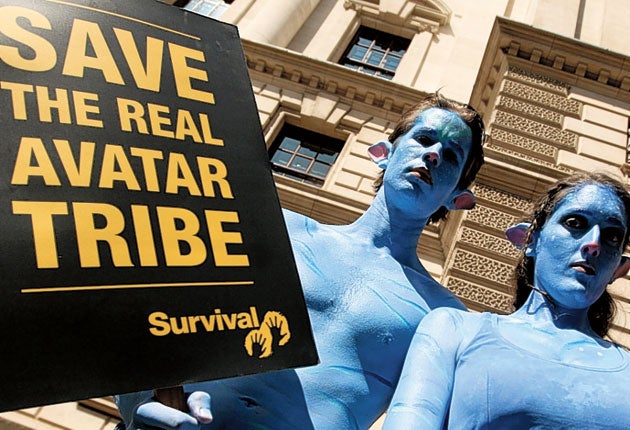
Imagine it: a room full of suits in London's austere and business-like Institute of Civil Engineers, engaged in a passionate debate about religion. That was the scene on Wednesday at the annual general meeting of the London-based and LSE-listed mining company Vedanta, which has been trying for years to get permission to mine bauxite on Nyamgiri, a mountain in the east Indian state of Orissa.
Vedanta has long been criticised by activists for what they claim is its cavalier attitude to environmental protection, worker safety and other issues at its operations in Africa and India, and every AGM since it was listed on the London Stock Exchange has been punctuated by protests. But as the Indian government comes close to issuing its final verdict on the mine, the protests have become noisier and more impassioned. Vedanta argues that it's not infringing human rights and that it's bringing wealth to the region.
Nyamgiri is regarded as a god by the Dongria Kondh tribe that lives on it, so for them and their supporters, tearing the peak of the mountain apart for bauxite would be sacrilege. In their effort to spike this argument, this year the company rolled out the top manager at the company's nearby bauxite refinery, Mukesh Kumar, who claimed that the tribe no longer worship the mountain and welcome the mine's arrival. Music to shareholders' ears – but was it true? You could only pronounce with confidence on the question if you were yourself a Dongria Kondha, or at least on pretty familiar terms with the tribe. Did Mukesh Kumar pass muster?
This was the point seized on by Samarendra Das, an Indian research scholar and activist from Orissa, who rose from his seat to ask Mr Kumar a simple question: by what name do the Dongria Kondh refer to Nyamgiri, their holy mountain? The silence was deafening – until filled by the boos and catcalls of the activist-shareholders at the meeting, which from that point onwards went down hill.
Shareholders need to trust the companies they invest in – to turn a profit, but also to tell the truth. Yesterday's headline in the Financial Times – "Vedanta's bad press risks undermining its City image" – was clear enough evidence that Vedanta's trust is now in jeopardy.
Mining's legacy
The obvious problem with mines, from the point of view of the people who live in their path, is that once they have been dug, nothing is ever the same again. However nicely dressed up for public consumption, the devastation they wreak is absolute.
I have just returned from a holiday in Cornwall, which is emerging from the process which now menaces Nyamgiri. It's a lovely place in many ways, but there is a kind of haunted emptiness at the heart of it which is the unmistakeable sign of a region that has been raped for its minerals: in Cornwall's case principally tin, but also silver, lead, copper, arsenic and much else.
The ancient Cornish are supposed to have sold tin to the Phonenicians and carried on digging it for many more centuries. It was much the most important mining region in the country – coal being the only obvious lack – and a local saying goes that you won't find a mine in the world without a Cornishman at the bottom of it. But as a source of pride and identity, mining only lasts as long as the stuff that's being dug up, and that's pretty well history now. What remain when it's gone are desperately low levels of education, employment and GDP compared to the rest of the country, and giant holes in the ground.
Clever people like Tim Smit may succeed in turning a worked-out china clay quarry into an Eden Project, but while the income and the jobs are welcome, it won't give Cornwall its countryside back.
Tribal loyalties
When Charles Darwin encountered the tribal people of Terra del Fuego he called them "the most abject and miserable creatures I have anywhere beheld" and as existing "in a lower state of improvement than in any part of the world".
"These poor wretches were stunted in their growth, their hideous faces bedaubed with white paint, their skins filthy and greasy, their hair entangled, their voices discordant, and their gestures violent ... one can hardly make oneself believe that they are fellow creatures and inhabitants of the same world."
But attitudes to other races are as subject to evolution as anything else, and the unquestioned conviction of the superiority of European civilisation that rings through those appalled, disdainful words is one of the attitudes we have thankfully begun to shed since Darwin's time. There is perhaps no better symbol of that change than Dr Felix Padel, the anthropologist who happens to be Darwin's great-grandson, and who was among the shareholder-activists witnessing Vedanta's discomfiture this week.
Padel has lived among the tribals of Orissa for years, and in his new book, Out of this Earth, co-authored with Samarendra Das and launched in London last night, the techniques by which mining giants set about breaking the resistance of tribal people who happen to be in their way through fraud, forcible occupation, corruption and intimidation, are documented in painstaking detail.
Charles Darwin lamented the inability of "primitive" people like the Fuegians to rise to our level. Padel by contrast laments our refusal to leave people like the Dongria Kondhs in peace.
Join our commenting forum
Join thought-provoking conversations, follow other Independent readers and see their replies
Comments
Bookmark popover
Removed from bookmarks