Philip Hensher: I'm a bleeding-heart liberal - so, what am I to make of these sickening scenes?
Unlike the riots of 30 years ago, actions last week had no clear explanation. And that's a real challenge for the chattering classes
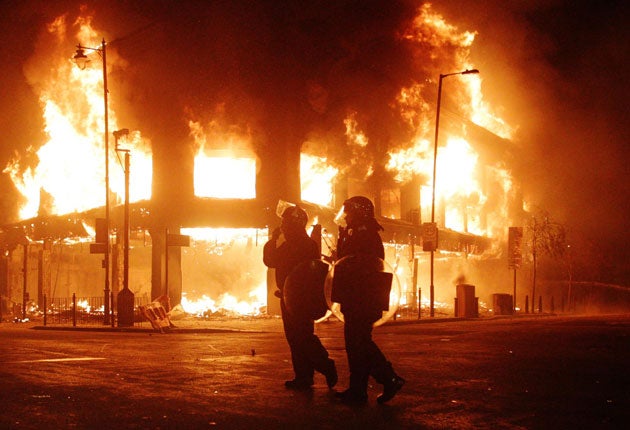
Perhaps it wasn't quite like this in 1981. The last summer of riots, spreading from city to city, also coincided with the first difficult years of a new Conservative-led government. Coincided, too, with the summer of a royal wedding. The anti-slogan of the 1981 riots was what Mrs Thatcher was said to have remarked on seeing the destruction in Toxteth. "Oh," she is reported to have said, "those poor shopkeepers!"
Then, and for many years afterwards, this ascribed remark was served up as an egregious example of the political classes missing the point. Most liberal observers thought, and sometimes said, that anyone who could say that had demonstrated their smallness of mind. The riots of 1981, most commentators and thinking people would have told you, were the product of rage among the underclasses, the unemployed, the young whose future was in the process of being destroyed. Who, in this apocalyptic scenario, could think primarily of the shopkeepers?
Thirty years later, to a certain degree, it was all about shops. The liberal response to riot, disorder and violence is to withhold blame, and look for causes. Other people might call for floggings at the first sign of a broken window, a rude word called across a street. But we liberals try always to see how far deprivation of culture or means might have led to what must surely be a sign of distress at some level. Understand and improve is the liberal's motto, not isolate and protect.
But it was so hard to see what distress was driving the destruction, and the looters were highly selective in their acquisitions. The first targets, at every site, were the sites of teenage desire: sportswear shops and electrical goods emporiums. One of the most startling images of the early stages of the riots was of Shereka Leigh, a 22-year-old woman, apparently taking some trainers out of the box in Tottenham and trying them on in the street. "Crap trainers, too," a friend said, rather missing the point.
At the riots at Clapham Junction, every shop in the precinct was targeted and attacked – except Waterstone's bookshop. What was the liberal mind to make of a riot which looked like shopping by other means?
"They just want to live the Bond Street experience for one day," an acid commentator said. But it wasn't as simple as that. The riots started to look as if they were means by which the young could express their attitudes in theatrical ways – above all in the arena which they understand pretty well, the shopping arcade. "We are not all gathering together and fighting for a cause. We are running out of Footlocker and thieving shoes," as one extremely brave woman shouted at the rioters in Hackney. When it turned out that the venerable Gay's the Word bookshop in Marchmont Street in Bloomsbury had been the only shop in Bloomsbury to have its windows smashed, the liberal response was instant, unselfconscious and surprising: "Oh, those poor shopkeepers."
"Well, the protest isn't politically motivated," people said to each other over images of children carrying away flatscreen televisions. "But there are political causes, aren't there?" In The Independent, Camila Batmaghelidjh stuck to the deprivation line, talking of needles and the stench of urine in the lifts of high-rises. Some surprising people, however, were by now saying in effect "Bollocks" to this argument. It was all motivated by consumerism. The liberal consensus started to agree.
One of the things that made comment so difficult was the honourable liberal insistence on not transferring responsibility from individuals to a minority. We didn't blame every Irishman in London during the IRA's mainland campaign. We didn't say anything about black people in general after PC Blakelock was murdered in Broadwater Farm and Brixton went up in flames, and we would never countenance Muslims being treated differently after the 7 July atrocities, though it might not have seemed like that at the time to the minorities concerned. In his new book of essays, Caryl Phillips talks about the choice of image offered after 1981 to a black man: to "be a rowdy, most likely dreadlocked youth who threw bottles in the street [and] abused the police... or attempt to gain a white-collar job".
Through all these episodes, we liberals stuck to our conviction that it wasn't right to taint a minority with the behaviour of some members of it. But as the rioting progressed, one fact emerged that was very difficult for liberals to accept. There wasn't a minority for us to prepare to be nice to, when it all died down – not even that most unpopular of minorities among liberals, the white working classes.
Some of the looters were black, but plenty of them were white. When Enoch Powell's dicta emerged from David Starkey's mouth on Newsnight on Friday night, they seemed as ill-informed, irrelevant and startling as Erda rising from her slumbers to spout total rubbish in Wagner's Ring. Were they poor? Laura Johnson, the child of millionaires, found herself before magistrates, accused of looting £5,000 of electrical goods. Unsure of the difference between right and wrong? Others were promptly turned in by their parents when they returned laden with consumer goods, suggesting that they had some pretty firm moral guidance while growing up. Were they deprived of hope or education? A succession of Olympic ambassadors, teachers, student lawyers turned up in the courtroom to try to explain why it was that they had thrown away their entire future for the sake of, in one case, a box of bottled water. Were they, perhaps, just extremely thick? That is a word we probably don't use.
The liberal urge to understand, explain, improve and cure ran up against a problem that did not exist in 1981: there just was no unified cause. We stayed away from Mark Duggan, posing with fingers in a silly revolver pose, as a proximate cause. Did anything unite the looters except, mostly, their youth? A looter strikes directly at something the liberal holds dear, the community. It took Brixton years to recover from the riots. Who, now, would open a shop in Tottenham, or could afford to? Businesses will be bankrupted, or just withdraw quietly. Useful chain stores will wonder whether that part of town is worth their investment. And a part of a city slowly withers.
"Throw the book at them," I said on social media, and a brave, liberal soul took me on. Yes, she said: throw literacy at them, libraries, reading. That will do them the world of good; prison will damage them further. What the liberal was faced with in August 2011 was a frightening abyss: a catastrophic action motivated, perhaps, by the shallowest and least idealistic of desires; an action of destruction and selfishness which seemed, for a moment, universal rather than the motions of an angry – perhaps rightly angry – minority. What to do about that? No one had the faintest idea. All we can do is what we do best – just go on talking.
Join our commenting forum
Join thought-provoking conversations, follow other Independent readers and see their replies
Comments