Philip Hensher: Laugh at the authorities if you want, but don't expect them to get the joke
The judge said the message was ‘menacing in its content and obviously so’. Really? Do menacing messages from terrorists begin with the word ‘Crap!'?
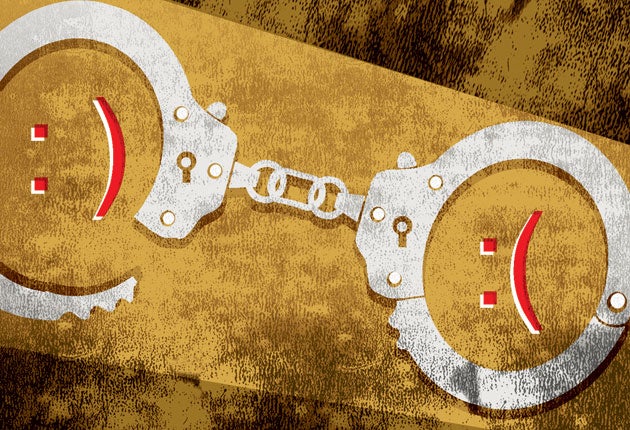
How much is a joke worth? It might be possible to work it out.
Mr Chris Moyles asks his hired friends on his radio programme what they would say to a Mexican eating cheese which did not belong to him: answer, it's nacho cheese.
We could take his gargantuan salary and divide it by the number of times a year he succeeds in making anyone laugh. Or we could estimate the cost to the authorities of a joke, if it inconveniences them or simply asks people not to accept their authority.
You might think that mocking authority is what a joke quite often does. And authorities have often agreed that the suppression of jokes is what authorities do. There were plenty of cases in Soviet Russia of people being persecuted for making an inappropriate joke – one story, in which a newspaper through a misprint refers to Sralin, or Man of Shit, instead of Stalin, or Man of Steel, is immortalised in Tarkovsky's film Mirror.
The idea is the driving force behind Milan Kundera's first novel, The Joke, written and published just before the Prague Spring, and quickly suppressed. Set in the early 1950s, in it, the hero, Ludvik, writes a postcard to a girl. It reads: "Optimism is the opium of the people! A healthy atmosphere stinks of stupidity! Long live Trotsky!" Not a very funny joke, but all the same, not bad enough to condemn Ludvik to hard labour down the mines.
We don't do work brigades as punishment for joking inappropriately. We have other means of punishment and public humiliation. Paul Chambers is a 27-year-old accountant. He was attempting to visit his girlfriend in Northern Ireland last winter. Due to heavy snow, his local airport in Doncaster was closed, threatening his holiday plans. We have all been there. I was affected in exactly the same way. My response to the disappearance of all assistance was, at the time, not very temperate: I clearly remember saying to my husband, without serious intent, "If I see an employee of easyJet going by, I'm going to give them such a kick up their fat orange arse." Probably hundreds of people were giving vent to frustration in much the same way.
When Paul Chambers was hit in this way, however, he did not limit himself to talking about it. He posted a comment on Twitter which read: "Crap! Robin Hood airport is closed. You've got a week and a bit to get your shit together otherwise I'm blowing the airport sky high!!" The authorities read this, and alerted the police. As we all know, you don't joke about having bombs in your luggage when you are passing through security at an airport. Mr Chambers was surprised to discover that you are not allowed to joke about these matters in any circumstances.
The police visited Mr Chambers. They do not seem to have made any attempt to discover whether he was, in fact, making any kind of threat, or whether he was making the kind of comment which we all make sometimes, such as "If you carry on playing that drumkit, I'm going to kill you," or "she needs a bomb putting under her", or "I'll have his guts for garters", which is not a serious threat of disembowelment. Instead, they told him that he did not understand the world we are now living in, and charged him. Interestingly, they did not bring a charge under terrorism offences, which would never have stuck, but under an antique law intended to prevent anonymous obscene phone calls.
The story might have been funny, if anyone involved had shown any judgement in the matter. But Mr Chambers was found guilty of sending threatening communications, and lost his job – he has not found it possible to find another. This week, his appeal was dismissed by a judge, Jacqueline Davies, who has shown all the wisdom, intelligence and discernment of a warthog in a porcelain gallery. She said: "Anyone in this country in the present climate of terrorist threats, especially at airports, could not be unaware of the possible consequences." No one has ever thought for a second that Mr Chambers was making a terrorist threat.
The judge said, however, that the message was "menacing in its content and obviously so. It could not be more clear". Really? Do menacing messages from terrorists often begin with the word "Crap!"? Do they often find a cause for threatening violence in the breakdown of services because of snow? If you ask me, Jacqueline Davies doesn't sound the brightest spark among Her Majesty's judiciary.
We are still coming to terms with Twitter, and with other means of online commentary. Probably, at first, we thought it was a small-scale conversation with friends which people might overhear, but not listen to. In fact, it is more like writing for publication. In that kind of public sphere, not everything is acceptable. This week, a public official was found to have fantasised in public, on Twitter, about a specific and horrible means of putting my colleague Yasmin Alibhai-Brown to death. That would not be acceptable in print, and is not online.
But it is perfectly possible to imagine writing, in a jocular way, in a newspaper, that the hopeless way a business is run has made you wonder whether they need a bomb putting under them. Would that, too, now entail a prosecution and the likelihood that you would lose all gainful employment?
Clearly, the authorities have decided that no one, at any level, may now joke about matters of security. It was interesting to note that Chris Morris's rather brilliant comedy about suicide bombers, Four Lions, was evidently restricted in where it could be filmed – a Derbyshire dale at one moment surreally passing itself off as a central London location. I guess that permission was refused to film anywhere that a real terrorist attack might be launched, whatever the intentions of the film-makers.
And if that is true for a Chris Morris, then how much more true of ordinary people like Paul Chambers, just making a passing comment out of frustration, and for the sake of his moment of flippancy, his life has been destroyed. Twenty years ago, when I was working at the House of Commons, a perceived increase in threat led to an enormous ratcheting up of security throughout the building. A colleague of mine at the time remarked, "Once it's gone, we'll never get it back – no one has ever heard of security protocols being lowered when the threat recedes."
He was absolutely right. A threat, whether genuine or estimated, to security leads to an increase in control over us by the authorities. They demand control over our behaviour, our speech, our writing, our thoughts, whether we are on the sites of their authority, or elsewhere. And nowhere is their control more strongly exerted than in the places where we try to amuse, or speak with disrespect, in a joke. Some people, writing about the Chambers case, have said: "It was just a joke, for heaven's sake." The authorities may be wiser, or more sensitive to their own dignity; because a joke is exactly the point at which we laugh at their posturing. There is no such thing, to a courtroom, or an airport official, as "just a joke". That is exactly why we should go on laughing at them.
Join our commenting forum
Join thought-provoking conversations, follow other Independent readers and see their replies
Comments