Sarah Sands: For spiritual uplift, there is nothing like a kestrel on the wing
As the RSPB's annual Garden Watch monitors the state of British birdlife, our writer explains the irresistible attraction of simply observing
The gloom within the Afghanistan summit at Westminster on Thursday might have momentarily lifted had Gordon Brown congratulated President Karzai on the recent sighting of the very rare large-billed reed warbler in the north-east of the country. If we substituted the United Nations with an international twitchers' alliance, we would quickly find sunlit common ground.
The most god-forsaken countries in the world often have remarkable birds. We could praise the Somali boubou rather than talk of pirates, or pay attention to the thick-knees of Yemen instead of terrorism. Haiti has a relatively short list of native birds, but how affecting that it includes the mourning dove.
My late uncle was a doctor in Yemen when President Jimmy Carter arrived on an official visit. My uncle was known locally for his knowledge of birds, and was called into action when the President turned out to be a twitcher too. Carter arrived with the secret service in a fleet of cars. My uncle's face darkened with irritation. No bird would come near such a crowd. The message was relayed to the President who dismissed all his aides on the spot. Twitching is an intimacy shared. Power and politics have nothing to do with it.
I am reminded of this as I set up my tripod in the kitchen in view of my back garden. Along with many other amateur enthusiasts across the country I am taking part in the Royal Society for the Protection of Birds (RSPB) garden survey to track the population of British birds. Could there be a more blameless national project? The RSPB has more than a million members – larger than the combined membership of all Britain's main political parties. If you go to any of the RSPB's big reserves – Minsmere, Titchwell, Leighton Moss, Abernethy – the car park is usually full. And once you are in, you enter a hushed world of men and women of all ages, backgrounds and expertise, watching, wondering and engaging in quiet conversation about the birds in front of them.
Bird etiquette allows you to ask anything of a twitcher, so long as you are not scaring the birds away. In no other field of human activity are conversations struck up so easily and with such good-natured intent. It is more classless and democratic than anything Harriet Harman could dream of. Suddenly, society has cottoned on to the potent relationship between grandparents and grandchildren. Birdwatching is a perfect framework for this.
Anyone can learn the deep calm pleasure of patient observation and identification. It costs nothing more than a pair of binoculars. Bill Bailey's Bird Watching Bonanza programme is a response to the twitching majority. Jonathan Ross never got birdwatching, which was his personal misfortune and his professional failing. The greater British public are not obsessed by sex and celebrity. They want to look at birds. As Bailey puts it: "I find it life affirming that more people watched Springwatch than Big Brother."
Birdwatching is a journey of enlightenment, so I quite understand why it leaves non-believers cold. An online critic of Bailey's Sky show writes: "The content was baffling, involving rounds in which the contestants had to count birds, take photographs, build something to watch birds from and answer questions about birds." Well what more could you ask for in life?
Accumulative knowledge is at the heart of birdwatching. If you can accurately identify a bird, particularly in an unfamiliar context, and tick it off you are the happiest person in twitcherdom. Of course you seek photographic evidence, for bird watching is an exact science and demands proof. You cannot claim that you have seen the large-billed reed warbler in the same way that you can pass off weapons of mass destruction.
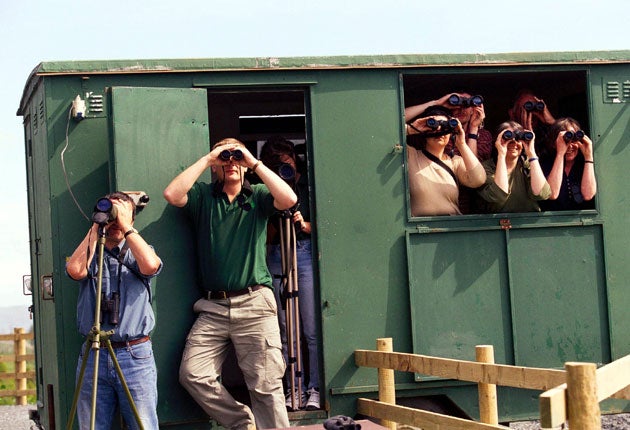
It is an additional pleasure that you can build a sort of treehouse to carry out your observation. Bird hides are especially exciting for children and some hides are much nicer than houses. I recommend the smart new observation hide of the Wetland and Wildfowl Trust at Welney where you can watch the wild whoopers and Berwick swans returning at dusk from the day's foraging in the fields. The hide sometimes fills with so many birdwatchers and their telescopes that the glass window steams up and nobody can see anything. It is both comic and touching.
I am also rather drawn to bird houses. I have a plain table at the moment, hanging from a winter branch, but I like the look of the little custom-made caravans advertised on birdwatching websites. Bird kit is never going to produce Apple-style worship, Stephen Fry will never promise to lick the lens of a telescope, but it has a more practical beauty.
Answering questions about birds is the state of nirvana we amateurs aspire to. There is so very much to learn about birds. For instance, where do swallows go in winter? An early theory was that they hibernated in the mud under the lakes, which is why you see them congregating in the reeds in September.
The great British garden survey this weekend satisfies us on many counts. It is a weekend for amateurs because we are only being asked to identify simple domestic birds (I discount the wretched parakeets who are squatting in west London). But we shall also be looking at the migratory patterns of birds, wherein lies the poetry of twitching. Migration is a whole subject of its own. We may see a parochial instance of it this weekend as we look for birds fleeing the hostile temperatures of the countryside for urban gardens. All kinds of birds who we would not normally consider feeders are arriving. We are seeing in our gardens long-tailed tits, goldfinches, siskins and wintering blackcaps. Compare this with the top 10 birds from last year's survey. They are: 1) house sparrows; 2) starlings; 3) blackbirds; 4) blue tits; 5) chaffinches; 6) wood pigeons; 7) collared doves; 8) great tits; 9) robins; and 10) long-tailed tits.
What appears in your garden is the foundation of national identity, climate change, the familiar and less familiar. We are always being lectured about civil society, but this usually means merely taking over the responsibilities of the state that it can no longer afford or be bothered with – policing, for instance. But the bird garden survey is truly something to discuss with your neighbours and their children and grandchildren. And all our good work goes towards the making of a giant bird atlas, showing where birds are, in what numbers and at which times.
This has been a winter of hardship for birds. Think of the swallow that died loyally at the feet of Oscar Wilde's Happy Prince rather than fly to the warmth of Egypt. Now imagine the beautiful brave goldcrest, with its yellow flash across its head. The high surface area to volume of small birds makes them suffer in cold weather, and it is harder still for insectivores such as the crests. Our lovely goldcrests and firecrests have died of cold this winter.
The appeal of birdwatching is that it is both splendid and humble. No bird is beneath notice – twitchers even embrace seagulls – but rarity evokes respectful reverie. I once went on a tiger-watching trip in central India as part of a television tribute to Kipling. A child on the tour was being filmed by a crew. After six hours and no sightings, the child's expression was turning to boredom and disappointment. The crew began to panic, making menacingly clear to the guide that without tigers, the trip was a disaster. Meanwhile, the guide and I were in animated discussion about the hundreds of interesting birds we had spotted. I was ticking them off happy as, well, a sandpiper. When the crew and child could not even find comfort in a dazzling kingfisher, I despaired.
There are more things in heaven and earth than are dreamed of but you must look for them. And then make sure you have logged them, if possible with photographic evidence, and inform the RSPB. Just as teaching of history has narrowed to Henry VIII and the Second World War, so nature has been taken over by lions, polar bears, and dishy male survivalists. It is wild life as Avatar. But there is also the gentle day-to-day nature of which schoolchildren know less. We need a little more "Hello, birds! Hello, trees!" We must cultivate our gardens.
Sarah Sands is deputy editor of the London Evening Standard
Join our commenting forum
Join thought-provoking conversations, follow other Independent readers and see their replies
Comments
Bookmark popover
Removed from bookmarks