Steve Richards: New politics? Don't you believe it. Old rivalries will soon be back
The so-called new politics is the logical extension of Blairism rather than a break from it, with both leaders testing their parties' ideological flexibility
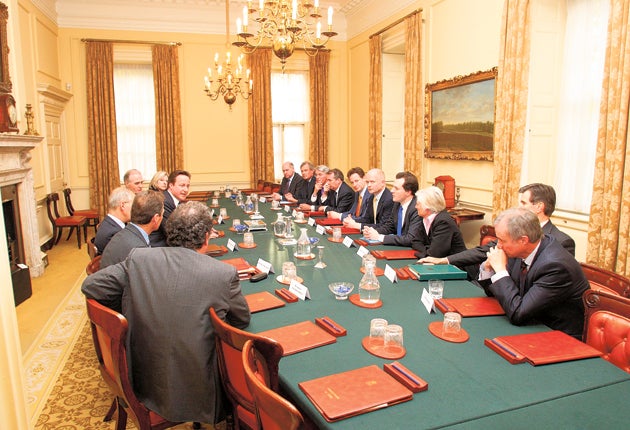
We are only at the start of the new Liberal/Conservative era and I already want to ban a phrase. The words I never want to read or hear again are "new politics". There is no such thing. There is politics, which is a noble vocation. Politics is about values, the clash of ideas and the resolution of conflicting views. In Britain resolution is determined by a party-based system and not a presidential one.
That is why the coalition between the Conservatives and the Liberal Democrats is doomed to fragility in spite of what will be a lengthy honeymoon. At their extraordinary joint press conference yesterday, David Cameron and Nick Clegg were in vivacious form. Afterwards I bumped into a bewildered Tory MP who told me: "I am sure I will wake up in a minute and discover this is a weird dream." For now it is the weird reality and voters who yearn for a "new politics" – there goes that term again – will be thrilled at first.
Cameron has proven that he is a leader willing to think the unthinkable and act on his adventurous thoughts. He has been generous to the Liberal Democrats, perhaps more so than he needed to be. In one leap he has challenged his party in a way that Tony Blair never did with Labour. Admittedly Cameron had no choice but to make overtures because of the indecisive result. Blair would have acted similarly in 1997 if Labour had failed to secure an overall majority. Still Cameron has composed a work on an operatic scale when he could have gone for a three-minute single: Five Liberal Democrat cabinet places, Nick Clegg as his deputy, other Liberal Democrats in the Government. If I were a Liberal Democrat I would be a little worried about such an embrace and whether they will be in any position to take on Tory candidates in marginal seats at the next election.
That is a long way off. For Cameron and Clegg this is the easy bit. The questions at their joint press conference were nearly all about the choreography. Where would Clegg be based? Would they take regular joint press conferences? These are not challenging issues. Even in such a benevolent climate Clegg twice sought to indicate good-humoured distance, once by pretending to walk away from the podium and on another by suggesting that if they travelled in the same car to campaign in a by-election they should get out of opposite doors. He must be acutely conscious of Liberal Democrat supporters watching in a state of anxiety and in some cases despair. They did not vote Clegg to get Cameron. Similarly Tories did not vote Cameron to get Clegg.
For now the excitement of power will bind the parties together. Few of the new ministers will have served in government before. Excitement will outstrip concern. Other Conservative and Liberal Democrat MPs will hope to be ministers at some point. They will behave themselves until their hopes are dashed. The media will love it too at first. The Cameron and Clegg double act will have them cheering in the aisles. Journalists who attended the press conference were comparing them to Ant and Dec.
But in the end new politics is like the old politics, a mix of principled conviction and expediency, rooted in a party. If Conservatives were Liberal Democrats they would not have joined the Conservative Party. At some point conflicting values will become an overwhelming theme, tested by events rather than a carefully mapped-out, but evasively thin five-page document published yesterday by the two parties. What would have happened if the coalition had been in place in September 2007 when Northern Rock was on the verge of collapse? We know that Vince Cable called for nationalisation and David Cameron regarded state-ownership as "a disaster". There would not have been as many jokes at a joint prime ministerial press conference then.
More fundamentally there are limits to how far leaders can move away from their parties. Tony Blair defined himself against his party, but in the end the party put up with it no longer even though he won three elections with big majorities. As such the so-called new politics is the logical extension of Blairism rather than a break from it, with both leaders testing their parties' ideological flexibility.
In such a context I am unsure how the coalition survives the referendum campaign on electoral reform. Presumably the new Labour leader will campaign for a "Yes" vote alongside Clegg. Cameron will be calling for a "No" vote. Perhaps it will be straightforward for Clegg and Cameron to return in unison, one of them defeated in a referendum, but I doubt it.
The policy agreements are not especially contentious although they were negotiated with a degree of enlightened maturity by a bunch of decent individuals happily straying beyond their parties' traditional boundaries. Labour's negotiating team also agreed to dump its support for a third runway at Heathrow and drop ID cards. Apparently they told the Liberal Democrats they could have as many civil liberties as they wished, almost relieved to be dropping the measures adopted by Blair/ Brown to woo Middle England and their newspapers. Civil liberties have been a red herring in recent years, an artificial dividing line between parties when, in reality, there are minor differences within each of them.
The agreement published yesterday does not address the politics of the deficit beyond an acceptance that the cuts will begin this summer. The so-called "orange book" Liberals are largely at one with the Tories on economic issues as Cameron recognised long ago. The party's social democratic wing is in a different place. Some will head for Labour before long.
At least they will do so if Labour adapts to changed circumstances, by no means guaranteed. As David Miliband pointed out when he declared his candidacy for the leadership, Labour has an opportunity and responsibility now that the Liberal Democrats have become allies of the Conservative Party. The new leader has a chance and a massive challenge. One former Labour cabinet minister summed up perfectly this moment of frail potential: "The coalition will last longer than I think it will." In politics the future is always unknown. It is more unknowable than usual, but at some point over the next few years the parties will reassert themselves as competing forces. They always do.
Join our commenting forum
Join thought-provoking conversations, follow other Independent readers and see their replies
Comments
Bookmark popover
Removed from bookmarks