Vince Cable: Osbornomics would make Britain poorer and less equal
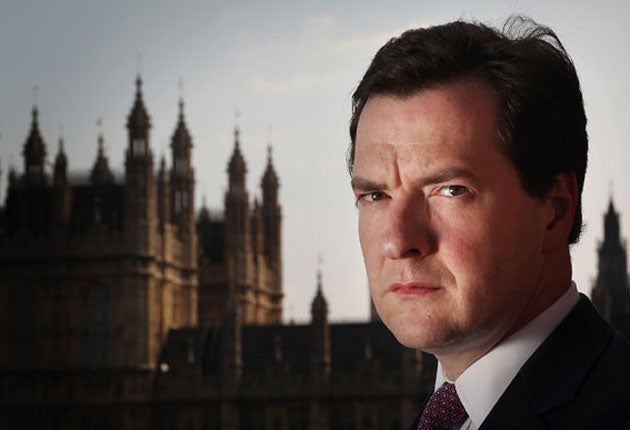
One of John Maynard Keynes' more memorable quotes was his observation that all men of affairs are slaves to some defunct economist. Some of us have identified our own defunct economists. (I was taught economics by the disciples of Keynes.) This week, George Osborne has an opportunity to tell us from where he derives his economic ideas.
The last Conservative government was led by people who had a clear sense of ideological direction and conviction. Mrs Thatcher was clearly influenced, directly or indirectly, by the ideas of Hayek - rolling back "the serfdom of the state". Sir Geoffrey Howe and rising stars like Nigel Lawson had developed a response to the inflationary 1970s through the monetarist ideas of Milton Friedman and the Chicago School.
It is very difficult to see any clear or consistent thread this time round. Serious economic thinkers like John Redwood are not part of the inner circle. The emphasis on image, triangulation, repositioning, good soundbites and invective directed at Gordon Brown has drowned out any bigger ideas. Perhaps more importantly, while the crisis of the late 1970s played into the Conservatives' natural anti-state philosophy, the banking crisis of the last year has, by contrast, left them looking flat-footed and sheepish.
They are uncomfortably aware that Tory policies in the 1980s, like the demutualisation of the building societies, helped to create the problem. A blind refusal to see the risks and a lack of ideas as to how to counter the banks' collapse also left them exposed.
The most influential texts of this latest crisis, like Hyman Minsky's 1986 classic, Stabilising an Unstable Economy, describe a world in which markets regularly overreach themselves through excessive leverage, excessive risk-taking, greed and folly, leading to panic and then to a collapse of confidence and credit markets. This picture is very much at odds with the world view of modern Conservatism with its touching, if misplaced, view that financial markets are always efficient and right.
No doubt the calculation has been made that the Government is so unpopular that competing ideas do not matter much and are potentially dangerous because they frighten the horses. David Cameron and Mr Osborne are said to be attached to something called "nudge theory". "Nudge" just about sums it up.
Yet there is one philosophical tract with Mr Osborne's name on it: a recent edition of Adam Smith's Wealth of Nations. I applaud his choice. Smith was one of the true greats and his intellectual case for markets, competition and free trade has stood the test of time. Gordon Brown, another son of Kirkcaldy, also claims to be a fan.
But Smith did not have a great deal to say about the financial markets and the banking system (unlike John Stuart Mill, whose descriptions of the credit crunch phenomenon in early 19th-century financial crises was uncannily prescient). His "hidden hand" of the market worked to allocate real things, not complex derivatives and securitised debt. Yet Smith would have instantly recognised those modern bankers engaged in a "conspiracy against the public", maximising profits in a state-protected industry with the help of anti-competitive practices.
More uncomfortably, Smith would have heartily disapproved of Mr Osborne's one big idea: lifting inheritance tax on wealthy estates. Smith wanted to see entrepreneurship and hard work rewarded and was contemptuous of the idea that "children of the rich" should become rich "without the necessity of any exertion".
Ahead of the general election, the main political battleground will, however, centre on macroeconomic policy and the management of the Government budget deficit and debt. The Conservatives have got much mileage out of their appropriation of John F Kennedy's quote about fixing the roof while the sun was shining.
It was, however, never clear how this construction work could be carried out and there was that embarrassing episode in the 2005 election campaign when the chief clerk of works, Howard Flight, was sacked - and expelled from parliament, no less - for inadvertently revealing that the plans were in disarray. Now, the issue is whether the priority is to embark on large-scale, long- term, roof repairs or to rescue the inhabitants from a flood. The former, clearly, has to happen, but it is perverse to treat it as the most urgent task. The perversity undoubtedly has some deep ideological roots: a suspicion of the Keynesian legacy which is to champion the use of fiscal deficits to counter economic slump.
It would be wrong to characterise the underlying arguments as Keynes versus the Monetarists. Keynes and Friedman would both have supported the very aggressive and rigid monetary policy response led by the US Federal Reserve, learning from the mistakes of the 1930s and, more recently, Japan: very low interest rates; quantitative easing (an attempt to inflate money supply); and, in the UK, devaluation. In relation to fiscal policy, huge budget deficits are being run in the UK and US and even in countries said to be worried about deficit financing, like Germany.
But here, the discretionary and deliberate deficit - that is, over and above the deficit caused by the crisis and recession - is very tiny: a stimulus of around 1% of GDP. I quarrel with the way the stimulus was executed, with its heavy reliance on VAT cuts, but Mr Osborne has chosen to make this marginal policy a major dividing line (as has Gordon Brown from the opposite direction).
I suspect all that is involved is a phoney war about small numbers in order to create a false impression of big policy differences. But there are those who suspect that lurking behind Mr Osborne's heated rhetoric about the deficit and debt is a closet Austrian. The Austrians - in contrast to Keynes and Friedman - are deeply suspicious of heavy government intervention to stave off a banking crisis and recession, fearing it perpetuates damaging investment decisions, reignites inflation and ultimately proves futile. The claims of David Blanchflower, a former member of the Bank of England's Monetary Policy Committee, that Mr Osborne plans to allow millions more to become unemployed, probably reflect that suspicion.
By contrast, I don't see any trace of rigorous or interesting economic thinking which would merit such attention. I am struck by the fact that the Conservatives' two main economic policy proposals amount to little more than messing about with quangos. One is to split the FSA and put its supervisory arm under the Bank of England: a badly thought out bit of juggling that will absorb a vast amount of time and energy and tells us nothing about the future direction of financial regulation.
The other is to create a powerful new quango to oversee public spending. There is a role for a stronger National Audit Office type body to assess government fiscal policy independently. But Mr Osborne appears to envisage placing unelected officials firmly in charge of what are essentially political decisions about when and how and where public spending is to be cut or reallocated.
So who is George Osborne's economic guru? Sir Humphrey.
Vince Cable is Treasury spokesman for the Liberal Democrats
Join our commenting forum
Join thought-provoking conversations, follow other Independent readers and see their replies
Comments
Bookmark popover
Removed from bookmarks