Stephen Brenkley: An unholy mess that was four years in the making
Anatomy of a crisis
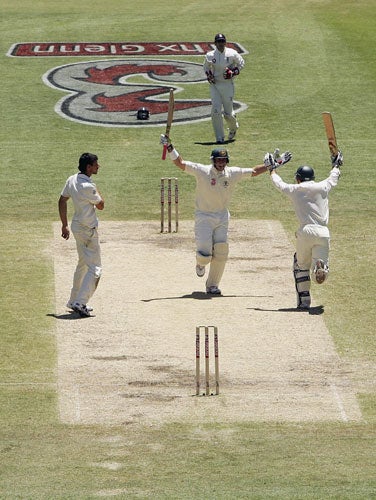
So much has gone wrong since those halcyon days of 2005. It was possible to believe yesterday that nothing would ever go right again.
The Ashes that were regained so joyously turned to dust long ago. It has been as if a Mephistophelean pact was struck: in exchange for winning the great prize the price would be damnation. The culmination, if that is what it proves to be, came yesterday and was grotesque in its shabbiness.
It had been a long time in the making. True, Kevin Pietersen was captain for only five months and Peter Moores coach for only 20, but what has emerged so messily in the last seven days is that this, like all that has gone before in recent times, was inevitable.
The turbulence surrounding the team and therefore the whole professional game was described yesterday by another former captain, Graham Gooch, as "an unholy mess". He could be criticised only for underestimating the extent of it.
Whatever the official line, it is now clear that the atmosphere in the England dressing room had become toxic. It had gone beyond conflicting personalities. They occur in every dressing room, in every walk of life, but distrust and favouritism were beginning to flourish.
Pietersen, who issued an honourable if self-serving statement last night, might have forgotten that along with being the best player as well as the captain comes additional responsibility.
Moores became bogged down in a mixture of coach and management speak, swallowing the instruction manual followed by the self-help guide.
However, there has been a lack of direction on the road travelled from Trafalgar Square in September four years ago and for this the blame can be apportioned in many places. Selectors who allowed the players to become too cosy because places were all but guaranteed, administrators who almost casually allowed certain individuals to become too powerful, rushed appointments, the formation of unnecessary committees dressed up to offer a panacea but whose aims were always ill-defined, have all contributed.
Throughout yesterday it was being opined that Pietersen and Moores had indulged in a very public row. This is not actually so. Their differences might have been paraded in public but the protagonists have said little.
In Pietersen's case, until last night, he offered one bald statement for his column in the News of the World, which considering what they are said to be paying him (more than £100,000 a year), was probably less than they might have expected. Moores has said absolutely nothing in public and there is no evidence to suggest he has said anything in private, so that it could be leaked by insiders. He leaves with dignity intact and, although he probably had to go in the end because of the circumstances, he can be deemed unfortunate.
"What really worries me is what's going on in the dressing room," said Gooch. "There are obviously some factions in the dressing room, some with Pietersen and some not, and that's not the sort of harmony you want before a big series in the West Indies and, of course, the Ashes."
This particular rift began with the appointment of Pietersen as captain in August. Pietersen and Moores had simply never got on. The trouble with England, however, started well before.
If it was not quite on the open-topped bus following the Ashes victory, it was not long after it. Going for a second run at the lovely Bagh-e-Jinnah municipal ground in Lahore during a warm-up match the following November, Michael Vaughan, the victorious captain, a copper-bottomed English hero, felt his knee lock.
He missed the first Test, which England lost from a winning position, and, though he made the next two, England went down in the series. Vaughan's knee was soon to go completely haywire. He went on the tour of India the following winter but he was only half-fit and he did not appear in the Test series.
Indeed, he did not play for another 18 months. So he became a part of the team while not being in it. He was captain of the team without leading it on to the field. This unfortunate, entirely avoidable, state of affairs was to have repercussions which were still being felt last week and led indirectly to the chaos which reached its nadir yesterday.
Of course, it was tempting to stick by Vaughan. He had won the Ashes. But still there was something uncomfortable about it. Those in his stead could not settle, the team could not settle. Perversely, this itself would put unknown pressure on Vaughan if and when he returned.
And return he did. But not until after two more bouts of knee surgery and two more captains. Andrew Flintoff took over at first, but was then injured. Andrew Strauss stepped into the breach and led England to a splendid victory against Pakistan in 2006.
Even that, however, was undermined (part of the Mephistophelean pact presumably) by the events at The Oval when the match was abandoned after Pakistan refused to take the field after being accused of ball tampering. But it was not Strauss who took the team to Australia that winter, it was Flintoff. It was a risk, an understandable one perhaps, but England were outplayed and Flintoff temporarily was diminished.
The door was now wide open for Vaughan's return but not before the ECB announced a wide-ranging inquiry into the running of English cricket. This became known as the Schofield Review and, whatever gravitas its pronouncements seemed to contain, it eventually represented nothing more than a moving of the office furniture.
Hugh Morris, who had sat on the review and was already deputy chief executive of the ECB, became England managing director. The long-serving chairman of selectors, David Graveney, was sacked to be replaced by his long-standing colleague, Geoff Miller. Ashley Giles, one of the Ashes heroes, was made a selector.
On the field Vaughan's recall did not work, partly because the team had moved on, partly because it was in transition and partly because they had a new coach in Moores, with whom Vaughan found it difficult to work. The selectors seemed to be in denial for a while. Continuity became an article of faith. Last August, he quit in a veil of tears after England lost to South Africa, their third successive defeat to authentic Test opposition. But he was not gone yet.
Pietersen was appointed to general goodwill and while he and Moores too made a pact it was obvious from the start that they were uncomfortable with each other. The extent of what was happening has only now started to emerge. Vaughan, perhaps through no fault his own, remained a spectre at England's feast.
Left out of the tour of India – a mutual decision between him and the selectors – he was available for the tour of the West Indies. There are disturbing stories about certain players being happy at some batsmen's loss of form in India because it might pave the way for Vaughan's return.
Pietersen wanted Vaughan for his experience of batting and captaincy but the selectors, who had been foolish enough to award Vaughan a central contract last September, justifiably left him out.
Pietersen, it is known, was angry. He may have seen this as a chance to rid himself of Moores. Seven days ago a story appeared suggesting that Pietersen was seeking a showdown with Giles Clarke, the ECB chairman, over Moores. If this was untrue the rift was patently obvious.
The ECB has done little to close it this past week. Suggestions that Vaughan was the source of the story are wide of the mark but someone clearly had an axe to grind and Pietersen was not unhappy about it entering the public domain.
"It's going to take a strong character as captain," said Gooch. England must hope, and they may be right, that that man is Andrew Strauss.
Crisis management: The key players in England débâcle
Kevin Pietersen Side's (possibly world's) best batsman and now departing captain after five months. Has stated intention to continue as player and will probably score century in the next Test.
Peter Moores Coach, appointed without interview after 2007 World Cup, not to Pietersen's liking. He had more players on his side than Pietersen thought and may be innocent, if largely unsuccessful, victim.
Andrew Strauss Mature, thoughtful cricketer and man appointed pro tem, but just might provide the solution. It will depend on form and results but England are not exactly spoilt for chance and are lucky to have him.
Giles Clarke ECB chairman. Has deliberately avoided involvement in the wrangle but may need to offer leadership now. This dispute has made the organisation he heads a laughing stock.
Hugh Morris England managing director who tried and failed to effect rapprochement, now has to pick up pieces. His job will be difficult from now on because the coach's position will be viewed as a poisoned chalice.
Join our commenting forum
Join thought-provoking conversations, follow other Independent readers and see their replies
Comments
Bookmark popover
Removed from bookmarks