Sam Wallace: It is incredible that South American clubs aren't swept off the global stage
Talking Football: Europe takes away the continent’s best players before they play professionally
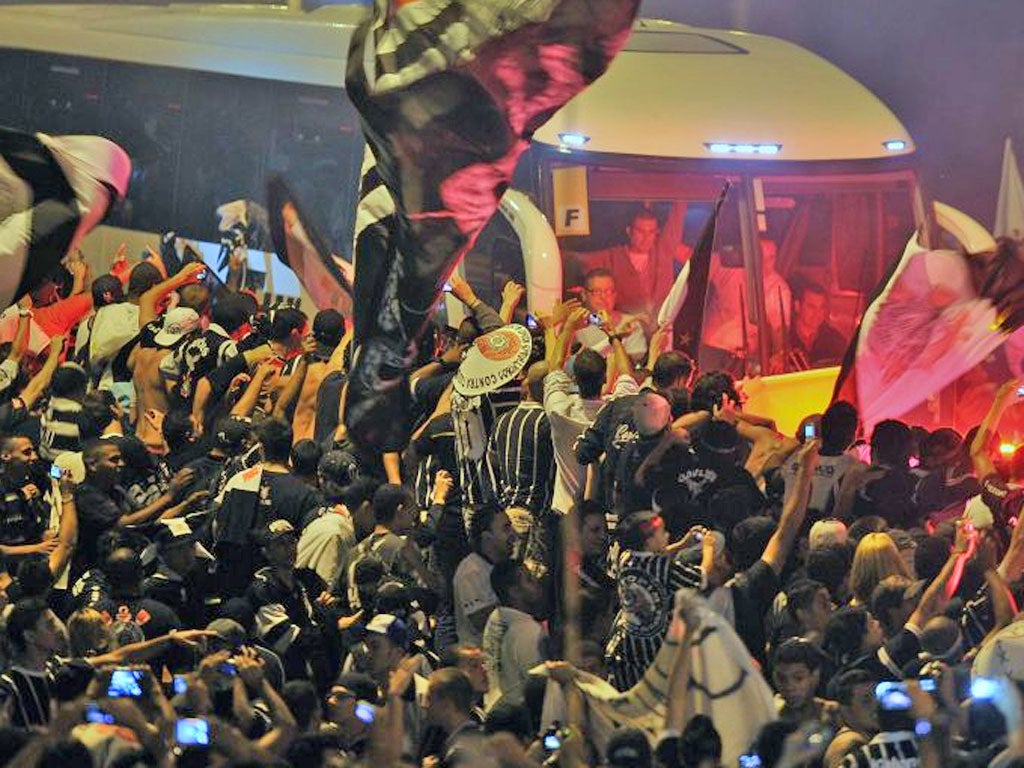
When the Corinthians squad left Sao Paulo a week ago today for the Fifa Club World Cup in Japan, 20,000 supporters came to see them off. The cavalcade of fans in cars blocked Ayrton Senna highway, one of the main routes into the airport in Guarulhos and then they invaded the terminal. The pictures of it are extraordinary. As fans pack the different levels of the airport with banners and smoke flares they might as well be on the terraces of a stadium.
It would be fair to say that the supporters of Corinthians, holders of the Copa Libertadores, champions of South America, are taking this competition seriously.
You only need to have been at Cobham, Chelsea's training ground, over the last few months to see the level of interest from Brazilian media. Some have stayed on in London since the Olympics just to cover Chelsea, European champions, who everyone supposes will be Corinthians' opponents come the Club World Cup final on Sunday in Yokohama.
What confuses the Brazilian media is the lack of interest from their English counterparts in this week's tournament. During Rafa Benitez's pre-match press conference for the Nordsjaelland match, one Brazilian reporter asked him plaintively: "Do you ever think you'll be asked a question about the Club World Cup that isn't from a Brazilian journalist?"
Put simply, the Club World Cup and its former incarnation as the one-off game, the Inter-Continental Cup, is one of the most stunning examples of the power of South American football. Europe takes away the continent's best players, sometimes, in the case of Lionel Messi, before they have played professionally in their home nation, and yet for all that the South Americans are still competitive.
The competition's record going back the last 20 years is 13-7 in European clubs' favour. But given the financial dominance of the game in this continent, the fact that South American sides have won seven (four Brazilian sides, three Argentinian) is testament to their enduring quality. That record does not include the additional World Club Championship in 2000, subsequently discontinued, which Corinthians won.
Fifa has fiddled relentlessly with the competition in recent years to come up with the current format, highly unsatisfactory, which includes the tokenism of including the Oceania champions. The amateurs of Auckland City were knocked out on Thursday, but even that silliness aside, being champions of the world is a title worth having.
South America provides so many of the players who make Uefa's Champions League what it is – be that Messi, Marcelo, Dani Alves, Alexandre Pato, Kaka, Sergio Aguero, Ezequiel Lavezzi, Arturo Vidal, Antonio Valencia or the Brazilian contingent at Chelsea. But in spite of having lost all these players to European clubs, South American teams are still competitive. It would be like giving America virtually all Europe's leading golfers and then winning the Ryder Cup with the next wave of players.
According to the official Uefa website, there were more Brazilians (76) in the Champions League group stages this year than any other nationality. That includes France (66), Spain (63), Germany (47) and Portugal (41). There were more Argentines (32) than Englishmen (31), a statistic that points to some pretty depressing side-effects to our all-conquering Premier League.
The South Americans do have some advantages when it came to the Inter-Continental Cup or latterly, the Club World Cup. It is the end of their season meaning that by the time Corinthians play their semi-final on Wednesday they will have been in Japan more than a week. Chelsea arrived yesterday. In addition, most of Chelsea's players and the manager, Benitez, who won the Club World Cup at Inter Milan and was sacked shortly afterwards, know that the competition carries limited credibility relative to the embarrassment of that early Champions League exit.
But even so, when you look back through the record books, the South American performances are extraordinary. Twenty years ago, Sao Paulo under Tele Santana beat Johan Cruyff's Barcelona team of Pep Guardiola, Michael Laudrup and Hristo Stoichkov in the Inter-Continental Cup final. The next season Santana's side won it again, beating Fabio Capello's Milan of Franco Baresi, Marcel Desailly and Jean-Pierre Papin.
In 2000, Boca Juniors, with Juan Roman Riquelme in the side, beat the Real Madrid team that included Roberto Carlos and Raul. The Milan team that lost to Boca three years later included three leading South Americans: Kaka, Cafu and Dida. In 2006, in the Club World Cup format, Internacional, from Porto Alegre, fielded an entirely Brazilian XI in the final, beating Barcelona, who had Ronaldinho and Thiago Motta, among others.
If we are handing out praise then the Congolese side Mazembe deserve it for making it to the Club World Cup final in 2010 having eliminated Internacional. They are the only non-European or South American side ever to have done that. But generally the theme is of South American sides over-performing to an extraordinary degree.
It is not just that the likes of Corinthians can expect to lose their established players, as they did once with Carlos Tevez, but the fact that major European clubs like Manchester United effectively have feeder clubs in Brazil. They harvest the talent at source. The degree of third-party ownership in South America demonstrates how little money is at the disposal of those clubs. But just look at the quality of the players they keep producing.
Santos' ground-breaking deal to keep Neymar shows that Brazilian sides have a little bit more financial muscle these days. But does anyone doubt he will end up at Barcelona before long? Equally, some of the big players such as Ronaldo, Ronaldinho and Juan Sebastian Veron have gone back to finish their careers in South America although they spent their best years in Europe.
On paper it should be Chelsea who win this competition come Sunday. Corinthians have the advantage of having longer to get used to the jetlag but when you place the two financial models of these clubs alongside each other, they belong to different worlds. Europe should really win every time. That they do not is testament to the remarkable power and depth of South American football.
Portsmouth Supporters' Trust can usher in brave new world
If the High Court rule this week that Portsmouth Supporters' Trust can buy the club at a price affordable to them, then a new era will begin at one of the most troubled clubs in recent years.
Of course, that is what should happen, because Pompey have been in the hands of too many people who did not care enough and the alternative – liquidation – is too depressing to contemplate.
It will be a great moment if it does go the way of the supporters although once the celebrations are over, you imagine that the hard work will only just be starting. The shame with football clubs in this country is that the right people only tend to get their hands on them when the situation is at its most dire.
Join our commenting forum
Join thought-provoking conversations, follow other Independent readers and see their replies
Comments