Tadese is the wheel deal
Having left his bicycle behind, a trailblazer from Eritrea is overtaking the great Bekele
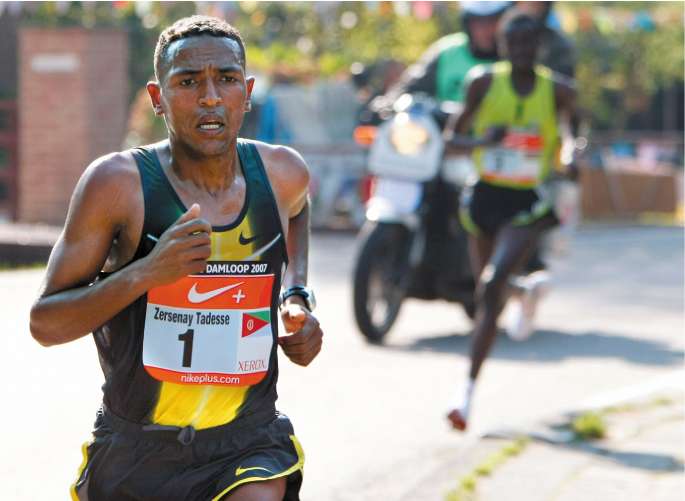
Zersenay Tadese is not the first man to have become an accidental hero of the cross- country world. Indeed, as he reflects on what might have otherwise been in his sporting life and prepares to defend the senior men's crown in the World Championships at Holyrood Park in Edinburgh today, the 26-year-old Eritrean might care to consider the case of the very first international king of cross-country running.
Back in 1903, Alf Shrubb emerged victorious from the inaugural International Championship at Hamilton Park racecourse in Lanarkshire. It was the forerunner of today's event and Shrubb was the first of the all-time greats who have graced what is now the blue riband of distance running. In one tour de force performance at Ibrox Park in Glasgow on Guy Fawkes Day 1904, the slightly built Sussex man who was known as "The Little Wonder" set 10 world records – among them a 10-mile mark, 50min 40.6sec, that stood for 24 years.
None of which would have happened if Shrubb had not returned home to Slinfold one summer night in 1899 to find his fellow villagers responding to the sounding of a fire bell from Southwater, some three miles away. One of his neighbours, Fred Spencer, the captain of Horsham Blue Star Harriers, told him he was going to race the fire engine to the scene of the blaze.
Shrubb, still wearing his heavy work boots after a day labouring at a building site, decided to join the local star runner and proceeded to match him stride for stride. They arrived at the same time as the fire truck and the astonished Spencer knew he had a red-hot talent on his hands.
It might have been different for Tadese, too, had he not fallen out with his team-mates while pursuing his first sporting love. The man who relieved Kenenisa Bekele of his world cross-countrycrown in Mombasa, Kenya, 12 months ago, ending the Ethiopian's five-year reign, was a successful road-racing cyclist in his home country until that spat with his colleagues late in 2001.
It was only then, approaching his 20th birthday, that Tadese turned to running instead. By the spring of 2002 he was in the Eritrean team competing at the World Cross Country Championships. He finished 30th at Leopardstown Racecourse in Dublin, wearing running shoes several sizes too big for his feet.
Since then, Tadese has been busy making a name for himself on the international running scene, although it was only after his victory in Mombasa that the quietly spoken East African politely pointed out that his surname was being misspelled. It was as Zersenay Tadesse that he was reported by the world as the winner of Eritrea's first Olympic medal – a bronze behind Bekele and Sileshi Sihine, another Ethiopian, in the 10,000m in Athens in 2004.
Now 26, and based for much of the year in Madrid, where he is guided by a coach by the name of Jeronimo Bravo, Tadese has twice won the International Association of Athletics Federations' World Road Running Championship, and in 2005 he set an unofficial world-best time for the half-marathon, 59min 5sec, running in the Great North Run on Tyneside. It was his world cross-country win, though, that put the Eritrean and his country on the global sporting map. Bekele stepped off the course in Mombasa with 800m remaining, complaining of the heat and humidity, but the holder of the world and Olympic titles plus the world record at 10,000m was already a beaten man by then.
In January this year, Tadese finished a second behind Bekele in icy, rutted conditions in the Great Edinburgh International Cross Country meeting at Holyrood. Tadese was swamped at the finish by hundreds of flag-waving British-based exiles from Eritrea, a land ravaged by guerrilla warfare for three decades before it gained independence in 1993. Through his exploits Eritreans have come to embrace distance running, though cycling remains the No 1 sport in the country. Like the national taste for the cappuccino, it is a legacyof Italian colonial days.
"Cycling was my first love," Tadese reflected. "I dreamed of being a cycling professional with one of the great teams in Europe. I would've loved to have ridden in a big race like the Tour de France. I won a number of races, mainly over distances of 30km to 50km. My success at cycling suggested to some local athletics people that I might have good stamina, and they invited me to compete in a race. I won that and I did well in my following races, so I carried on running."
The years of conditioning in the saddle clearly helped Tadese to race with his feet. After his win in Mombasa he underwent physiological tests which found he required less oxygen per kilometre than other elite distance runners. A report published in the British Journal of Sports Medicine suggested he was the world's most efficient runner.
Whether he proves the most proficient over the 12km of the 2008 world cross-country course remains to be seen. Bekele starts a strong favourite, having last summer won the World Championships 10,000m title for a third time and last month set a world indoor two-mile record in Birmingham. There are rivals capable of putting a spoke in the Ethiopian's wheel, though – not least the one-time pedal-pusher from Eritrea.
Join our commenting forum
Join thought-provoking conversations, follow other Independent readers and see their replies
Comments
Bookmark popover
Removed from bookmarks