'I cannot see the Olympics coming to the Arab world any time soon'
In an exclusive interview with The Independent - IOC member Prince Feisal bin Al Hussein of Jordan talks about the success of London 2012 and whether the Arab world is ready to hold the Olympics
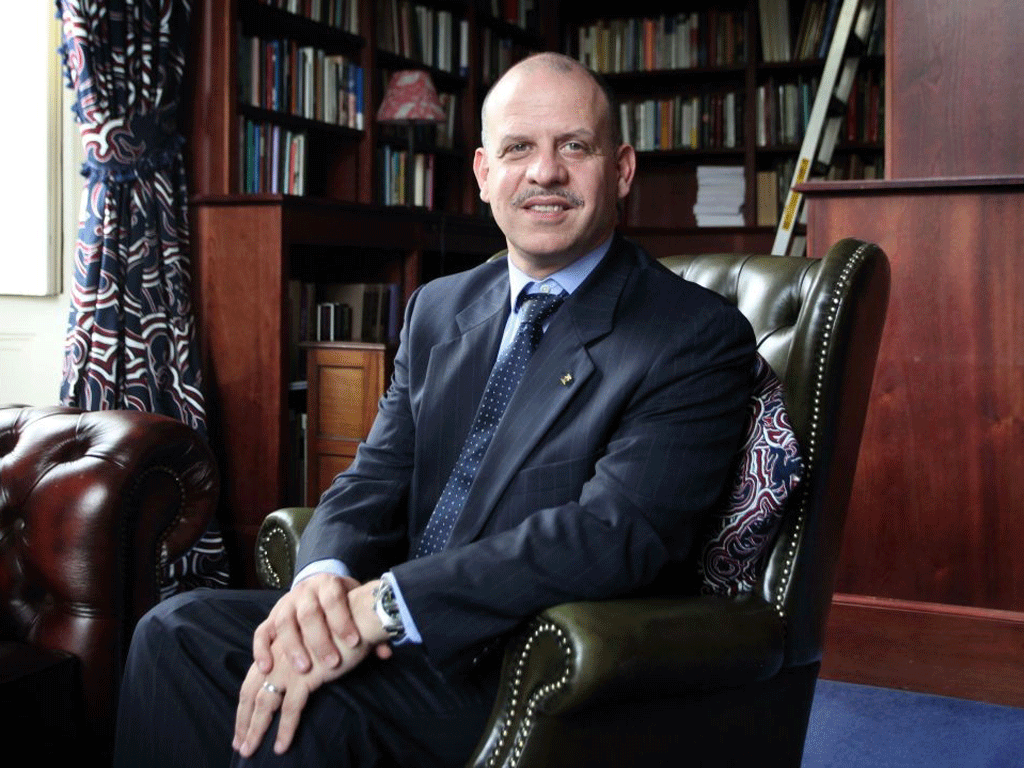
We may be living the Olympic dream as Team GB racks up medals, but spare a thought for Jordan which has never ever won an Olympic medal.
This explains why for Prince Feisal bin Al Hussein of Jordan the most memorable moment of London 2012 is yet to come.
“ I’m hoping”, he tells me, “it will be when we win our first Olympic Medal, that will be the defining moment of the Games for me.”
The country’s best hope is in the Marathon on Sunday. But special as that joy will the Prince, whose brother Abdullah sits on the throne, has seen enough of the London games to be convinced 2012 is a success.
As a member of the International Olympic Committee and head of the Jordanian Olympic committee he has travelled to various venues and says , “The games are based in London but I can see that all the people in the UK are part of it. It has been wonderful to see everybody very happy and when you walk down one of these streets you see people with all the different team t-shirts talking about the various sports. Sebastian Coe has really hit the nail on the head and done a wonderful job. He should be rightfully proud of what the Games have produced so far and the British people should be proud of what they’ve been able to show the world of their country.”
Feisal goes further to say, “Sebastian Coe understood what he wanted to do, that it could inspire the youth of the UK and that of the world. London 2012 is leaving a wonderful legacy. Sports is a tool that teaches us to be part of a greater community to help children to learn to look at each others as humans.”
This seems a tall claim given the struggle to get Saudi men to look on their women as equals. The Kingdom did have its first ever woman Olympian, Wodjan Ali Seraj Abdulrahim Shahrkhani in judo, but she could face a hostile reception on her return home. Prince Feisal accepts, “A lot still needs to be done,” but insists, “we are making good progress. The fact that we have problem in getting women involved does not mean the Arab world lacks forward thinking. As a Member of the IOC Women in Sports Commission I have been working hard all over the world to allow women the opportunities to take their place alongside men. In the past that hasn’t been that case but we’ve seen a lot of development of women in sports in the Arab world. I’m not aware of any Islamic barriers for women’s participation and in London for the first time every single country in the world has women participating.”
The Prince, as one of the leaders of Asia’s Olympic movement, encouraged the Saudis to open up and says, “Even a few months ago people doubted that that would happen. But the kingdom took a very good decision and they will realise the wisdom of that. There has been a recognition there for some time to allow women to take part. Dalma[Rushdi Malhas] their equestrian lady at the Youth Olympic Games, won a medal. Changing culture takes time. It’s not something that can happen overnight.”
And Feisal is absolutely sure that Arab culture is not anti sport. “In the Arab world we have an old saying : the sound mind in a sound body and it’s an essential part of human development.”
This is still to translate into sporting success and this Olympics once again sees the Arab nations hardly feature in the medal table, despite the vast wealth of some of these countries. Feisal agrees that, “In a lot of the Arab countries sports was looked at as a luxury rather than an essential part of human development. But we are seeing a change in perception in our part of the world, a growing realisation that sport teaches so many things to young kids, particularly teamwork, respect for rules and regulations, respect for each other as competitors, play fair. ”
The timing of the London Games does provide a problem for the devout Muslim coming in the middle of Ramadan, the season of fasting. Feisal has a simple advice for his fellow believers. “When you’re competing against the rest of the world fasting will prevent you from doing your best, and in so doing you’re not really representing your people or your country in the best way possible. I’ve encouraged my people to focus on the competition and once they’ve finished the competition, if they want to fast there is 11 months to make it up. There is flexibility in Islam for that. I will make up my fasts after I have finished my work here.”
This work includes promoting his Generations for Peace program which trains youth leaders from areas of conflict. “Some of these youth leaders have sporting backgrounds, some of them have never dealt with sports. We select youths who are really committed and passionate about making a difference in their communities, the youngest is 18, the oldest has been 56.”
It has so far trained some 6,000 youth leaders reaching out to 9,000 children in countries like Serbia, Kosovo and the Caucasus Region. However Feisal admits, “ We can’t work in an actively conflicting society. What we look at focussing is pre-conflict or post-conflict societies. We can’t go into Syria. How can you get children together if there are bullets and shells flying around? Sports won’t be the answer to all the world’s problems and we haven’t changed the world yet. But in the areas that we have been in operation we have been very successful in changing mentalities and attitudes.”
He is just as keen to change our mental attitudes towards his fellow IOC members and the wider Olympic family. Until recently this included Mohammed Moammar Al-Gathafi, son of Libyan dictator and still includes General Mowaffak Joumaa, as head of the Syrian Olympic Committee and Suresh Kalmadi, as head of the Indian body. The general, a close confidant of President Assad, was denied entry to this country and Kalmadi, who faces corruption charges in India, was prevented from attending the Opening ceremony by India’s Supreme Court.
Feisal’s defence is, “If these officials of the national Olympic committees have gotten into their position of power because they were elected by their general Assembly, then who are we to disagree. At the end of the day look at any representative of any Government in the world you might like then, you might dislike them, they might be good people, they might be bad people, but it’s not up to us as outsiders to sit and make judgement on the decision of the people.”
And while the Olympic family may be staying in some of the swankiest of London hotels with chauffeur driven cars travelling in Olympic lanes Feisal insists , “I disagree with the view that this is a fat cat organisation. We are volunteers and we are here because we love Olympic values and believe Olympics can make the world a better place.”
However the realist in him accepts that he cannot see the Olympics going to an Arab country soon. “We would love to see it come to the region, it would be inspirational for Arab youth but I cannot see it happening soon and certainly not in Amman. The Olympics is too much of an investment and right now we can’t afford to do it.”
Should that day ever dawn King Abdullah, unlike the Queen, would not need a stunt to parachute in the Olympic stadium, this having been part of his training with the Special Forces. “Unfortunately since he’s taken on responsibility [as monarch]he’s been prevented from doing that. I think he would love the opportunity.”
And then Feisal reveals that the Queen playing a cameo with James Bond at the opening ceremony did not surprise him. “His Majesty had come out for the Jubilee celebrations and when he returned he told us, ‘You know I’ve heard that they are going to be doing something along those lines.’ I believe it had emerged in discussions with Her Majesty. What the Queen did was just great.”
Join our commenting forum
Join thought-provoking conversations, follow other Independent readers and see their replies
Comments