Olympic hopeful who lost his legs in Tiananmen Square
Fang Zheng was a promising discus thrower when he dared to join the demonstrations in Beijing in 1989 – and fell under a tank. His national pride will forever be tinged with anger. Clifford Coonan hears his story
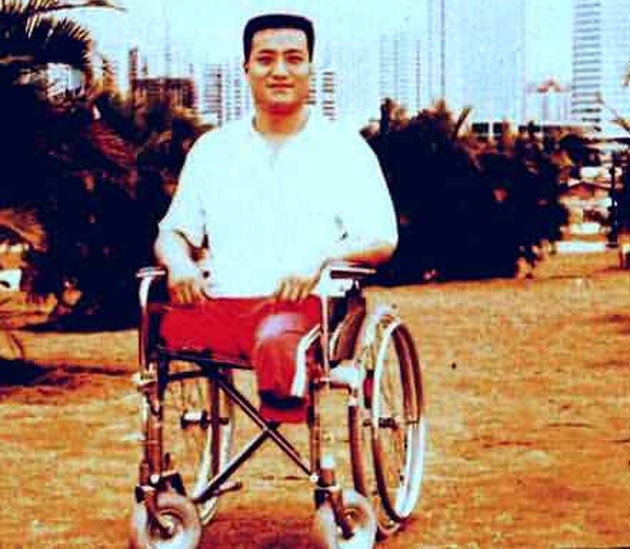
Fang Zheng is one Chinese sporting hero whose story will not be heralded at the Beijing Olympics. When the action starts, he will be watching from a wheelchair at his home in Hefei in Anhui province, one of China's poorest.
Fang's hopes of taking the field as a discus thrower in the Games were crushed, along with his legs, under a tank in Tiananmen Square on 4 June 1989.
His Olympic story is about politics, not sport. It was not so much the loss of his legs which cost him his career as an international athlete, as he competed very successfully in competitions for disabled athletes in the years after his injury.
It was the manner in which he became disabled, losing his legs during modern China's most serious political crisis, which ruled Fang out of international competition.
"The Olympics have a great significance for China and to the Chinese people. The Games will make China more open," said Fang. His selfless, quietly expressed sentiments only partially mask a deeper anger.
He lost both legs in the massacre – his right leg was lost above the knee, his left leg amputated just below the knee. To protect himself and his family, he has to be careful what he says, especially during a week when thousands of athletes, officials and tourists descend on Beijing to celebrate the world's biggest sporting event.
His early life is the classic biography of an emerging Chinese sports star. He was fired up by China's return to the Olympic Games at Los Angeles in 1984 after a long hiatus. "I've been a sports enthusiast since my childhood, and we were all so excited back then that China was going to become part of the Olympic family again. It was one of the reasons I applied to go to the Beijing Academy of Physical Science," he said.
A patriot, he wanted to help his country win medals, and he started studying in 1985, training at night. He was inspired by the spirit of political change and idealism that swept through Beijing, coming to a head in the spring of 1989, which saw thousands of students occupy the city's central square to protest against corruption and call for democratic change.
A few months after the events in Beijing in June 1989, in cities such as Leipzig, Budapest and Prague, governments decided not to act against their people, and the chain of events which led to the fall of the Berlin Wall and the opening up of Eastern Europe began.
But in Beijing, the Supreme Leader, Deng Xiaoping, architect of the same reforms which saw China end its long period of isolation, Olympian and otherwise, took a different line. The Chinese government sent the tanks in to crush the fledgling democracy movement in Beijing and in other cities around the country.
The official line is that the Tiananmen Square crackdown was necessary to ensure stability, and since 1989, the government has begun to implement some of the freedoms the protesters on the square had sought, such as getting rid of rules dictating where Chinese could live or work, and even the person they could marry.
Years of strong economic growth have given millions of Chinese a say in their destinies. The government is engaged in a highly public campaign to crack down on the corruption which has blighted the country and which it once denied existed, though in the absence of a free media or speech, critics say the campaign is doomed to fail.
At the same time, power in China still belongs exclusively to the Communist Party and independent political activity is forbidden. Nearly all of China's active dissidents have been exiled or imprisoned.
The crackdown is no longer a topic of discussion these days and has become an increasingly historical problem. Students entering university this year were not born when the massacre happened, and even this year's graduating class were toddlers when it took place.
Fang tells a tale of a night of terror as the tanks rolled in early on the morning of 4 June and opened fire on the unarmed demonstrators. Along with fellow students, he ran for his life to the west of the square.
As they reached the Liubukou crossroads, grenades were thrown into the crowd from behind, and Fang heard the tracks behind him. He saw the tank approach until he thought its barrel was right in his face. He was helping a female student into a side street when his legs went under the tracks and he was dragged along behind the vehicle before hauling himself clear.
He started to train again as part of the lengthy healing process following the double-amputation, focusing on discus and javelin. In March 1992, he represented Beijing in the third All-China Disabled Athletic Games in Guangzhou, winning two gold medals and breaking two records for the Far East and South Pacific region.
He qualified for an international event in 1994 but the Sports Ministry did not allow him to take part because of fears that he would talk to foreign reporters and cause embarrassment. Deng Pufang, Deng Xiaoping's son, who was paralysed after being thrown from a window during the Cultural Revolution, tried to intervene, to no avail.
Fang has been sidelined ever since. The official version is that he lost his legs in a "traffic accident". He still feels anger but is not bitter, although the entire sports apparatus is controlled by the government and his family is poor.
"I do not plan to come to Beijing for Olympics or Paralympics. As to what happened to me, it was many years ago. I am certainly very angry about it," he said. "These days I live a very ordinary life. I am just an ordinary civilian," he said.
Join our commenting forum
Join thought-provoking conversations, follow other Independent readers and see their replies
Comments
Bookmark popover
Removed from bookmarks