England's numbers do not add up to success
Autumn Tests prove Martin Johnson's side lacks experience to be World Cup contenders. Chris Hewett reports
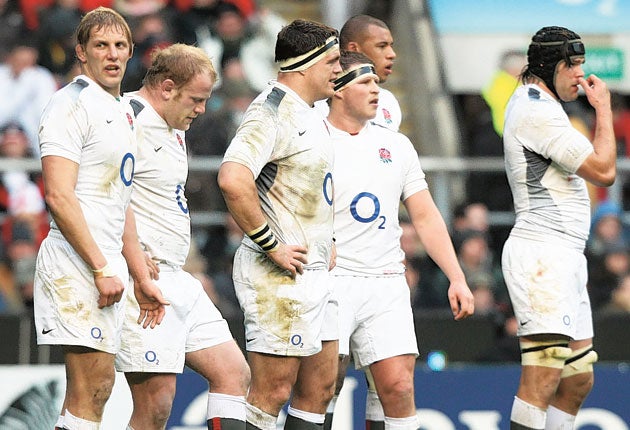
Let's talk numbers. England have eight matches left to them – five of them serious tournament fixtures, three of them low-rent runarounds of the warm-up variety – before they face Argentina in the first of their World Cup pool games next September, and while Martin Johnson has a far better idea of his first-choice combination now than he did seven months ago, there is no obvious similarity between his state of readiness for a global gathering and Clive Woodward's position in 2003. If Woodward fancied himself as some kind of sporting Henry V, his successor has more than a touch of the Ethelreds about him.
In Woodward's last eight games before boarding the Australia-bound plane and launching his successful campaign for the Webb Ellis Trophy, he saw his team stick 40 points on Italy, another 40 on Scotland, and 42 on Ireland in Dublin in a performance worthy of the Grand Slam. He then watched them face down the All Blacks in Wellington, run rings round the Wallabies in Melbourne, make a truly horrible mess of Wales in Cardiff and put one over the French at Twickenham before crossing the water for a return match, fielding an experimental side and losing by a point. The word "wow" was the only legitimate response at the time, and remains so to this day.
The key to this was experience: hard-earned, hard-bitten know-how. To all intents and purposes, Woodward had the spine of his World Cup-winning side in place two years before the competition, the only latecomers being Josh Lewsey at full-back and Trevor Woodman at prop. As a consequence, the team travelled south with caps coming out of their ears – a reassuring change from the English norm, which saw callow, underdone players heading off with their ears sticking out of their caps.
According to Eddie Jones, who knows a thing or two about World Cup achievement having coached Australia to the final in 2003 and played a significant role in guiding the South Africa to victory four years later, the competition is no place for bright young things. "If a country is serious about winning the World Cup, team-building is absolutely crucial," he wrote in these pages within six months of Johnson's appointment as red-rose manager. "This is not something that looks after itself. By my reckoning, a team mounting a genuine challenge for the title will have around 650 caps in its starting line-up, which works out at just over 40 a man. Those caps have to come from somewhere – that is to say, players have to be on the international field to earn them, which takes a while."
Johnson should have understood this better than anyone, having been at the heart of Woodward's side. Yet when England take the field against the Pumas in Christchurch, New Zealand, they will be well shy of Jones' optimum figure – perhaps a couple of hundred shy if their longest-serving players, Mike Tindall and Lewis Moody, break down beforehand. For all the excitement generated by the victory over Australia at Twickenham 17 days ago, it is difficult to avoid the conclusion that the first two years of this regime were a waste of time.
Those who have not wasted their time include the All Blacks, the Wallabies and the Springboks, who, by strange coincidence, will almost certainly start next year's tournament as the three favourites. The New Zealand side who recorded a third-gear victory over Wales at the weekend had around 750 caps between them, while the South Africans who beat England had 600, give or take – and that was without such long-serving practitioners as Bryan Habana, Jaque Fourie, Fourie du Preez, John Smit and Schalk Burger. As for the Australians who ripped up France for loo paper in Paris ... well, they had 650 caps and counting.
Virtually all the southern hemisphere players who featured here over the last four weeks will be at the World Cup, fitness willing: certainly, there were no obvious signs at Twickenham of Victor Matfield (105 caps), Bakkies Botha (72) or Juan Smith (69) heading towards zimmer-frame territory. As for the New Zealand pair of Richie McCaw and Mils Muliaina (both in the 90s)...let's put it this way: they didn't exactly look past it.
England might have been in a similarly happy position by now had Brian Ashton been allowed to build on the 2007 World Cup campaign – he coached the team to the final, lest some people forget – by tweaking his back-room team and continuing to invest in some of the young players he was in the process of introducing: Danny Cipriani and Shane Geraghty, to name but two. Instead, a star-struck Rugby Football Union opted for the untried, untested Johnson and a less ambitious, less imaginative approach.
If Johnson is committed to this current group of players, it is in large part because he has run out of opportunities to implement change. Most of the team that played on Saturday will be retained for six or seven of the games left to England, and if that means the likes of Tindall, Moody and the 32-year-old, once-retired hooker Steve Thompson travelling to New Zealand with their rugby in sharp decline, so be it. Meanwhile, the great powers of the southern hemisphere move onwards and upwards, secure in the knowledge that in their part of the world, rich experience and even richer form happily co-exist.
Three outsiders who may make late charge in to England's world cup squad
Brad Barritt (Saracens)
Brendan Venter, the Saracens director of rugby, won a World Cup-winner's medal as a centre and understands a thing or two of what it takes. He rates Barritt, and while the naturalised South African is far from the biggest, there is a hardness to his game that might yet interest the selectors.
Joe Marler (Harlequins)
Andrew Sheridan's return to fitness, and his rediscovery of rugby as a fun way to earn a living, makes him the undisputed heavyweight champion of English loose-head props, but the number two position is up for grabs. Marler is big, powerful and dynamic, if a little green as a scrummager.
Tom Wood (Northampton)
Size mattering as much as it does to the England management, the former Worcester flanker is playing his way into the Twickenham consciousness. Deployed as a breakaway by his new club, he uses his 6ft 4ins, 17st frame to good effect, and his positional versatility helps.
Join our commenting forum
Join thought-provoking conversations, follow other Independent readers and see their replies
Comments
Bookmark popover
Removed from bookmarks