How the US Open turned into the Spanish Masters
Nadal and his compatriots are stealing the show in New York
Ask any representative of tennis in the United States, Australia or Britain why they produce fewer top players than they used to and it is a fair bet that they will point to the global nature of the modern game. More countries are competing, they will say, and youngsters from less privileged regions, like eastern Europe, have a greater hunger for success than those from the more traditional tennis nations. Gone are the days when a single country can dominate.
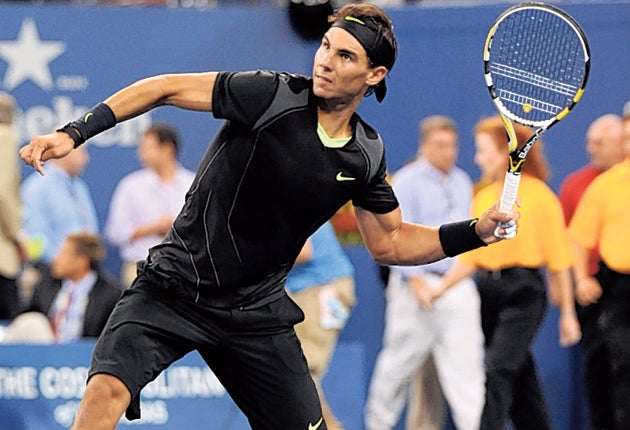
If that is the case, how come the US Open has been in danger this week of being renamed the Spanish Masters? Six of the last 16 in the men's singles here were Spaniards and Rafael Nadal is finding fellow countrymen at every turn. On Tuesday night the world No 1 beat Feliciano Lopez and in the quarter-finals today he will meet Fernando Verdasco. The only other time in the Open era when anyone enjoyed similar success here was in 1969, when there were six Americans and six Australians in the last 16.
The arrival of the Spanish Armada off the shores of Long Island is not the result of any quirky shift in the wind. Seven of the top 25 in the men's world rankings and 13 of the top 100 are from Spain.
Compare those figures with some of the traditional tennis powerhouses: the United States, with a population six times that of Spain, has seven players in the top 100, while Australia, Sweden and Britain have one apiece. Spain have won the Davis Cup four times since the turn of the century.
"We've been there for ever, haven't we?" Tommy Robredo, who lost to Russia's Mikhail Youzhny in the fourth round, said. "I think in the last 10 years the average has been 13 Spanish players in the top 100. You know Nadal is going to be there because he's world No 1, but there's also [David] Ferrer, [Nicolas] Almagro, Lopez, Verdasco, myself, and a lot of other players like [Juan Carlos ] Ferrero and [Carlos] Moya. I don't think it's strange that we have a lot of players in the later rounds."
Lopez believes success has bred success. "When you have more people competing you have to improve your game to get better," he said. Emilio Sanchez, a former Grand Slam doubles champion and founder of the academy in Barcelona where Andy Murray trained, agrees. "The Spanish player today is a bit of a warrior," he said. "A five-set match favours them. They are strong mentally and physically."
While other eras have produced Spanish champions – men like Manuel Santana, Manuel Orantes, Andres Gimeno and Sergi Bruguera – the current generation are notable both for their numbers and their versatility. There was a time when you would expect Spaniards to excel only on clay, but Nadal has won Grand Slam titles on grass and hard courts and the likes of Ferrero, Verdasco, Ferrer and Lopez all compete well on quicker surfaces.
Just as in football and cycling, Spanish tennis can point to the Barcelona Olympics of 1992, when facilities were upgraded, as a turning point. "They have a lot of courts and good facilities to practise," Youzhny said. "It's not really expensive to practise in Spain for Spanish people."
The Spanish are recognised as supreme athletes. "They're all in unbelievable shape," America's Mardy Fish said. "You won't come across a top-50 Spaniard who isn't afraid to take his shirt off in practice and looks good doing it."
Jose Higueras, a former Spanish player who is now director of coaching at the US Tennis Association, believes that playing on slower-paced courts has taught the Spanish to become more athletic and make fewer mistakes. "If you grow up on hard courts, missing becomes a lot more normal because the courts are faster and you don't have much chance to get set up," he said. "On clay, the misses are normally not as acceptable."
Higueras believes the Spaniards' other great strengths are their movement – "They're moving every direction – laterally, diagonally, forward, back," he said – and their ability to cut down on unforced errors. He said Spanish youngsters are taught the importance of keeping opponents under pressure without making mistakes.
Where you will not find Spanish success is in junior tournaments. In the boys' competition here there was only one Spaniard in the 64-strong draw. "They use junior tournaments as a tool of development," Higueras said. "It's not so the kid becomes top 10 in the world in juniors, because that doesn't really matter. It matters what he does when he plays with the big people."
Join our commenting forum
Join thought-provoking conversations, follow other Independent readers and see their replies
Comments
Bookmark popover
Removed from bookmarks