Mauresmo bows out after rising above jibes
6 Wimbledon winner retires having overcome prejudice about her sexuality
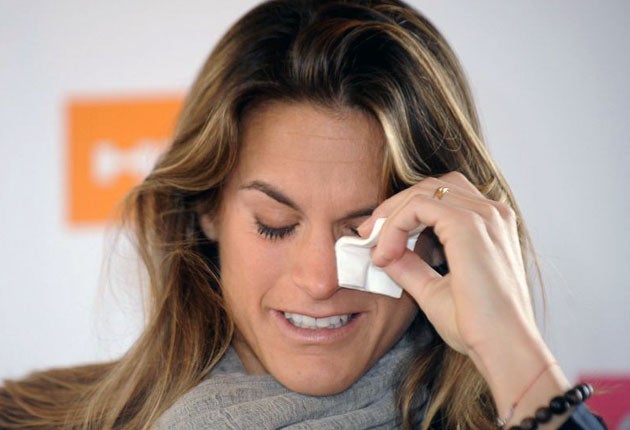
Amelie Mauresmo, who announced her retirement yesterday at the age of 30, would like to be remembered, no doubt, as a woman who became the world No 1, winning Wimbledon and the Australian Open: a player who combined athleticism with grace and craft in an era dominated by baseline drones. Others who have known the Frenchwoman throughout her years at the top will recall her passions for vintage wine, of which she has a cellarfull back home in Geneva, or for her Harley Davidson motorbike, or for the intelligence of her conversation.
Tennis folk are likely to remember all those aspects of her character and career ahead of the aspect of her life that will probably come first to the minds of those with only a passing interest in the sport. To most of the latter she will be recalled as a woman who made no secret that she was a lesbian.
For those of us who have known or been around Mauresmo over the years, her sexuality has been as rare a subject of discussion as the colour of her dresses or what she drinks with her breakfast. To Mauresmo being gay has simply not been an issue.
Nevertheless in her early years in tennis – a sport in which plenty of lesbians have reached the top while concealing their sexuality – it was not always quite that easy.
During the 1999 Australian Open, when she was 19, Mauresmo acknowledged — in a matter-of-fact way — that she was going out with Sylvie Bourdon, a nightclub owner. The revelation was widely reported, but would not have become a major subject for discussion had two fellow players not made offensive and hurtful comments. Lindsay Davenport, having lost to Mauresmo in the semi-finals, said it was like "playing a guy", while Martina Hingis, who won the final, said the Frenchwoman was "half a man".
Mauresmo kept her composure throughout and on her return to Paris attributed her good form in Australia to her girlfriend's presence. "I felt liberated and it showed in my game," she said. 'There are dozens of other players like me who say nothing, are often ill at ease and even unhappy."
If the episode put a temporary halt on Mauresmo's progress as she struggled to cope with intense media attention, the Frenchwoman eventually started to realise her potential. Similarly, early tensions within her family over Bourdon – for a while Mauresmo became estranged from her parents – quickly faded after the relationship ended.
As for the public, Mauresmo's frankness was admired and she quickly became one of France's most popular sporting figures. The French love Mauresmo for her intelligence, wit and independent nature. She is knowledgeable about tennis but is just as comfortable discussing football – this reporter recalls an interview after which we spent more time talking about a forthcoming World Cup than we had the impending start of Wimbledon – or wine or politics. When playing in America five years ago she happily explained her disapproval of the war in Iraq.
A sporting audience for whom style is just as important as substance have also appreciated the variety and subtlety of her game. The irony of the comments by Davenport and Hingis was that power never was the basis of Mauresmo's excellence. While some might consider her frame unfeminine, she is not big by modern tennis standards. At 5ft 9in tall and weighing less than 11 stone, she is significantly smaller and less muscular than many other top players, who hit the ball much harder.
What made Mauresmo different was the way she played. Her sweeping one-handed backhand has been a rare stroke of beauty – like Roger Federer's in the men's game – while she has had an arsenal of shots and strategies at her disposal. Some believe that her greatest problem was that she had too many alternatives and spent too much time thinking about her game. Players with less to ponder would have had fewer self-doubts.
Unlike most modern players, Mauresmo was happy to venture forward and volley, which she demonstrated in her finest moment when beating Justine Henin to win Wimbledon in 2006. On her return to Geneva she celebrated by buying a 1921 bottle of Chateau d'Yquem on which her eyes had been feasting for some weeks.
Mauresmo's only other Grand Slam triumph came at the Australian Open earlier that year. To the annual disappointment of the Parisian public over a period of 15 years, she never got past the quarter-finals of the French Open.
Her appearances at Roland Garros aroused similar emotions to Tim Henman's at Wimbledon, the difference being that the Briton reserved nearly all his best performances for his home Grand Slam event. Mauresmo was never entirely at ease on clay and the emotion of playing in front of her home crowd – she comes from nearby St Germain-en-Laye – usually got the better of her. Ironically enough, she won the last of her 25 titles at the Paris indoor tournament earlier this year.
Mauresmo, who also won the Fed Cup with France in 2003, was world No 1 for a total of 39 weeks, most recently as November 2006, but she was never the same after an appendectomy the following year.
Wiping back the tears at a press conference in Paris yesterday, she said she would look back with pride and no regrets. "I dreamed of this career," she said. "I lived 10 magical and unbelievable years."
Pride and prejudice: The different reactions to gay sports stars
Justin Fashanu Britain's first £1m black footballer, who was once humiliated about his sexuality by his manager Brian Clough, came out in 1990. He committed suicide eight years later.
Greg Louganis The Olympic gold medal-winning diver made more than one attempt to kill himself after jibes from fellow sportsmen. In 1998 he discovered he was HIV positive.
Martina Navratilova Multiple Wimbledon champion initially 'outed' by the author Rita Mae Brown, with whom she had a relationship. Navratilova later talked freely about her sexuality.
Ian Roberts Became the first rugby league player in Australian history to admit to being gay. Initial hostility was quickly forgotten.
Muffin Spencer-Devlin The first player on the main women's golf tour to come out. Suffered from depression but received wide support.
Join our commenting forum
Join thought-provoking conversations, follow other Independent readers and see their replies
Comments
Bookmark popover
Removed from bookmarks