A monument to evil that can teach the modern world
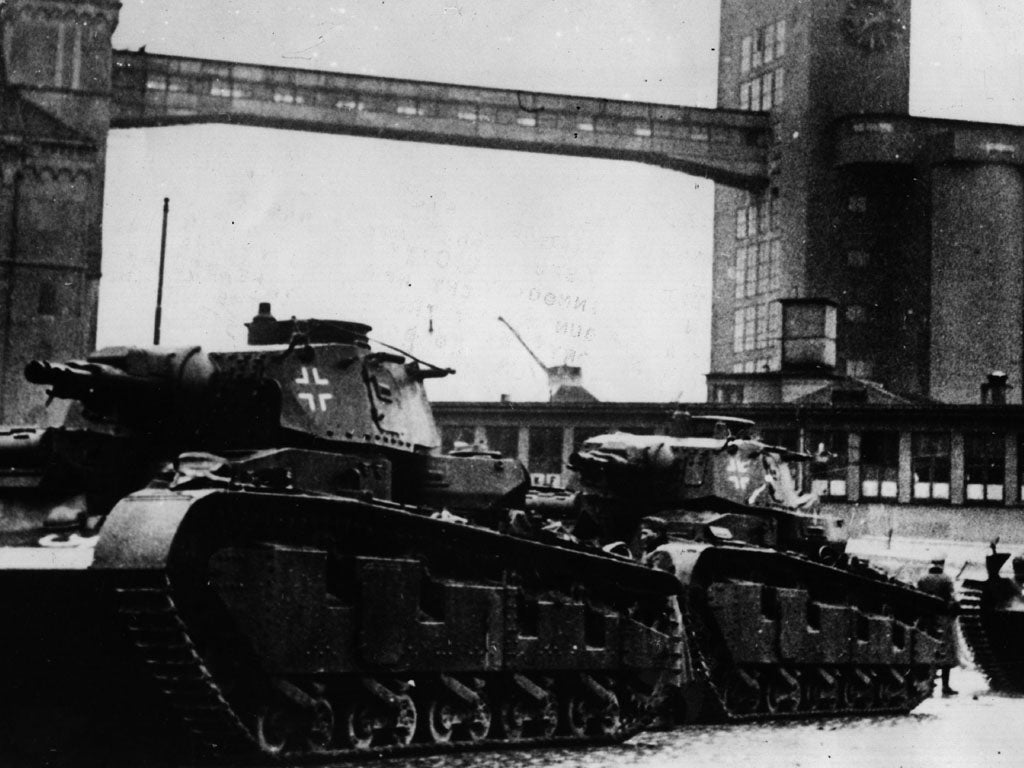
The picture shows German tanks on the streets of Oslo in 1940. In Norway, our correspondent examines how education, terror and history are linked

We were half-way up to the great German fort at Syreneset when Tore turned to me and suggested that Muslim fundamentalism thrived because of the failure of education in parts of the Arab world.
I didn’t agree. Weren’t some of the killers of 11 September 2001 rather well educated? Wasn’t the Lebanese hijacker of that day the son of a schoolteacher and a tax official?
Tore Mydland, a retired Norwegian bank manager, thought about this. He believed that young men taught in mosques believed everything they were told.
Panting to keep up with him on a mountain path – trying not to squelch through sheep dung as the frozen wind tore across us from the islands of western Norway – I suggested that injustice rather than illiteracy turned men to violence.
And then I stopped my little lecture. Hadn’t Norway produced Breivik, the very flip side of al-Qa’ida? Wasn’t he educated?
For that matter, weren’t some of the Nazi leadership – the very men who ordered their great guns to be hauled up to Syreneset after the German invasion of Norway in 1940 – educated? And they were fundamentalists of the most racist kind.
Tore turned round to me. “I was eight-years old when the Germans invaded and I kept out of the way of them,” he said. “My father, Arnlev, worked for the telegraph, so he saw a lot of the Germans. They were signallers so they were older than most soldiers.
My father went on working there, but no one knew he also worked for the XU, the Norwegian resistance. He could communicate, and sent secret messages across Norway.” The Gestapo came sniffing round the Johan house from time to time but never discovered Arnlev’s real work.
We had already trudged past a clutter of small wooden houses where still lives one of the Norwegians who built the concrete blockhouses for the Germans on the granite cliffs above us.
A collaborator? “Well, these are fishermen with small fields and you have to live, you have to earn your money somehow. And he used to tell me how he and the other workers would deliberately weaken the concrete.”
Tore was climbing now, like a mountain goat – I was amazed I could keep up, until I reminded myself that he was 80 – and then we were atop the German fortress. Gun positions, blockhouses, ammunition bunkers, slit trenches, concrete cisterns – still filled with brackish water – command posts, billets and machine-gun embrasures, black and sinister stencilled instructions in German still on the inner walls.
At the top of the highest gun position, an unknown German soldier – no doubt looking across the cold and silver fastness of the North Sea, as I was now doing – had drawn a line in the concrete on 8 April 1943 and written with his finger the date and the words “Gegen England” – Towards England.
There were still up to 380,000 German troops in Norway when Hitler killed himself, all waiting for an Allied invasion that never came. Seventy German artillerymen waited in this monster at Syreneset as neutral Sweden’s iron-ore ships heaved across the sea to Germany, their contents turned into ball-bearings for Tiger tanks. Mustang fighters shot up the lighthouses but the Brits never dropped a single bomb on the fortress. They did, it seems, attack the local ferry, killing many of the Norwegians aboard.
“A woman managed to swim ashore and she later had a child with a German soldier,” Tore said quietly. “He was an Austrian and he came back after the war and was reconciled with his son. The boy still lives here, a fine boy.” And I was struck by the humanity of this man, of the simple way he framed his memories of the war, of those few words about the attack on the ferry and the woman and how a whole novel could be written around them.
The Norwegians believe in education, by God. When they talk about education in English, they call it “knowledge”, which seems a much more accurate word.
How did the Germans, then, with all their knowledge, manage to create such evil? Tore shrugged his shoulders and shook his head.
Maybe we were somehow overawed by the same thought: that this bit of Hitler’s Reich really is likely to be still here in 1,000 years.
Join our commenting forum
Join thought-provoking conversations, follow other Independent readers and see their replies
Comments
Bookmark popover
Removed from bookmarks