A Muslim 'Measure for Measure'? That's one updated version of Shakespeare I'd love to see
Plus: Absurd person singular in Mohsin Hamid's new novel and "feel-good" isn't good enough for Parks and Recreation
Does Shakespeare always have to be our contemporary? Many theatregoers will surely have had moments when they answered "no" – when the prospect of a period production of the play they're watching will have risen up like a tantalising mirage, overlaying the storm-troopers or the city bankers or the Edwardian toffs who have been selected to refresh our sensibilities. It's even happened to me now and then – and I count myself as pretty easy-going about these things. But it can be very soothing, sometimes, to think of a production that dispenses with all forms of conceptual seduction and simply lets the language do the work.
The other day though I found myself daydreaming about a high-concept production which (as far as I've been able to determine) has never been attempted but seemed to fit at every angle. That's often a problem with contemporary productions. An ingenious setting will make perfect sense of one aspect of the play but generate all kinds of problems at another. But in this case the setting and play seemed to snap together like two Lego bricks, with a solid click that no more conventional production could hope to match – in part because the assumptions around which the play was built have steadily peeled away from the ones we – in this country at least – live with every day.
What I'd like to see – quite eagerly, now that I've spent some time thinking about it – is a Muslim Measure for Measure. One reason is that it's one of my favourite Shakespeare plays and I'm always happy to see another production. But another is that an Islamic setting would make it less of a problem play than it usually is. Think about it. The setting isn't Vienna any more but a minor Gulf state. The Duke is in fact an Emir, educated at an English public school and thus susceptible to a certain relativism in the application of the moral code. Angelo is a mullah, rigid in his application of Sharia law, but prone to temptations. Isabella, as the historian Tom Holland pointed out when I mentioned this on Twitter, would be perfect as a pious hijabi, while Claudio makes pretty good sense as one of those rich young Gulf state playboys, nightclubbing and racing their Maseratis along some desert corniche. The more dubious lowlives could be British expats, shocked to find that the blind eye suddenly isn't so blind any more.
It isn't just that a contemporary setting can be made to fit Shakespeare's original one though, but that the modern location revives, as vividly real concerns, dilemmas that a secular audience is inclined to address at one remove. Isabella can easily look neurotic in her defence of virginity to a non-religious audience, but not, surely in this case – in a culture which prizes sexual honour so highly. Claudio's plight – in attempting to prostitute his sister for his own life – recovers some of the intensity it has inevitably lost. And the debate between Angelo and the Duke, between unyielding literalism and a more flexible attitude to human weakness is a live issue for many Muslim societies. Even the beheadings and the arranged marriages at the end would make a little more sense. Do the play like this and you plug it into a live source of current which makes all kinds of things in the text light up again.
The only problem being, I guess, that there's no earth. Would anyone dare touch the thing for fear of electrocution? You'd have to plan for pickets – given the eager readiness of some sections of the Muslim community (mostly unrepresentative sections, it should be said) to take offence. The pickets though would be proof that this was more than a gimmick. I'd love it if someone took the risk.
Absurd person singular
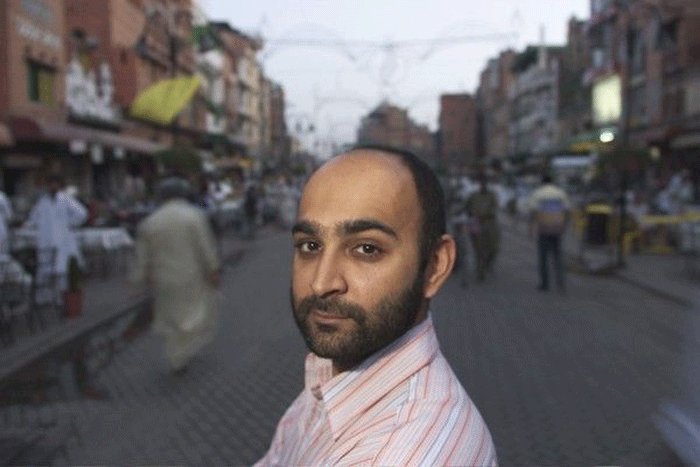
You pick up a novel and discover that it is written in the second person singular. Your heart sinks, because you've never been entirely sure about this form of narration. It seems to promise a greater immersion. And since How to Get Filthy Rich in Rising Asia, the new novel by Mohsin Hamid, pictured, presents itself as an unusually literate self-help book you see there's reason for this form. But, as it continues, you can't help but feel continuously pushed out of the story, particularly when it starts making demonstrably false statements about "your father" and "your background". You read on, muttering.
Aren't all comedies feel good?
I was a bit startled to hear a BBC continuity announcer the other night introduce Parks and Recreation as "the feel-good comedy". Had she watched it at all? "Feel awkward comedy" might have worked, given most of the big laughs in Greg Daniels and Michael Schurs' series come from the mismatch between the central character's dreams of public service and the banality of her day-to-day work. Leslie Knope, we understand, is irrepressible but her colleagues never give up. Of course you do end up feeling good – or better anyway – after watching, but shouldn't that be true of any decent comedy? I can't help thinking that a descriptor so bland (often code for 'not terribly funny but it should make you smile') isn't good enough for Parks and Recreation
Join our commenting forum
Join thought-provoking conversations, follow other Independent readers and see their replies
Comments
Bookmark popover
Removed from bookmarks